

This story was originally published by The Hechinger Report on January 29, 2015.
As the governor of North Carolina, I supported the adoption of higher learning standards for one simple reason: our kids need them. In a global economy, it doesn’t matter where you live but it does matter what you know, and children everywhere ought to know what other students across America and the world are learning.
For too long, states kept learning standards low in order to artificially boost their test scores and mask achievement gaps. An independent think tank rated North Carolina’s old standards a “D.” So, in 2010, we adopted the Common Core State Standards. Forty-five other states did the same thing and most are staying the course.
It makes no difference whether you call them Common Core or whether every state gives them a different name. But as a former teacher and public official, I do care that our schools prepare our young people for success. Learning is different in this fast paced world in which skills and jobs change daily. That’s the world our kids are facing so they have to learn how to explore and innovate.
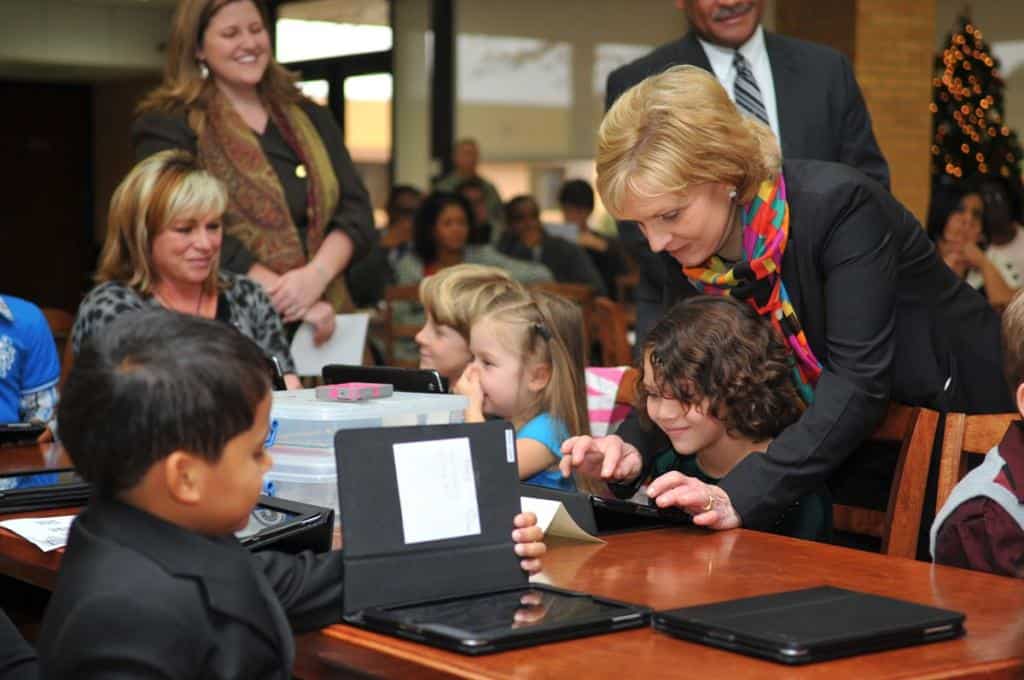
I recently visited a second-grade classroom in North Carolina and watched a fabulous teacher help kids understand the concept of the number “55.” She used 12 addition and subtraction examples to show kids how many different math equations get you to 55.
She showed them how you can use five buckets of tens and five buckets of ones. Or you can use 11 buckets of fives — or six “fives,” two tens” and five “ones.” She taught these second-graders to think logically and to explore how many ways you can get to an answer.
It was thrilling to see them working in teams and when they found the answer, yelling out, “I get it.” If they can get it, we can all get it.
Along with raising standards, North Carolina also adopted other important ways of improving education: Intervening in low-performing schools; training, evaluating and supporting teachers to help them get better; using real-time data to inform our policies; and investing in technology.
These common sense reforms have put our state on a path to better schools. Today, high school graduation and college enrollment rates in North Carolina are rising and the state is out-performing the national average on a test given to samples of students in every state.
North Carolina’s progress is at risk, however, because of fears that, by adopting Common Core, the federal government is over-reaching into our schools and threatening to nationalize curriculum. The state has even empaneled a commission to review and rewrite the standards, even though North Carolina has already invested over $66 million in training teachers and school leaders, updating curriculum and transitioning to the Common Core.
As the commission proceeds with its work, they should know the facts: the Common Core State Standards were not created, approved or mandated by the federal government. The standards were created by the states. And, they don’t dictate curriculum, which remains entirely under the control of local school boards, principals and teachers.
A lot of people use “standards” and “curriculum” interchangeably, but they are not the same. Standards are learning goals designed to give our children the education they need to graduate from high school ready for college or the world of work. The Common Core standards encourage problem-solving and critical thinking skills – skills that were often absent in the classrooms of the past.
Curriculum, on the other hand, is what teachers do every day in the classroom to help kids meet the standards. Standards define the destination. Curriculum is the journey and the teacher is the guide.
There’s another reason why high standards are especially important for North Carolina. Our state has the 4th-highest percentage of rural students in the country – 48 percent – nearly twice the national average. These students have less access to rigorous curriculum and diverse teachers.
If our rural children are being held to high, comparable learning standards with students across America, they can get online access to the very best instruction and learning materials from classrooms and schools from across the country. In fact, it is already happening.
Under a partnership with North Carolina New Schools, 11 rural school districts are helping thousands of rural students earn college credits while still in high school. The program also includes training for rural teachers. Guilford County, North Carolina is replacing textbooks with tablets and introducing middle school students to technology and on-line learning. Mooresville is a national leader in digital learning, eliminating textbooks, integrating personal computers into the classroom, and getting great results in terms of student performance.
These examples illustrate the infinite potential of high learning standards coupled with technology. This is also important because rural communities are undergoing dramatic demographic changes. Today, an influx of Hispanic immigrants is creating new staffing challenges for small-town schools that struggle to attract bilingual teachers.
Rural districts also face shortages of STEM (science, technology, engineering and math) and special education teachers. No one is suggesting that computers could replace teachers, but technology can provide some relief for districts facing these staffing issues.
And like large urban school systems, rural schools also face challenges outside the classroom, including a poverty rate of 17 percent – higher than the national average. Many of the smaller rural districts lack the social services and counseling needed to support these children at risk. A high-quality education aligned to high college-ready standards is their only chance to climb the ladder from poverty into the middle class.
With so much positive progress under way, states should not be driven by fear-mongering around federal control of our schools and our children. Education is not in the hands of Washington bureaucrats; it’s exactly where it always was – in the hands of skilled, passionate and dedicated teachers.
Today, more and more teachers feel prepared to teach to the new standards. And more and more parents want their children to be challenged. Instead of retreating from high standards, states across America should embrace the opportunity to give every single child the best chance at a good life. That starts with an effective 21stcentury education.