
CEOs highlight Pre-K as linchpin of reading, and jobs

As the co-founder and CEO of the analytics software company SAS, Jim Goodnight ranks as an iconic North Carolina business leader and places 51st on the Forbes 400 list of the wealthiest Americans. As the president pro tem of the state Senate, Republican Phil Berger of Eden ranks as the most powerful North Carolina legislator.
Goodnight and Berger share a focus on third-grade reading. In different forums in recent days, both offered insight into their own approaches, and what they said, and didn’t say, deserve some attention.
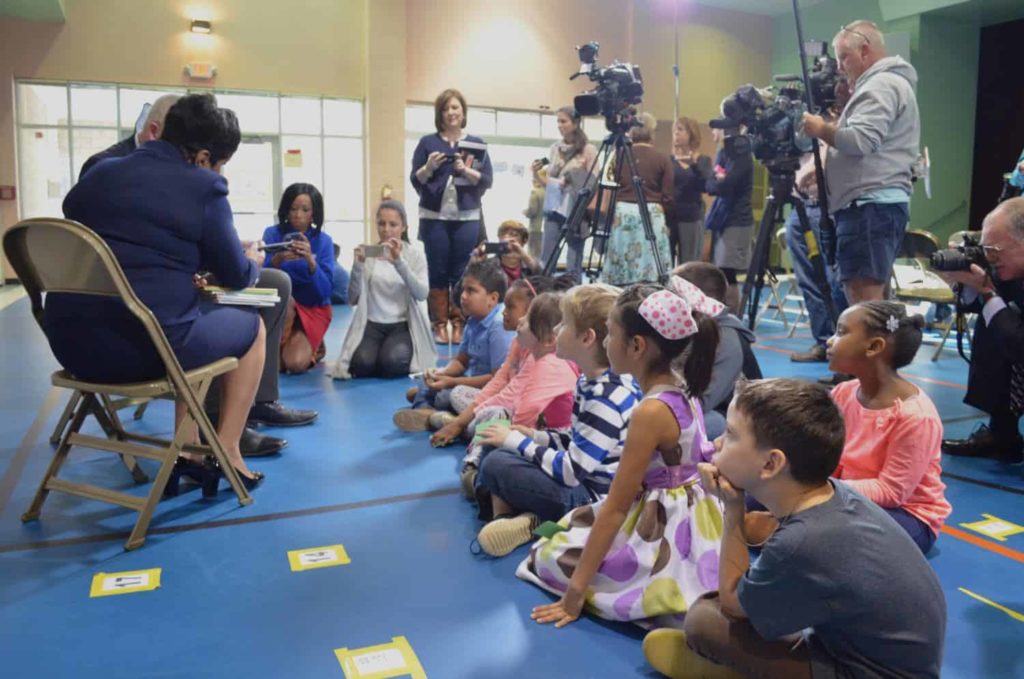
Several North Carolina corporate executives, with Goodnight as the central figure, assembled at a Wake County elementary school, held a press conference, and visited the General Assembly to apply to North Carolina a national Business Roundtable report. As business leaders have so often, they framed their argument for education initiatives in terms of an economic imperative — to close the “skills gap’’ between available jobs and people qualified to fill them.
“Improving third-grade reading proficiency has proven to be a powerful lever to address this skills gap over the long term,” said Goodnight.
The Business Roundtable proposes a state policy early-literacy agenda and calls on corporations to “commit your company’’ to its pursuit. Indeed, the business community can exert a powerful influence in education-policy deliberations.
In addition to linking third-grading reading to closing the “skills gap,’’ the Business Roundtable agenda rests on another crucial finding: that learning to read is a cumulative process over years. Thus, Goodnight and his colleagues stress the need to “expand access to high-quality Pre-K learning opportunities.” And their agenda calls for literacy-infused professional development for teachers from Pre-K through third grade.
For his part, Berger has focused specifically on the third grade. He was the driving force behind enactment of Read to Achieve, which delays promotion of third graders who don’t pass a reading assessment, as well as the awarding of bonuses to third-grade teachers whose students showed marked improvement in reading scores.
In remarks to a gathering sponsored by BEST NC, a coalition of state business leaders, Berger continued to defend Republicans against critics who contend they have let teacher pay lag. And while he mentioned Read to Achieve, he stressed the news that more than 1,200 teachers qualified for the $3,500 bonuses. He called the bonuses an “innovative solution, one based on business principles.”
But what Berger doesn’t say, and the Business Roundtable understands, is that elevating third graders’ reading involves the work of teachers in kindergarten, first, and second grades. Those teachers received no bonuses for improvements in their students’ reading proficiency.
Drawing on academic research, the Business Roundtable report gives a nod to North Carolina: “Participation in North Carolina’s Pre-K program had a positive impact on third-grade reading achievement equivalent to about two to four months of extra instruction.” But a Pre-K-through-third-grade agenda poses challenges to state policymakers.
Under the More at Four program, now folded into NC Pre-K, the state placed at-risk four-year-olds in public schools. But some parents prefer to have their young children in non-school settings, and child-care center operators would push back against efforts to diminish their supply of four-year-olds. An effective expansion initiative would strike a balance between school-based and center-based Pre-K with qualified teachers in both settings.
Another challenge has to do with how to finance what the Business Roundtable seeks. The corporate executives stay silent on the fiscal aspects, but there is a clear linkage between budgetary practices and early-childhood policy. A Pre-K-through-third-grade literacy initiative won’t thrive under artificial budget restrictions, or with tax cuts or shifts that erode state revenue growth.
The voices of Goodnight and his corporate colleagues are a welcome intervention in North Carolina’s decision-making on early childhood education. And it’s important that they persist in make the case of the linkages between Pre-K and third grade, and between third-grading reading and the jobs of the future.