
Can the kumbaya moment possibly last?

Hurricane Florence brought devastation to North Carolina, but it also brought some measure of political peace. Leaders who prefer to avoid the same rooms came together to address the aftermath of the terrible storm with grace and bipartisan fervor.
The General Assembly met in a special session to allocate money, waive missed school days, ensure continuity of salary for school workers, and more. The cooperation began early, with Governor Roy Cooper calling for a special session on October 9th, General Assembly leaders wanting September 28th, and the actual special session being held on October 2nd — a middle-ground compromise.
And in contrast to the special session held in 2016 after Hurricane Matthew, this session stayed focused. The December 2016 special session did address the damage caused by Hurricane Matthew, but then legislative leaders closed that session and started another one where they pushed a bundle of controversial policies, including some that weakened Governor Roy Cooper and the State Board of Education.
On October 2, however, lawmakers met in a joint appropriations meeting in the morning, fielding a few questions but little opposition, and then met in their separate chambers in the afternoon to quickly pass the legislation unanimously. They’ve promised to come back October 15th, once there is more information about what needs North Carolina schools and citizens have.
Lisa Godwin, the Teacher of the Year advisor to the State Board of Education, captured the feeling of seeing the state’s Democrats and Republicans cooperate, when she said, “Hearing them work together in a bipartisan manner was just the most beautiful thing.”
She went on to say that she hopes political leaders learn a lesson from all this — that when North Carolinians put the “Republican” and “Democrat” designations aside and work together, “great things and great change can happen.”
She went on: “I pray that … is the lesson that is going to be learned from this great tragedy.”
It’s not just lawmakers, either. Superintendent Mark Johnson and the State Board of Education have had a tumultuous relationship ever since the General Assembly passed legislation transferring some of the powers of the Board to Johnson. That happened at the aforementioned special session that came right on the heels of the Hurricane Matthew session.
A lawsuit followed, and then court battles, tension at Board meetings, and criticism from both sides. Even after the Supreme Court essentially ruled in favor of Johnson, the Board and the superintendent still didn’t quite get along.
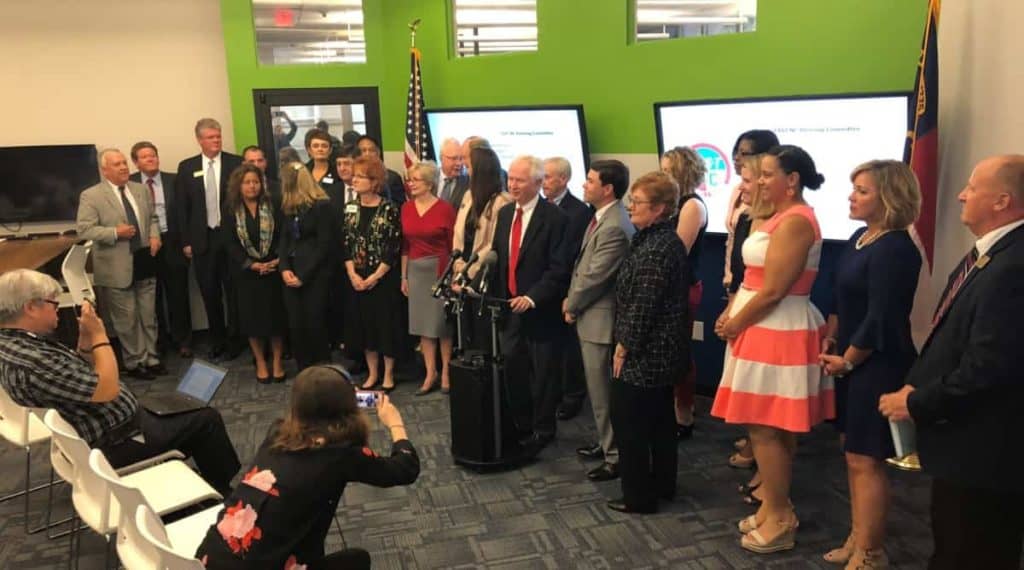
But, after Florence, Johnson, a Republican, got together not only with Board Chair Eric Davis, but also former Superintendent June Atkinson — his Democratic opponent in the 2016 election — to announce FAST NC an effort between them and a diverse group of people and organizations to collect donations to help those affected by Florence.
This is what a press release about the partnership said: “Elections and lawsuits may have put them on opposing sidelines in the past, but now these leaders are working together to help the team that matters most: North Carolina’s public schools.”
So, a statewide tragedy sparked the best in our political leaders, but can it last?
Elections are just around the corner in November and every lawmaker in the state is up for a vote. In the General Assembly, at least, it would be naive to think the sides won’t revert to attack mode in an effort to maintain their roles. It’s also important to note that, with elections so close, it probably isn’t in the best interest of lawmakers to appear petty in the wake of a disaster. That could, in part, have contributed to the cooperative atmosphere in the legislature.
But maybe Godwin has a point, and that the example set by our state’s politicians will have some lasting impact. Maybe, in the heat of a partisan political fight on some other subject, lawmakers of both parties will remember back to the moment when they came together and find a way to compromise just a little.
Maybe.