A decade ago, Cherokee County was facing a new kind of economic development problem — a housing shortage.
Paul Worley, Tri-County Community College’s (TCCC) vice president of economic and workforce development, said that the county simply did not have enough affordable homes for current or future residents.
The housing shortage was not going to be a quick fix, and it would take more than anecdotal evidence to prove the county’s need.
Today, TCCC is leading the charge to meet local housing needs, implementing a multifaceted housing project that will not only provide affordable housing but is also training students for the jobs of the future.
 Sign up for Awake58, our newsletter on all things community college.
The role of community colleges in economic development
Sitting in the westernmost part of North Carolina, rural Cherokee County is home to more than 30,000 people and borders both Tennessee and Georgia. The area serves as a hub for outdoor activities, which supports much of the local economy. Some of the county’s largest employment sectors include education, retail, and health care.
Unlike other counties in the state, where local governments and chambers of commerce often lead economic development, Tri-County Community College serves as the economic developer for Cherokee County. The college also supports workforce and economic development across its entire service area, which includes Cherokee, Clay, and Graham counties.
Workforce training is a vital component of attracting new companies and projects, a service community colleges are poised to offer.
“Sometimes it just makes the most sense for the college to serve as the economic developer,” said Aaron Patton, TCCC’s associate vice president of continuing education.
Understanding housing needs
In 2017, the Cherokee County Economic Development Corporation, in collaboration with the Cherokee County Board of Commissioners, identified housing as a top priority. This led to a 2018 countywide housing study by The Concord Group with support from the Board of Commissioners.
Following that, Worley said that a more comprehensive study was needed to better understand exact housing needs. In 2022, Dogwood Health Trust helped fund a more in-depth housing needs assessment across Cherokee County.
The assessment analyzed a number of factors, including demographic trends, economic conditions, existing housing inventory and conditions, commuting and migration patterns, and development barriers. An asset inventory was also conducted to mark water and sewer lines.
If a county is wanting to invest in housing, they need to invest in a housing study first.
— Paul Worley, Tri-County Community College’s vice president of economic and workforce development
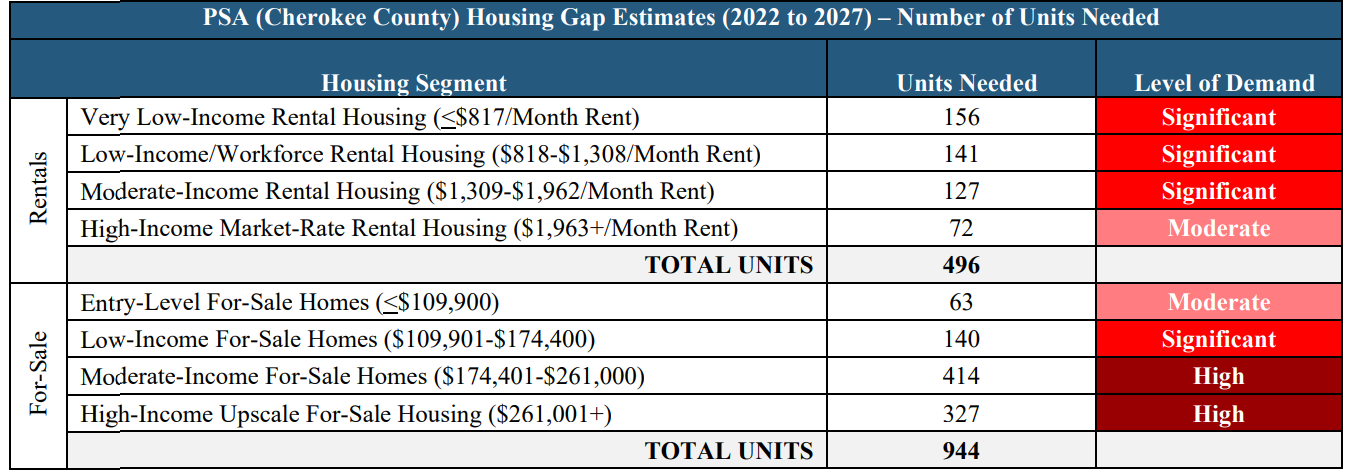
The study found that, while Cherokee County’s population and the number of households had grown since 2010, with growth projected through 2027, there were a limited number of affordable rental and for-sale properties. Most available homes were priced at $300,000 or higher.
The study concluded that this “relatively small inventory of affordable product provides limited choices for existing and future residents and may limit the area’s ability to grow.”
The following table from the 2022 housing needs assessment summarizes the approximate potential number of new residential units needed in Cherokee County over a five-year period.
After the assessment confirmed the county’s need for more affordable housing, Worley said that a new problem emerged — finding someone to build them.
Worley explained that it was not cost-effective for developers based in Asheville, Chattanooga, or Atlanta to reassign crews to Cherokee County when demand was just as great in their local markets.
Educating the future workforce and building affordable houses
To address this worker shortage, students in TCCC’s Building Construction Technology program are constructing affordable homes themselves as part of the college’s multiprong housing project.
The project is expanding the number of for-sale homes in Cherokee county, offering homes at roughly the cost of construction. Proceeds from each home sale will be reinvested into the housing project, allowing additional homes to be constructed.
The project also provides hands-on-training, as students apply what they have learned in the classroom to a real-world construction site.
This housing project is as much, if not more, about training people.
— Paul Worley, Tri-County Community College’s vice president of economic and workforce development
Housing construction requires complex coordination between various trades, from construction crews and electricians to HVAC technicians and heavy equipment operators. Students are able to train right alongside individuals they will collaborate with on future homebuilds.
As the college helps to expand the community’s affordable housing market, it is also addressing continued labor shortages in North Carolina by connecting younger students to construction careers.
In spring 2025, UNC Public Policy students partnered with the Carolina Across 100 Initiative to analyze labor shortages across North Carolina’s 100 counties. Their research found that construction labor shortages have emerged as a statewide challenge. Key reasons for the shortages include impacts from the 2008 recession and the COVID-19 pandemic, an aging workforce, a lack of adequate wages and benefits, diminishing union strength, the rise of gig work in construction, and a sharp decrease in the number of immigrants in the workforce.
About the homes
The college’s foundation was gifted 12 acres in Andrews and a $2.8 million grant from Dogwood Heath Trust to develop market-rate and affordable housing. The land has been subdivided into 17 lots, each measuring over half an acre.
Each lot will consist of a 1,400 square-foot, single-level home with three bedrooms and two bathrooms. The properties will have septic systems and municipal water, and the roads leading to the homes will be maintained by the state.
Upon completion, TCCC will partner with Mountain Projects, a nonprofit community action agency based in western North Carolina, to facilitate home sales. Mountain Projects will also assist in identifying eligible buyers and brokering the transactions. Home prices are projected to average $250,000.
Worley said that the goal is to use these homes to attract essential workers, such as teachers, first responders, engineers, and health care professionals.
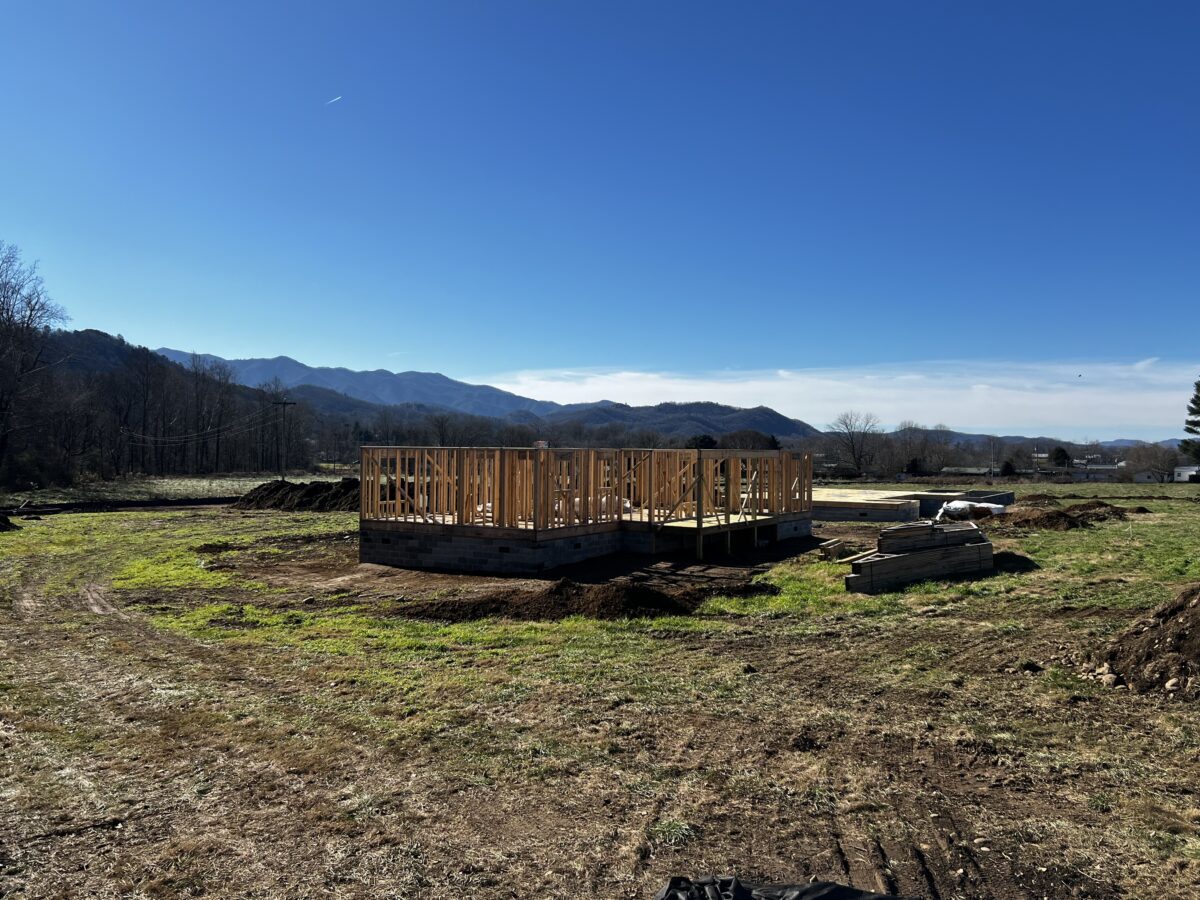
As of February 2026, the first three homes are currently under construction.
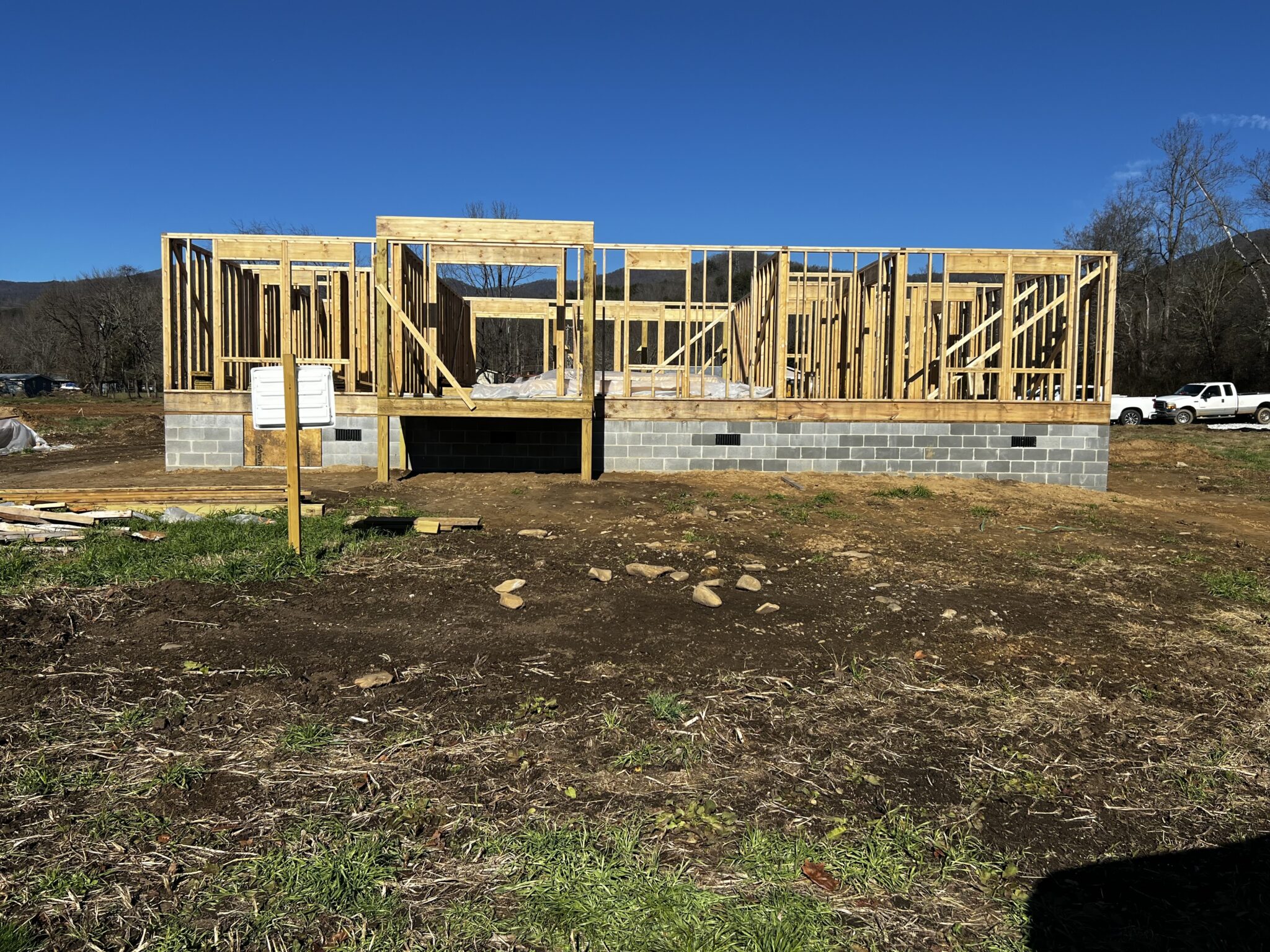
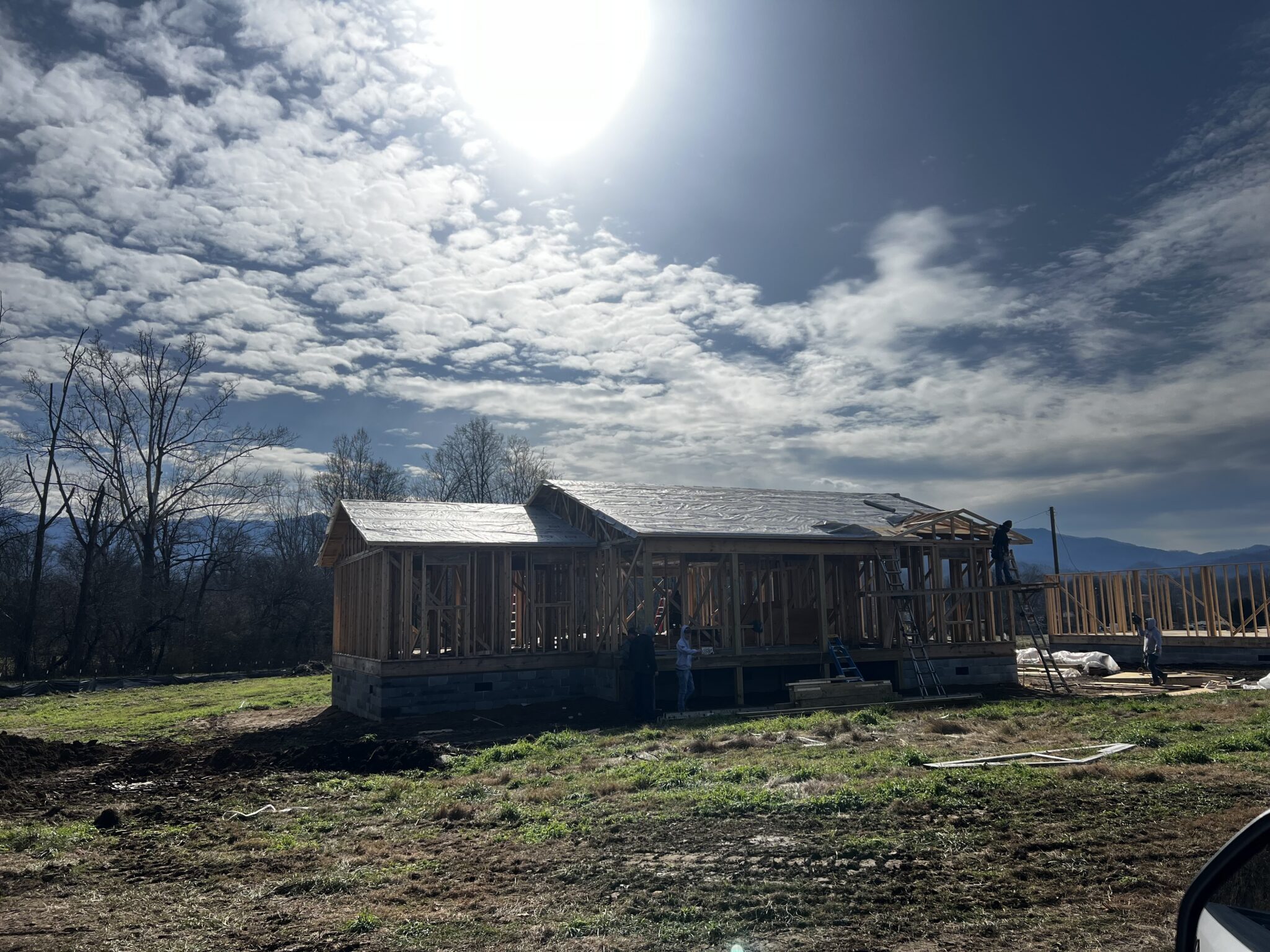
This project aligns with the county’s priority to address affordable housing shortages. Elsewhere in the county, other efforts are underway to increase the affordable housing supply in response to the 2022 housing needs assessment. For example, in 2023, the town of Murphy broke ground on the Valley River Apartments, a 56-unit affordable housing complex. The complex offers one, two, and three bedroom apartment units with income-based rent.
Additional economic and workforce development efforts
Tri-County Community College continues to lead other economic development and workforce training initiatives across its service area. This includes:
- Developing a 27-acre industrial park in Cherokee County that will feature four sites that can accommodate facilities ranging from 20,000 to 40,000 square feet.
- Providing training to support Core Scientific, a data processing plant in Cherokee County. The company is converting its large plant from Bitcoin mining to support artificial intelligence (AI) operations. The college previously supported skills training in electrical wiring during construction phases.
- Offering commercial driving license (CDL) training to support transportation needs for Amazon’s warehouse and distribution center that opened in Clay County in November 2025.
- Providing workforce training, including preemployment and customized skills training, to Eco King Solutions, a U.S. subsidiary of Chinese manufacturer Zhejiang Kingsun Eco-pack Co., Ltd, located in Graham County. In July 2025, Gov. Josh Stein announced 515 new jobs for the county, as Eco King Solutions invested $80.5 million to open its first North American production facility in Robbinsville. The facility will produce disposable, biodegradable paper tableware. In addition to skills training, Worley noted that company leaders have been involved in the college’s English as a Second Language (ESL) program. Eco King Solutions is expected to begin hiring in March 2026.
Editor’s note: Dogwood Health Trust supports the work of EdNC.
Recommended reading