
Brief | Getting everyone counted in the 2020 Census

A complete and accurate census count is incredibly important. The census shapes how billions of dollars in federal funding are distributed (including $43.8 billion to North Carolina), how political seats are apportioned, and how communities plan for their future residents.
Historically, certain populations have been undercounted in the census, due to a variety of factors. In 2010, the Census Bureau estimated the census missed about 2.1% of the Black population nationwide. For young children, the undercount was worse: estimates suggest the 2010 Census missed 6.3% of Black children under 5. Undercounting these communities skews census data that’s used to ensure fair political representation and support critical services such as schools, parks, and health care facilities.
What do response rates for North Carolina’s Black communities look like today?
As of June 18, an estimated 57.8% of NC households had self-responded to the 2020 Census. Census tracts in NC containing 40% or more Black residents had a census self-response rate of 6.7 percentage points lower than the state average.
This table shows the 2020 Self-Response Rate, as of June 18, by Black population share. You can also see historical self-response and overall mail return rates from 2010.
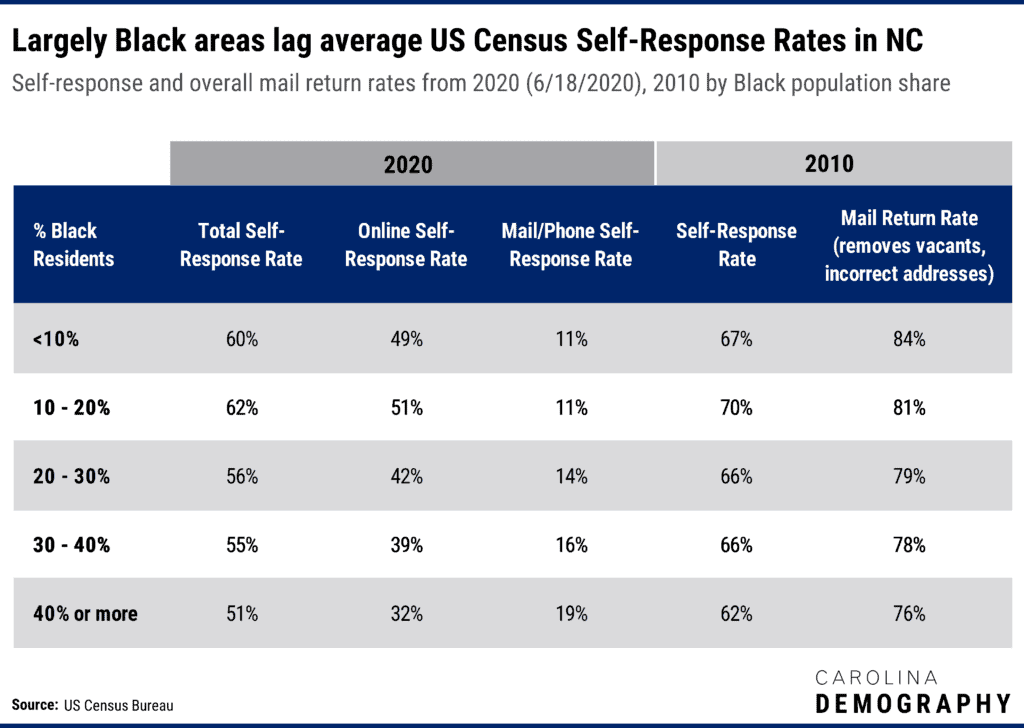
The self-response gap in census tracts with larger Black populations is largely driven by lower online response rates: census tracts with 20% or more black residents are more likely to respond to the census by mail/phone than the statewide average (12.7%).
What do these patterns look like across NC?
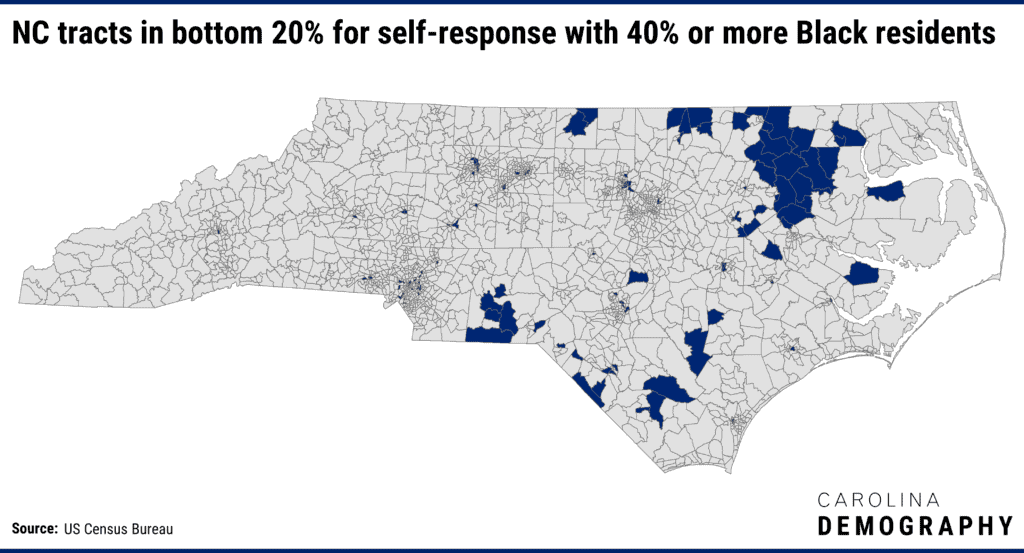
We have also mapped the intersection of tracts that are in the bottom 20% for response rates that contain 40% or more Black residents, as of June 1. Clusters of low response rates appear in the Northeast, Sandhills, and Southwest Prosperity Zones in NC.
What do low self-response rates mean?
Every household that doesn’t fill out the census form online, by mail, or by phone — known as “self-response” — enters the Census Bureau’s non-response follow-up (NRFU) universe. During NRFU, the Census Bureau sends trained enumerators door-to-door to collect census responses directly. In a previous blog post, we document how individuals living in the lowest-responding tracts are increasingly likely to be minority residents.
Increasing response rates across North Carolina is critical in the next few months. As the CUNY Graduate Center notes, “The NRFU door-knocking operation is challenging, expensive, and adds substantially to the risk that people will be missed or counted inaccurately.” When certain groups are more likely to be undercounted, their communities are at risk of having lower-quality data and less than their fair share of political representation and funding for the next decade.
The results of the 2020 Census informs decisions about the allocation of hundreds of billions of dollars each year to communities across the country. NC’s Office of Budget and Management has calculated that as a state, North Carolina could lose over $417 Million per year based on the May 31, 2020 response rate.
Resources
My Black Counts NC has created a toolkit with suggested social media copy for elevating the importance of filling out the 2020 Census online. The national organization Census Counts has also released an online toolkit with social media and messaging. Among their suggestions:
- Elevate the importance of the 2020 Census online. Post on social media and send communications to your members or supporters about the importance of the 2020 Census and the ways that people can participate (online, by phone and by returning the paper questionnaire by mail). Stay tuned for graphics coming your way soon!
- Host a Facebook or Instagram live about the importance of the 2020 Census. Interview leaders from your organization and community who can talk about the importance of the census.
- Host a Create-a-thon. States like AZ, TX, MS, OK and NY will be hosting their own, we recommend you do the same! Create-a-thons are a great way to create content for your communities to use and share for census. Now that we are on a longer deadline, it’s so important to create fresh and exciting content.
- Organize a digital event. Invite your coalition, partners, and community members to participate and hear why the 2020 Census is so critical to your community. You could host a tele-town hall, census remote training, census online party, twitter storm or virtual census kiosk. We need to get the message out that the households should respond to the census now!
- Do the #CensusChallenge. An opportunity to highlight why the census is so important by tagging three friends to remind them you are COUNTING on them to fill out their census. See more here!
- Host a virtual dance party. What better way to fill out your census than with people dancing! Organize a virtual dance party, ask your community members to join, answer questions on the census and have people fill out the form during the party.
- Recruit volunteers and host a Phone or Text Bank. Work with your partners and volunteers to set one up and encourage people to participate in the 2020 Census by contacting them via phone or text. Help create momentum and reach out to your community members with why #CensusCounts.
Editor’s note: This piece was originally published by Carolina Demography. It has been posted with the author’s permission.