A note from us
Welcome to Awake58 — a weekly newsletter where you’ll find the latest updates on community college related news and events around the state. Plus, a look at what’s trending nationally in higher education.
If you’re new to Awake58, welcome! If you were forwarded this email, you can sign up for the Awake58 newsletter here. You can also find the latest edition on our website.
Tri-County Community College is helping solve housing shortages and train students… North Carolina’s child care task force recently toured Davidson-Davie Community College’s child care center… Community colleges are starting and expanding high-cost health care programs… Understanding the diploma trap… Gov. Stein’s plan to scale youth apprenticeships… New research briefs from the Belk Center… Plus, results from the Richmond Fed’s survey of community college outcomes…
Hi all, Emily Thomas with Awake58.
I’m always amazed at the ingenuity of our state’s community colleges, particularly their ability to pivot and meet specific needs of their local community.
This week, we’re highlighting some of those stories, starting with this unique homebuilding project at Tri-County Community College (TCCC).
Almost a decade ago, Cherokee County was facing a new kind of economic development problem — a housing shortage. To address the issue, TCCC leaders implemented a housing project that would provide affordable housing, help solve construction labor shortages, and train the next generation of construction workers.
Students in TCCC’s Building Construction Technology program are constructing affordable homes themselves as part of the college’s multiprong housing project.
The project is expanding the number of for-sale homes in Cherokee County, offering homes at roughly the cost of construction. Proceeds from each home sale will be reinvested into the housing project, allowing additional homes to be constructed. The project also provides hands-on-training, as students apply what they have learned in the classroom to a real-world construction site.
“This housing project is as much, if not more, about training people.” — Paul Worley, Tri-County Community College’s vice president of economic and workforce development
Further east, Davidson-Davie Community College is tackling a different economic issue — child care. As one of about 15 community colleges in the state with an on-campus child care center, the college’s center helps student parents stay in school, attracts faculty to the college, and provides hands-on learning to prospective teachers.
During a recent visit to the center, Sen. Jim Burgin, R-Harnett, said the model needs to be duplicated on every campus in the state.
We know that child care is unaffordable for many North Carolinians, and difficult to find. Since the start of the pandemic, the state has lost 7% licensed child care programs, an EdNC analysis found. A lack of child care makes it difficult for parents to stay in school and earn credentials that can lead to family-sustaining wages.
Davidson-Davie Community College President Jenny Varner said: “One of the great things about community colleges is that it’s not just purely about education. It’s about education, but also how it connects to every facet of the communities we serve.”
I appreciate how Varner describes the role of community colleges, which leads me to this question: How are you seeing community colleges connect to the communities they serve? We want to know. Send us your thoughts and story ideas.
As always, be sure to check out EdNC reads and AroundNC for more postsecondary coverage.
Until next week,
Emily Thomas
Regional Director of Western North Carolina — EdNC.org
EdNC reads
Building skills, building homes: Tri-County Community College launches new initiative to address housing shortages
The college’s foundation was gifted 12 acres in Andrews and a $2.8 million grant from Dogwood Heath Trust to develop market-rate and affordable housing. The land has been subdivided into 17 lots, each measuring over half an acre. Each lot will consist of a 1,400 square-foot, single-level home with three bedrooms and two bathrooms. The properties will have septic systems and municipal water, and the roads leading to the homes will be maintained by the state.
Upon completion, TCCC will partner with Mountain Projects, a nonprofit community action agency based in western North Carolina, to facilitate home sales. Mountain Projects will also assist in identifying eligible buyers and brokering the transactions. Home prices are projected to average $250,000. Worley said that the goal is to use these homes to attract essential workers, such as teachers, first responders, engineers, and health care professionals.
As of February 2026, the first three homes are currently under construction.
State task force visits child care center at Davidson-Davie Community College: ‘We need to duplicate that on every campus’
Davidson-Davie prioritizes the center because of its benefits to the campus and the community, Varner said, though it takes “a very large financial commitment to a center, up-front and ongoing.”
“I wish all our sister colleges had centers too, except I know why most of them don’t, and that is (that) they are expensive to maintain at a high-quality level, and you know, we struggle all the time,” she said.
Students and faculty are able to study and work while knowing that their children are safe and learning, leaders said. The same is true of other working parents in the county. The center also welcomes newcomers to the campus, and leaders said they see it as a form of outreach.
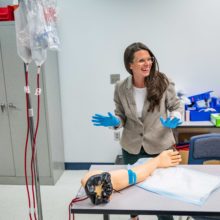
Meeting workforce needs: NC community colleges launch and expand high-cost health care programs
The number of health care and social assistance jobs will increase more quickly than any other industry between now and 2034, according to the U.S. Department of Labor’s 10-year employment projections released last fall. North Carolina’s labor market, according to the state’s Department of Commerce, closely mirrors these national projections.
The state’s 58 community colleges play a key role in meeting these workforce needs, as each college offers health care programs designed in response to local industry demand. In 2024-25, more than 44,000 students were enrolled in health care programs across the North Carolina Community College System. However, starting and maintaining health care programs can cost hundreds of thousands of dollars, creating barriers for community colleges working to meet health care workforce needs.
Perspective | The diploma trap, and why The Leon Levine Foundation has issued an RFP
From Russell Altenburg, the education program director at The Leon Levine Foundation:
“The reality of the Carolinas today is a tale of two economies. On one hand, we have booming tech, health care, finance, and manufacturing sectors. On the other, we have a regional talent pipeline that is failing to meet the moment.
Because our systems aren’t producing workers with the right mix of skills and exposure, many of these companies are forced to hire from outside the region. We are importing talent while our own brilliant, capable young people sit in a holding pattern, lacking the gatekeeper experiences that signal readiness to an employer.
It’s not for a lack of talent; it’s a lack of sight. Recent data shows a staggering exposure gap: While 75% of students have the natural aptitude for high-demand careers like tech or advanced manufacturing, very few express interest in them. Why? Because they’ve never seen them. They haven’t been exposed to the world of work early enough to realize they belong in it. Despite the fact that 79% of high schoolers say they want work-based learning, only 2% actually land an internship before graduation.”
Around NC
EdNC’s Hurricane Helene Playbook | This chapter provides an overview of the Public School Insurance Fund, a state-managed insurance fund created to insure the property assets of North Carolina Public Schools. And this chapter highlights the lessons learned from liaisons for homeless students.
Youth apprenticeships | A New America article details North Carolina Gov. Josh Stein’s plans to dedicate discretionary funds under the Workforce Innovation and Opportunity Act (WIOA) to scale registered youth apprenticeships in high-demand sectors. The funding will go to support NC Career Launch — the state’s youth apprenticeship system. “Stein’s decision illustrates how governors can use WIOA to execute their vision for workforce development — with youth apprenticeship as a central strategy,” the article states.
UnitedHealthcare scholarships | “Through a $500,000-gift, UnitedHealthcare scholarships will support students at Pitt Community College and 34 other community colleges located in Medicaid Regions 1, 5, and 6. The goal is to improve the state’s health care talent pipeline by helping 400 students pursue short-term health care credentials and degrees over the next three years,” according to a recent press release from Pitt Community College.
National cyber league | Forsyth Technical Community College students competed in the Fall National Cyber League Team Games in November 2025, competing with over 4,000 teams across the country and scoring 1,830 points. The students scored in the top 12% in the nation, doing particularly well in forensics and network traffic analysis, according to a recent college press release.
Bellwether award finalist | Wayne Community College is a Bellwether Award finalist for the fourth time. According to a college press release, the college was recognized for its role in implementing the Southeastern Education and Economic Development (SEED) initiative, which the college has hosted in 2024, 2025, and again this summer.
Cosmetology hours | Some community colleges, including Alamance Community College, are asking state lawmakers to consider lowering the number of required hours to become a fully licensed cosmetologist. Leaders cite that the 1,5000 hours of studying hair, skin, and nail services can create a time barrier for busy students who may just want to practice hair care. A draft proposal submitted earlier this month would create a new hair designer license requiring 1,000 hours. The bill would create a clear distinction between those who specialize in hair services and fully licensed cosmetologists who can offer additional services. The bill would also eliminate a requirement of licensing apprentices. You can read more here.
Belk Center research briefs | The Belk Center has released two new research briefs. The first brief explores the advantages and impacts of eight-week courses for career and technical education (CTE) students. The second brief provides insights for supporting community college students in workforce development and continuing education programs.
Other higher education reads
 Sign up for Awake58, our newsletter on all things community college.