Editor’s Note: “A Long Way Down” won numerous awards including “Best Picture” at the Southern Shorts Awards in fall 2025.
Hurricane Helene hit North Carolina on Sept. 27, 2024.
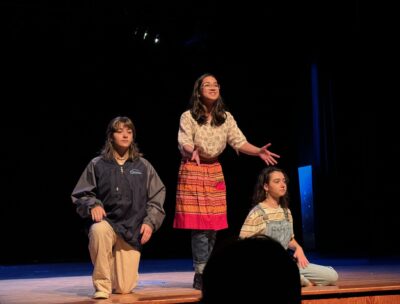
On Oct. 29, just a month after the storm devastated western North Carolina, the Pioneer Playmakers premiered an original theater production — titled, “Surge” — to a full house at Watauga High School (WHS).
“It is a love letter to our community,” said Sarah Miller, a theater arts educator and co-director of the play.
Days later, the students performed the play in Shelby at regionals for the North Carolina Theatre Conference (NCTC) and then later in November they performed at the NCTC State High School Play Festival. Their “Judge’s Choice” award came with an invitation to perform at the Southeastern Theatre Conference (SETC).
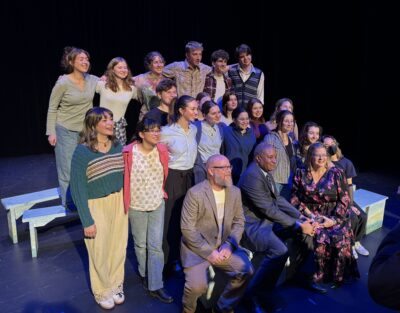
In January 2025, the students performed the play in Raleigh for the N.C. State Board of Education. Watauga County Schools Superintendent Dr. Leslie Alexander, School Board Chair Dr. Gary Childers, and WHS Principal Scott Strickler were all there to support their students.
And just six months after the storm in March 2025, the lights had yet to fade on the the seventh and final performance of the original work — writes Keith Martin, a professor of theatre at Appalachian State University, in an article for The Watauga Democrat titled, “Playmakers shine in national spotlight, ‘Surge’ wins most awards in WHS history” — when “the entire audience leaped to their feet in a spontaneous standing ovation” as “the audible sniffles and sobs from attendees were replaced by whistles and cheers as the applause continued well after the house lights came up.”
That last performance was in Baltimore at SETC, the “strongest and broadest network of theatre practitioners in the United States.”
“Surge” captured five awards, including, according to Martin, the coveted “Excellence in Ensemble Acting.”
Ahead of the anniversary of Hurricane Helene, EdNC is releasing a documentary about the play and the playmakers. It’s titled, “A Long Way Down,” after the play’s original score.
“You are a living example of the support that we need for our students, but you are also the living example of what is good, what is so good,” said Heather Smith, the 2024 North Carolina Teacher of the Year, to the playmakers. “I am just so excited that you can be a voice for the students of western North Carolina.”
The play’s call to be ‘stay helpers’
On Oct. 20, 2024, Beckie Spears, the 2024 Principal of the Year, emailed me about a publishing a perspective by an educator, Sarah Miller.
“What do you do when 15 days of teaching are gone? From a curricular perspective, from a trauma-informed care perspective, what do you do as an educator?” Miller wrote.
When I scrolled down through the email Spears sent, I could see an email forwarded to her by Kelly Walker, another educator.
That email said, “What (Miller) doesn’t say is that she is coaching her students to devise, write, and perform their NCTC show for Saturday, Nov. 2 after being out of school for 15 days. The kids made the pivot on Zoom meetings after the Hurricane to concentrate the focus of the show on the hurricane and its effects. It’s their teenage catharsis that they will share with the world on Tuesday, Oct. 29 and then in competition mode on Nov. 2. That in itself is nothing short of miraculous.”
Turns out the playmakers had landed on the story itself on Oct. 14, outlining it on a white board. Days later, the script was written.
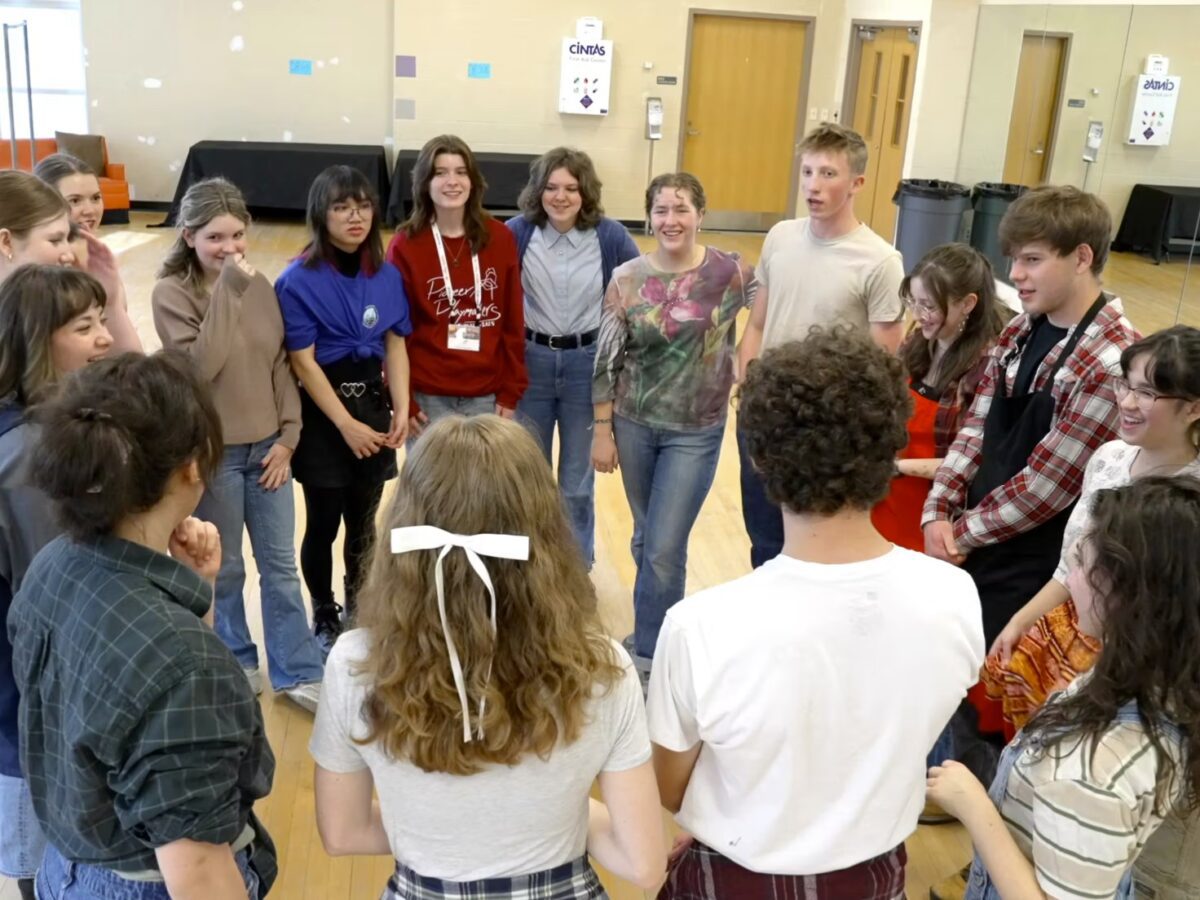
Spears and I met at Watauga High School on the evening of Oct. 29. We were backstage with the students and Miller as they made the final changes to the script, running through a few key moments before taking the stage.
When education journalist Amanda Ripley — the author of “The Unthinkable: Who Survives When Disaster Strikes — and Why” — talks about leadership in crisis, she describes the three phases of disbelief, deliberation, and then the move to decisive action. Once they were back together, these students moved through disbelief in seconds. They moved through deliberation in days. Within a month, they were performing the play.
In the play, four reporters covering the hurricane serve as narrators, but community members also call them out for how they showed up in communities after the storm.
“You know, it would go a lot faster if you would help us,” a student says to one reporter.
“How bad is it?” another reporter asks the father of a family in the play. “Look around,” the father responds.
Later in the play, as a reporter begins to help, a community member played by Rowan Tait asks, “Are you a day helper or a stay helper?”
Tait’s question, his call to action, has kept me up at night like nothing else ever — and there have been plenty of things that have kept me up at night in this job.
As journalists, it should keep us up at night.
In May 2025, Tait, his mom, and Miller, joined me in Raleigh at a gathering of leaders in education. It was important to me for Tait to have the opportunity to stand up and in his own words with his own voice pose his question to education advocates as well.
Thank you to the playmakers and their families, Sarah and Zach, and the school and the district for trusting EdNC to share the story of your leadership. Thank you to Heather Smith, Beckie Spears, and Rupen Fofaria for your commitment to our students and going above and beyond in getting this story in front of state leaders and out into the world. Thank you to Samaritan’s Purse and Leslie Hilliard, an educator in Yancey County Schools, for donating the footage from the storm and its aftermath. Thank you to Robert Kinlaw, the videographer and director of the documentary, for helping me document this “miraculous” making of a new story.
I live in Watauga County. This is home for me. We are at the beginning of recovery. Long after the anniversary of the hurricane has passed, the region will need journalists and other leaders to serve as stay helpers.
The play reminds people, Miller says in the documentary, that “the beauty of the world is in humans holding each other’s hands.”
Editor’s note: The N.C. Press Association has awarded EdNC its public service award for our coverage and strategic support of western North Carolina after Hurricane Helene. You can see all of our coverage here.

Recommended reading