
Hearing begins on DPI’s choice of Istation to assess young readers

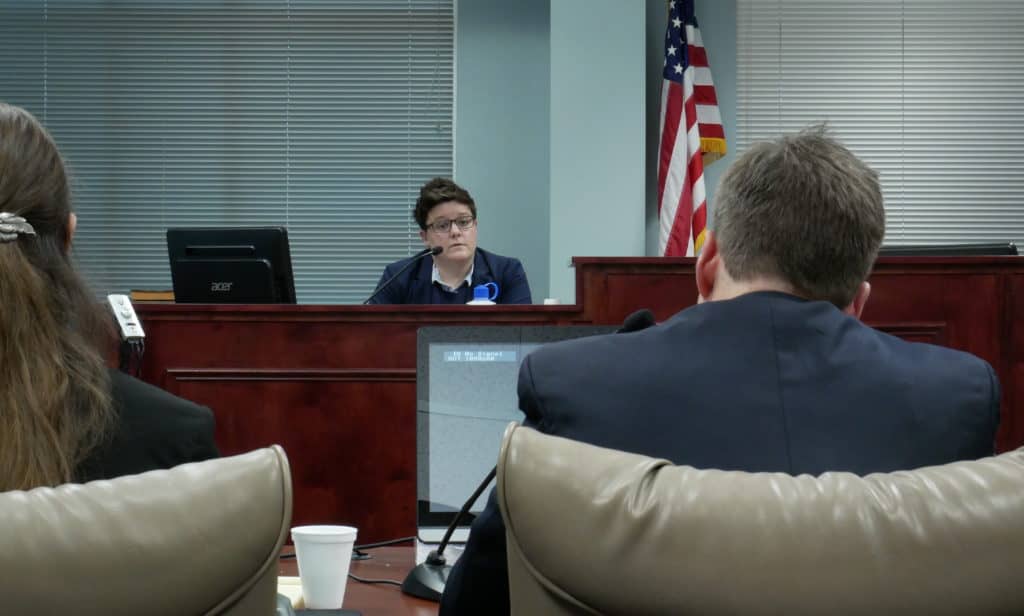
The long-awaited hearing on the Department of Public Instruction’s choice of an assessment tool vendor to test K-3 student reading began Monday.
Department of Information Technology (DIT) General Counsel Jonathan Shaw on Monday began reviewing DPI’s process, which losing bidder Ampify claims was unfair.
Since last summer, DPI’s decision to measure reading proficiency with a tool from Istation, a Texas-based e-learning company, has been disputed. The state is required to assess its youngest students’ literacy levels by Read to Achieve, a piece of legislation aimed at improving student reading results.
Amplify, the state’s previous vendor to test K-3 students, protested DPI’s choice in July and asked for a stay until a hearing could review DPI’s selection process. Amplify argues that the procurement process included several mistakes, that the evaluation criteria were changed without notification of the parties, and that Istation did not meet a bidder requirement related to screening children for risk of dyslexia.
“But for these errors, Amplify would have won the contract,” said Mitch Armbruster, an attorney representing Amplify, in his opening statement Monday. “Therefore, Amplify will ask at the end of this proceeding that the contract with Istation be voided, and that the award be made to Amplify as the next qualified bidder.”
Both DPI and Istation argue that the process was fair and that Istation met the state’s needs.
“Istation represented the better value to the state of North Carolina and, as a result, the evaluation panel recommended unanimously to the superintendent that Istation be awarded the contract,” Special Assistant Attorney General Tiffany Lucas, who is representing DPI in the case, said about the decision to choose Istation.
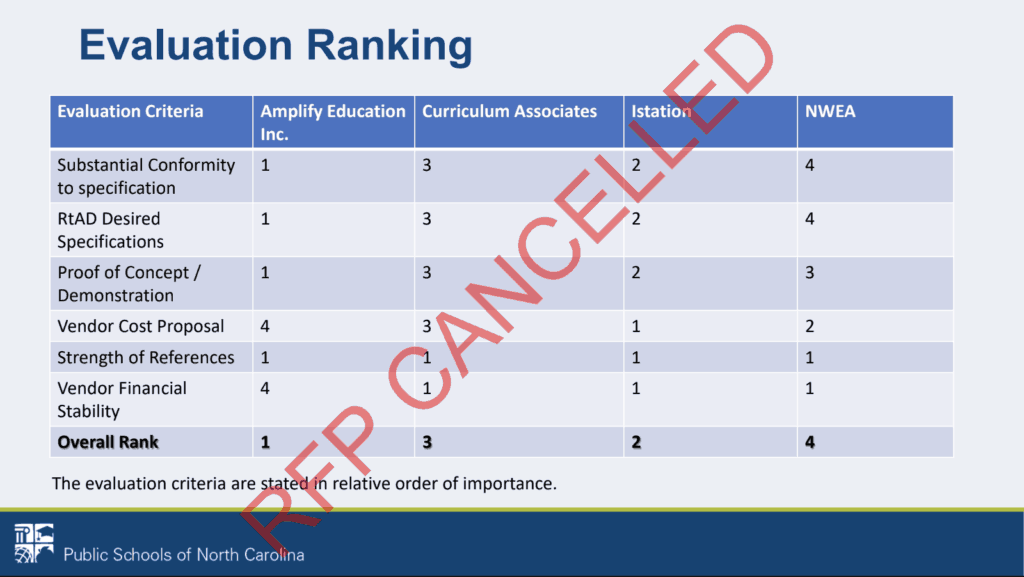
Before a final evaluation panel chose Istation, a larger evaluation team met and evaluated four bidders in November 2018, ranking Amplify as its first choice and Istation as its second. Meeting documents from the team’s next meeting in January 2019 show the team voting, with six recommending Amplify, three recommending Istation, and one recommending moving forward in the process with both companies.

Photo courtesy of the Department of Public Instruction Photo courtesy of the Department of Public Instruction
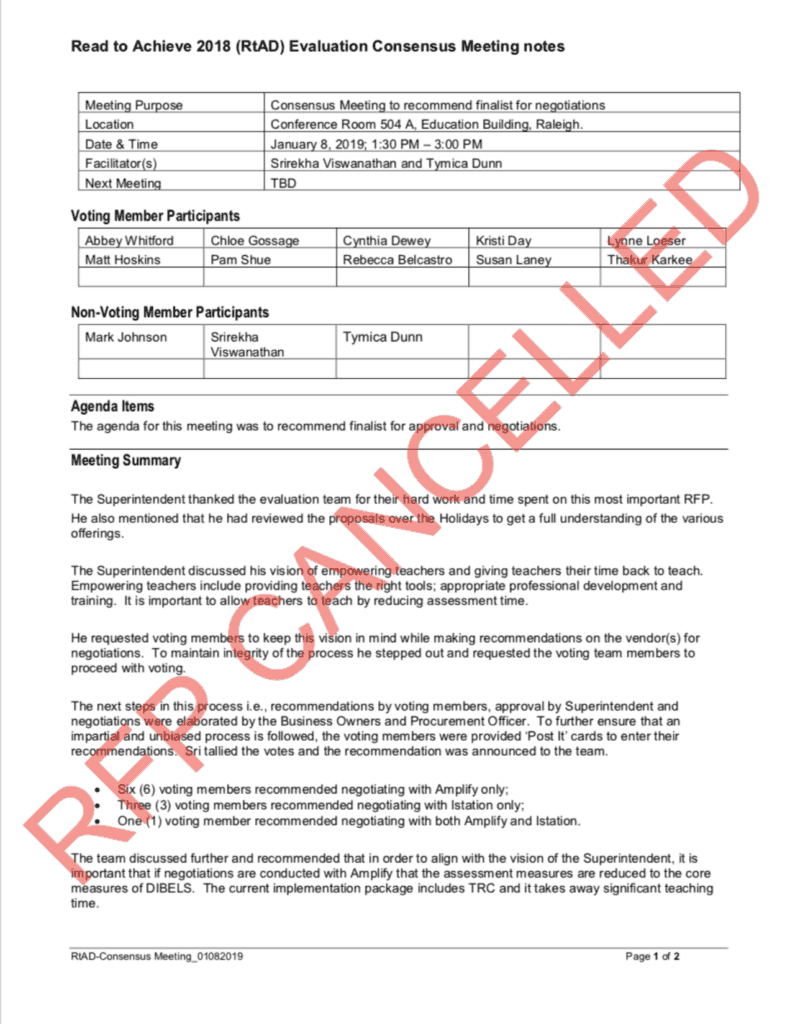
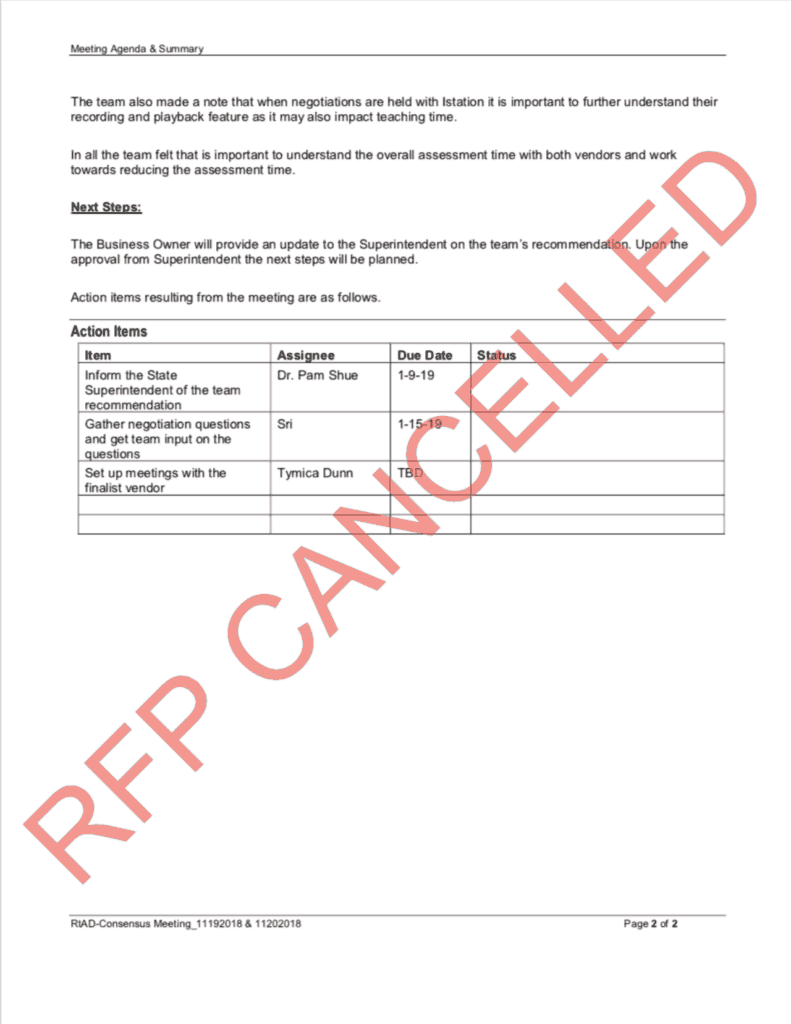
Lucas said in her opening statement that no final agreement was reached as to which vendor the team would recommend to Superintendent of Public Instruction Mark Johnson. The 2017-18 state budget gave the superintendent authority to make the final decision.
DPI canceled the procurement process in February 2019 and told DIT, which was overseeing the procurement, that the costs were so far apart that direct negotiations were necessary. From those direct negotiations with Amplify and Istation, Istation came out on top.
Former DPI employee testifies
Amy Jablonski, a former DPI employee who led the canceled procurement process before leaving the department at the end of 2018, took the stand Monday on behalf of Amplify.
Jablonski testified that the evaluation team ranked Amplify as the top choice at a meeting in November 2018 and was about to move only Amplify forward for negotiations, but that it was then recommended to move two vendors forward.
“The team came to consensus to move it forward and then were told that it was strongly recommended that it would look better to move two forward,” Jablonski said.
She said that the team was then going to recommend both Amplify and Istation but that the meeting was ended “abruptly.” Jablonski said a team member said it was the superintendent’s decision to make the final call.
Kieran Shanahan, an attorney for Istation, asked Jablonski why the consensus she said the team reached was not reflected in the minutes of that meeting. Jablonski said she must not have noticed the omission when reviewing the minutes.
In a meeting the next month, Jablonski said, she and other evaluation team members met with Johnson to update him on the process. They shared the rankings from the November meeting.
Lucas asked Jablonski on Monday about how those rankings were calculated, and Jablonski replied that there was no mathematical calculation. In the table below, Shanahan pointed out, an average of the category rankings would put Istation ahead of Amplify. Armbruster argued that an average would not be sufficient as the categories had varying importances.
Lucas also asked why Jablonski did not mention to Johnson the process used for ranking, which included evaluation committee members voting “yes,” “no,” or “maybe,” with sticky notes.
“You did not deem it important to inform the superintendent that the evaluation committee had considerable questions as demonstrated by the number of ‘maybe’ votes that were cast for various specifications for each vendor?” Lucas asked.
Jablonski said she gave the final rankings but not the methodology or the tallies of “maybe” votes.
Jablonski also testified that Chloe Gossage, chief strategy officer for the superintendent’s office, made a comment to her before the start of the procurement process that Amplify would not win the contract.
Jablonski said she then went to her supervisor at the time, Maria Pitre-Martin, who no longer works for DPI, to express her concerns about Gossage’s comment. She said Pitre-Martin said nothing could be done.
“At that point at the Department of Public Instruction, there just was … overall a fear of losing jobs,” she said.
Shanahan and Lucas asked why Jablonski did not cancel the procurement or remove Gossage from the process, and Jablonski said she did not have the authority to do that.
The hearing continues Tuesday morning and is scheduled to last through Thursday.