
Perspective | Impeachment inquiry as a ‘teachable moment’

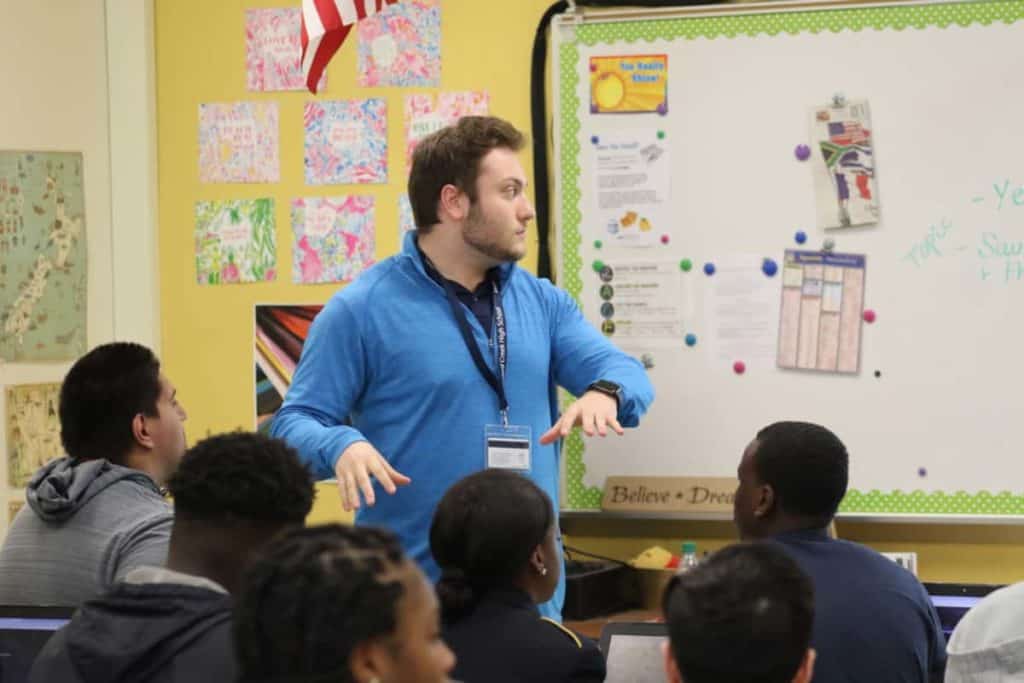
The U.S. House opened a new chapter in American history when it decided to pursue an inquiry into whether to impeach President Trump. Living through this historical moment may well become a defining learning experience for today’s high school and college students.
The question is not whether teachers should engage with their students in exploring questions and issues raised by history-in-the-making, but rather how they should do so. After all, American schooling arose and spread in the young nation as an instrument for forging an informed citizenry to sustain democracy. In a declaration typical of his generation, George Washington in his Farewell Address promoted “institutions for the general diffusion of knowledge … (as) essential that public opinion should be enlightened.”
Nowadays from right and left come voices of deep concern over survey results suggesting a shallow grasp of historical facts and figures. For example, the Woodrow Wilson National Fellowship Foundation reports that only one in three Americans can pass the U.S. Citizenship Test, that only 13% know the year the Constitution was ratified, that 72% could not identify the 13 original states. In general, older adults had deeper knowledge than younger adults.
And yet, as Sam Wineberg, a Stanford education professor, argues in his book, Why Learn History (When It’s Already on Your Phone), historical knowledge cannot be measured simply by “supple memory’’ in taking multiple-choice tests. What is needed is connecting-the-dots and critical-thinking in navigating the narrative of a self-governing people, their trials and tribulations; scandals, rascals, and transformative leaders; class and racial frictions, and what has been overcome and what hasn’t.
It’s not effective to issue sweeping generalizations about the teaching of history and civics in North Carolina. No doubt it’s uneven. Just as surely the state has creative and dedicated high school teachers who can rise to the occasion in this moment of history — not only in their own classrooms but also in mentoring and collaborating with colleagues.
In writing this commentary, I’m mindful of the challenge facing me to adapt in real time the two courses I’m teaching this semester at UNC-Chapel Hill as the impeachment process plays out. One is a seminar designed to prepare first-year students for the 2020 elections; the other is a writing-intensive course on public affairs journalism. Here are some thoughts about ways those of us who meet with students can help guide them:
- History of the Constitution. The nation’s founders debated impeachment as a check against a presidency run amok. James Madison’s notes on the constitutional convention and the Federalist Papers have become freshly relevant.
As a high school student in the mid-1960s, I recall spending several afternoons in the main Louisiana State University library scrolling through microfiche to research a paper on the 1901 assassination of President William McKinley. Today, teachers and students have easy digital access to documents, such as this Library of Congress collection of Madison’s papers.
-
The role of news media. Students read, listen, and watch news in increments, on their hand-held or laptop devices, not by turning the pages of a newspaper or magazine. The intense coverage of impeachment proceedings will require students to understand distinctions between reporting and editorializing; between online reports from news institutions with editing and ethical standards and propaganda-type websites with scant regard for facts and context; between inevitable mistakes in the human enterprise of gathering and writing news and purposeful distortions that produce “fake news.”
Teachers can introduce students to the workings of professional journalism by assigning readings of various approaches and viewpoints from publications of substance. They can also have students engage in roundtable discussions such as Washington Week in Review.
- Responsibility of citizenship. No doubt students may feel frustrated, lacking immediate agency, while often-heated debate proceeds in Washington. Still, public opinion matters, and history-making events have a way of propelling people into unanticipated involvement in political parties, campaigns, or other civic institutions.
In the U.S., elections are both secular struggles for power and a sacred exercise of citizenship. The impeachment inquiry centers on actual and potential foreign involvement in American presidential and congressional elections. In 2016, Russian social media tactics, solid evidence has shown, intended to exploit and widen political polarization. In the weeks and months of the impeachment process, teachers and students can deliberate and debate how to offset excessive polarization and elevate the value of free elections to a free people.