
Perspective | A budgetary impasse in stark red and blue

Is it all about Medicaid? Is there any way out? Is there no sense of urgency?
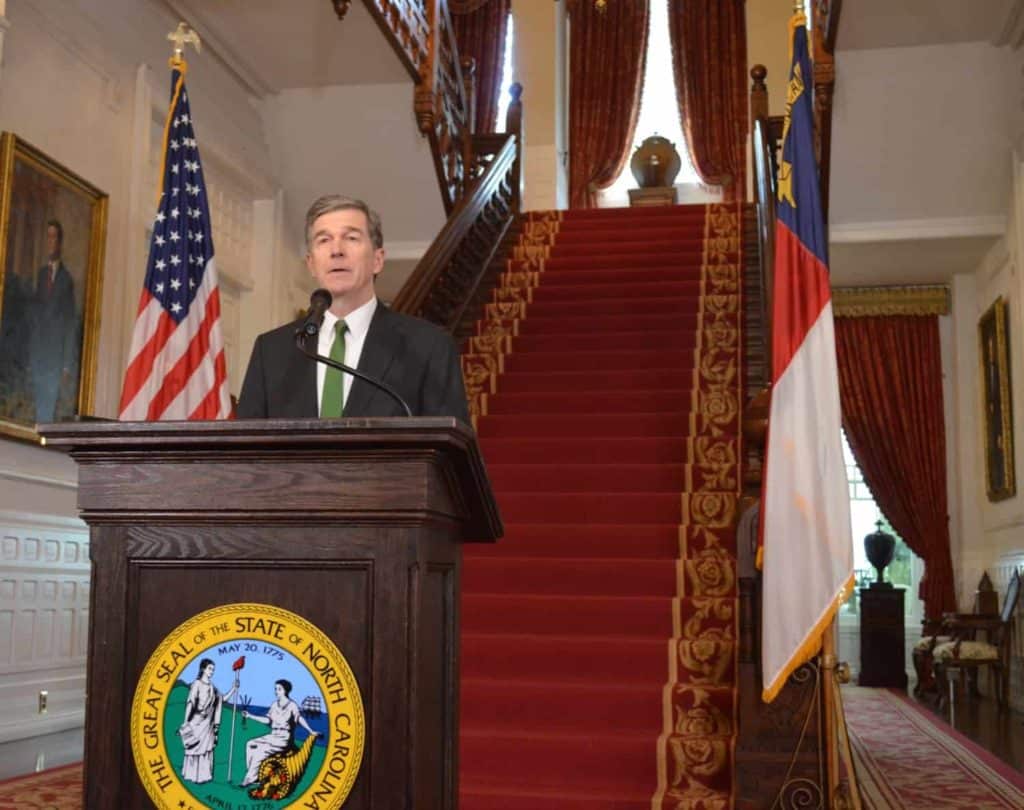
These questions come to mind as the impasse over the state budget enters its fourth month since Democratic Gov. Roy Cooper vetoed the $24 billion Republican-devised appropriations bill on June 28. In the 2016 and 2018 elections, a polarized electorate produced a divided government in which consensus has proved elusive.
As he vetoed the budget bill, the governor indeed highlighted the continued Republican resistance to expand Medicaid, the federal-state health insurance program for lower-income people, under the Affordable Care Act. North Carolina remains among the 14 mostly Southern states that have not adopted the Medicaid expansion.
Republican legislative leaders attribute the budget stalemate almost entirely to what they depict as Cooper’s stubborn refusal to put aside the Medicaid issue for another time. It is, to be sure, a central issue. But the budget, as passed and then vetoed, has an array of provisions that fall short in urgency and in propelling the nation’s 9th largest state forward — not least in supporting schools.
Here is a rundown of major budget provisions bearing on pre-K-12 education.
By the state’s own reckoning, North Carolina needs $8 billion in new schools, additions, and renovations. The governor proposed $2 billion in bonds, the House somewhat less, to meet school facility needs. The budget bill, however, reflects the Senate’s go-slow, pay-as-you-go plan to finance construction by devoting a portion of annual revenues.
North Carolina has roughly 60,000 young children eligible for NC Pre-K, but its state-and-local funding provides a slot for barely half of them in either a child care center or a classroom for 4-year-olds. The budget adds $5.2 million over two years in a rate increase that can relieve the financial burden on some counties. However, the appropriation doesn’t guarantee additional slots. Once a national leader in early childhood enrichment, North Carolina mostly runs in place. Opportunity passes up thousands of children who are 4-year-olds only once.
Pay raises for teachers remain in contention, the size of increases unresolved. Cooper has proposed to raise salaries at roughly double the percentage favored by Republican legislators. In a state in which teachers have gained national attention for their mass marches, the legislature has approved pay increases in recent years that moved North Carolina up in the state rankings, though educators’ salaries remain well below that of comparable professionals.
The budget also contains another revenue-depleting tax measure. It could cut the franchise tax paid by businesses — on top previous business-tilted cuts, principally reduction of the corporate income tax rate from 6.9% to 2.5% over the past five years. Erosion of the revenue base in this relatively moderate-tax state will make it more difficult to assure young North Carolinians the sound, quality education to thrive in an often-turbulent economy and society.
That Democrats and Republicans are at loggerheads over the budget — on education as well as Medicaid — is a reflection of the distinctive divisions between the major parties in the second decade over this century. A provocative national analysis, produced jointly by the Wall Street Journal and the Brookings Institution, asserts that the Democratic and Republican parties occupy separate geography and represent increasingly divergent economies.
Republicans occupy non-urban territory with more traditional industries and with rather flat productivity and household income. Democrats have a “big-city tilt’’ with household incomes rising along with growth in professional and digital services employment.
“The current economic trends underlie the current party divide and reinforce it,” write Mark Muro and Jacob Whiton of Brookings. “For at least the foreseeable future, therefore, the nation seems destined to struggle with extreme economic, territorial, and political divides in which the two parties talk almost entirely past each other on the most important economic and social issues, like innovation, immigration, and education because they represent starkly separate and diverging worlds.”
North Carolina has become not simply an evenly divided “purple’’ state, but a “red’’ state and a “blue” state within a common border. That’s the political reality fueling an urgency-sapping budgetary impasse.