
Eastern N.C. teachers explore animal waste-to-energy trend in their own backyard

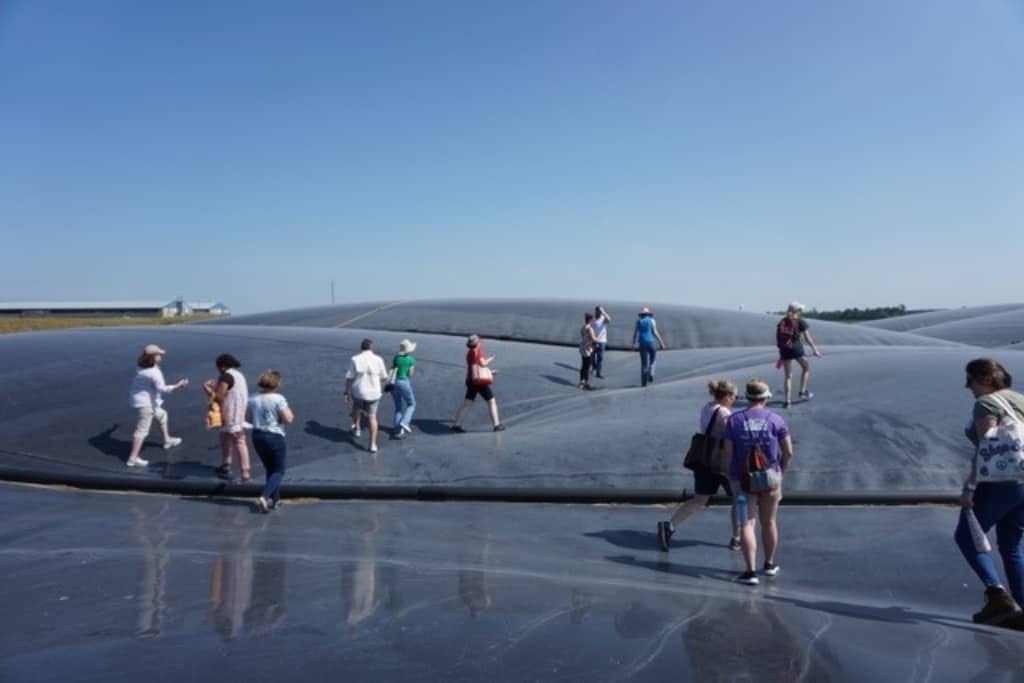
“I didn’t know much about this technology even though I live in this county!” exclaimed one teacher as she stepped onto covered swine waste on a Smithfield Farm in Duplin County.
This sentiment was felt by a number of teachers who recently stepped out of the classroom for the day to learn about animal waste-to-energy technologies in eastern NC. Nineteen educators from eastern North Carolina participated in a place-based workshop sponsored by the UNC-Chapel Hill Institute for the Environment (IE) with funding provided by the Duke Energy Foundation. Duke Energy has generously supported the IE’s K-12 energy education programming since 2014.
The NC Renewable Energy Portfolio Standards, which were adopted in 2007 require 12.5% of a utility’s sales to come from renewable energy by 2021 and include a requirement for utilities to utilize animal waste-to-energy technologies, are the impetus behind this growing trend in eastern NC.
In an effort to educate teachers about this trend and the underlying technologies, teachers toured Optima KV in Duplin County to witness up close how swine waste is captured from five Smithfield hog farms and converted into renewable natural gas where it can then be transported to a nearby power plant to generate electricity. Walking on top of anaerobic waste digesters that generate methane from manure was the highlight for many teachers, most of whom had never stepped foot on a hog farm.
Later in the day, teachers toured Prestage AgEnergy to see how turkey litter is being used to generate both steam and electricity for use in Prestage Farm operations. In addition to learning about the co-generation of steam and electricity, teachers also learned about the corresponding waste product — a high quality ash that can be used as fertilizer.
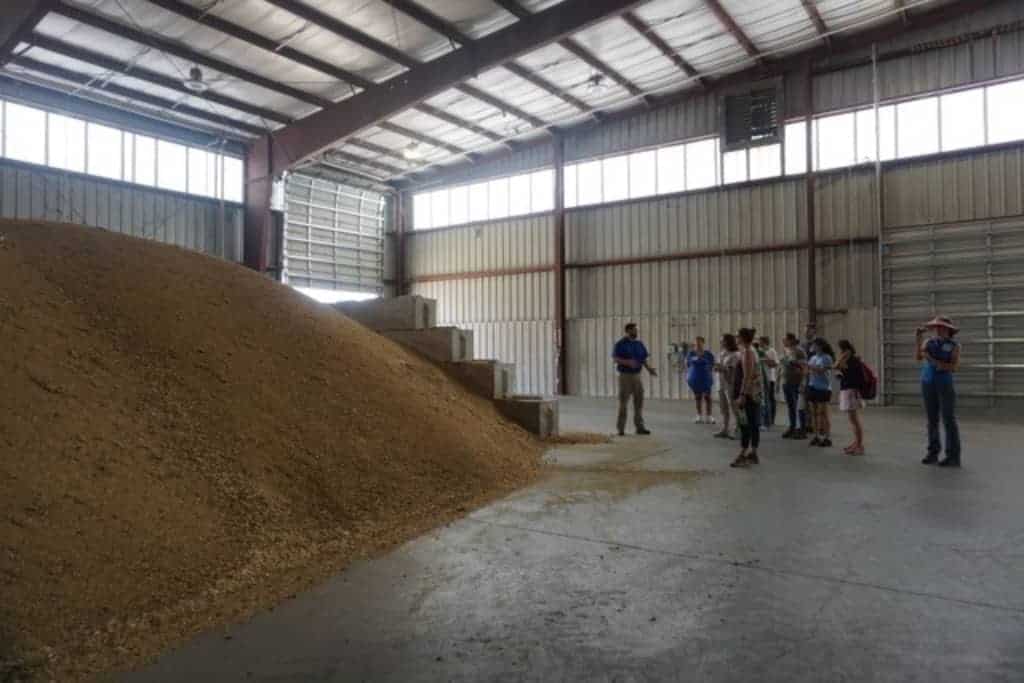
These field trips enabled teachers to consider not only the ingredients needed to convert animal waste into energy but also the resulting end products. These kinds of experiences are meaningful to teachers who strive to get their students thinking holistically about the various energy sources on which we rely.
By touring these sites in person and meeting the personnel involved in operations, teachers are able to discover the many curriculum connections that can be made by introducing the featured energy technology — from land use implications, to social and economic considerations, to career connections. The impact of large scale animal operations on communities in eastern North Carolina have led to concerns about environmental and social justice issues for a number of years. Carolyn Fryberger, with NC Growth, joined the participants on the tours and later discussed how these animal waste-to-energy operations can mitigate some of the negative impacts associated with large-scale livestock production for workers, neighbors, animals, and the environment.
Travis Payne from Duke Energy Renewables and Distributed Energy Technology and Kraig Westerbeek from Smithfield Foods also met with workshop participants to discuss these technologies from the perspectives of the utility and pork industry. Animal waste-to-energy operations will become increasingly relevant in eastern North Carolina since Smithfield Foods recently set a goal of having these projects across 90% of their hog finishing spaces in the state over the next 10 years.
“Being from eastern NC, I can share the information learned today to open my students’ eyes to the possibilities of using animal waste to make energy right in our own backyards,” said one teacher at the end of the day.
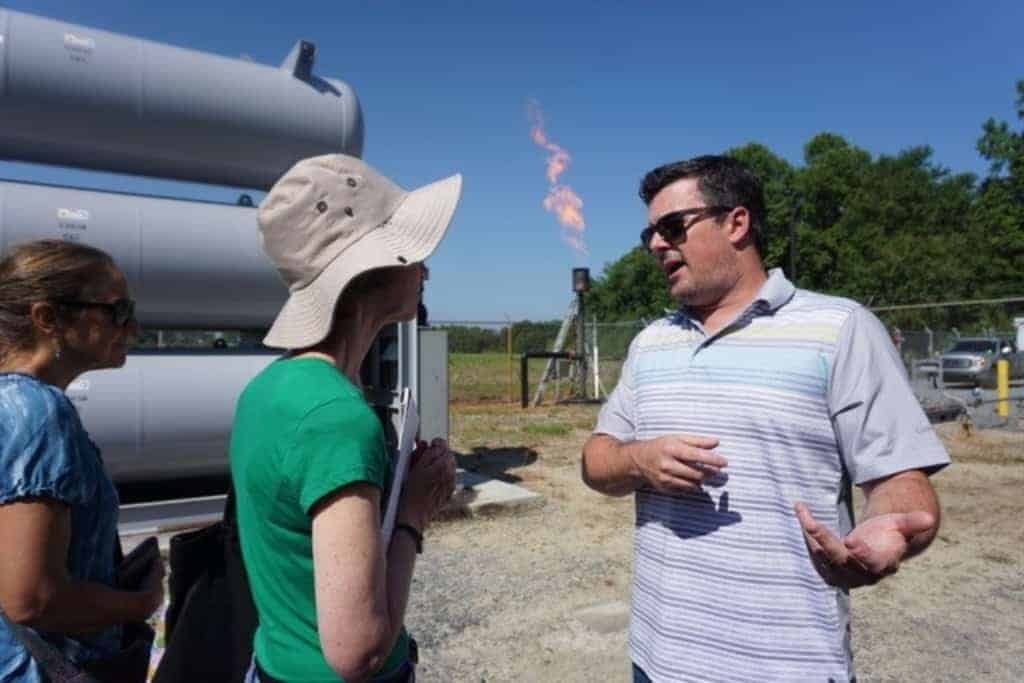
In fact, one workshop participant has already done just that — Julie Blodgett, a chemistry teacher from Duplin County — had her students do a three-day research project to learn about natural gas and how it can be harvested locally. This included having students examine alternative sources of natural gas, such as landfills and animal waste and learn how the resulting methane is refined by removing substances such as sulfur dioxide, carbon dioxide, nitrogen and water. Inspired by the workshop, Blodgett also asked her students to consider the benefits for the environment, the farmers, and the community.
“This activity was valuable in that students were able to apply their chemistry knowledge to their neighborhood,” said Blodgett.
This kind of student engagement with locally relevant examples is exactly what is needed as the state continues to build its renewable energy capacity and develop its future energy workforce. Teachers who are knowledgeable about what is going on in their own backyard and who incorporate this knowledge into their teaching will ultimately inspire students and spur the innovation that is needed to move North Carolina towards a more sustainable future.