
My Future NC commission aims to smooth education continuum
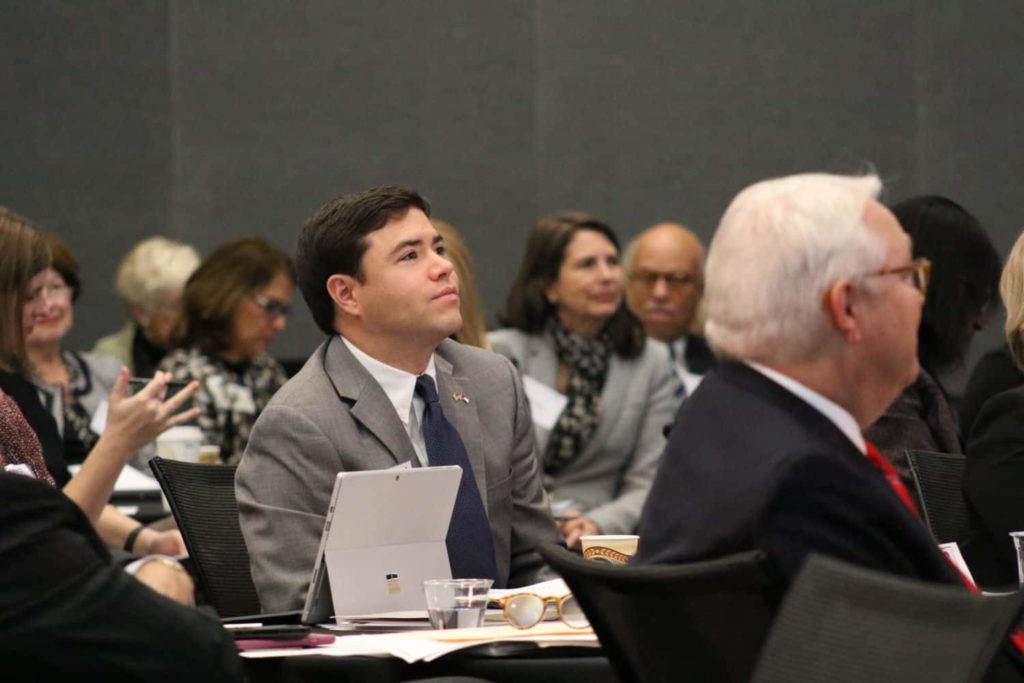

A new commission, My Future NC, is rethinking the state’s education system and workforce pipeline with an initial focus on the shifting demographics of the state. Co-chaired by UNC System President Margaret Spellings, Bank of America Chief Administrative Officer Andrea Smith, and Medical Mutual Holdings CEO Dale Jenkins, the commission met for the first time on Monday and plans to make recommendations to the state, localities, and institutions on how to support individuals’ learning throughout their lives.
“Together, our task is complex in execution but straightforward in its conception,” Spellings said at the meeting. “Today, we are only a handful of states without a statewide post-secondary education attainment goal to guide us.”
Spellings said both the changing labor market and evolving population of the state are intensifying the importance and urgency of the problems the state and its educational system face.
“We all know, or you wouldn’t be sitting here, about the hard work of increasing attainment, reducing disparities, and ensuring students graduate with the skills they need, but that work becomes nearly impossible when the stages and transitions of the educational continuum, from pre-K to K-12, high school to post-secondary education, community college to four-year degree, etc., aren’t well enough aligned,” Spellings said. “As a state, we must define where we need to go with bold statewide goals and then achieve these goals by creating actionable recommendations on how to fix the holes and the seams though which we lose students.”
The work is called for by the UNC Board of Governors’ strategic plan, adopted earlier this year. The commission is funded by grants from the John M. Belk Endowment, Bill & Melinda Gates Foundation, and the Goodnight Education Foundation.
The commission, which has three committees — P-12, postsecondary, and workforce — along with several subject matter experts, heard from Michael Walden, economist and N.C. State University professor, and Jim Johnson, professor of strategy and entrepreneurship at UNC-Chapel Hill’s Kenan-Flagler Business School.
Both speakers described the national and statewide demographic and workforce changes of the last decade and made projections about the state’s future. Here are some key takeaways from their presentations:
- The state’s growth will be concentrated.
Both Walden and Johnson mentioned differences in growth and wealth between regions of the state. Despite the addition of an estimated 3.2 million people statewide by 2050, 33 counties will lose population in the next several decades. Walden said he often hears students from rural areas at N.C. State that plan to go back home to work originally, but eventually stay in Raleigh or other urban areas of the state instead.“Our economy in the Triangle is in part built by importing smart people from rural counties,” Walden said.
- The state’s economy is going through another big change.
Walden described large transitions in the state’s workforce — from farming to manufacturing and manufacturing to services. The step after services, however, is unclear. Walden emphasized the effects technology will have on the kinds of jobs that are available in the future. Routine jobs, he said, will be the first to be replaced by machinery or a computer algorithm. As artificial intelligence develops, Walden said more complex jobs could also be taken over by a quicker, more efficient piece of technology.“… A conclusion that I think that makes sense here is that we can’t predict to what extent technological unemployment’s going to occur … but I think it makes even more important us having an environment that promotes innovation (and) entrepreneurship,” Walden said.
- North Carolina’s population will experience “browning” and “graying.”
The premise of Johnson’s presentation was the necessity of a hard look at how the make-up of the country and state will change drastically in the future. Johnson said, as North Carolina has both more non-white and elderly residents, systems must change to reflect that. In the 2015-16 school year, less than half (49.5 percent) of the state’s public school population was white for the first time. Making sure high school graduation and post-secondary success is attainable for a diverse set of students will be important, he said. Just as important, he said, is explaining how embracing Hispanic and people of color in general into society matters for the state and country’s competitiveness.“The next generation of talent is going to be mostly black and brown and you have a generation of kids that are locked out of educational opportunity,” Johnson said.
- Everyone needs to keep learning.
As available jobs shift, some communities grow and others struggle to survive, and demographics change, Walden said the state’s educational system should expect — and fully support — older students looking to make career changes or gain new training.
The commission broke into committees to hear from the leaders of different sectors and start brainstorming what is and is not working.
By the end of 2018, the commission will have met in different regions of the state and held eight community input meetings to hear from different stakeholders. The group will publish two reports: one providing educational attainment goals and outlining the state’s major challenges, and one making recommendations on how to overcome those challenges and meet the set goals. There will also be a series of policy briefs from the commission on topics like early childhood education, teacher quality, college readiness, credit transfer, and postsecondary student success.
Editor’s Note: EducationNC CEO Mebane Rash is a subject matter expert to the P-12 committee of the commission. The Goodnight Education Foundation contributes to EducationNC.