
Illumination from the Kozol-Osborne divide
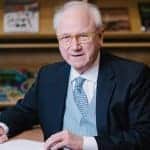
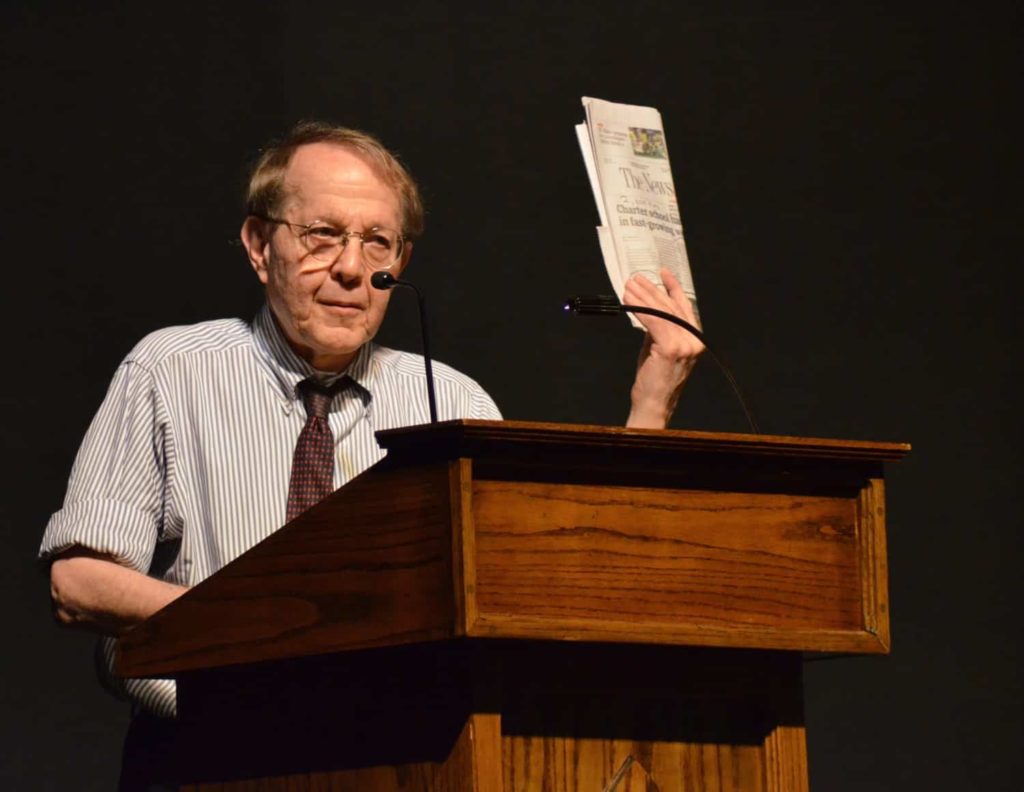
David Osborne and Jonathan Kozol are public thinkers worth listening to even if one does not wholly agree with them. Both have written books on American schooling, and they discussed their education research in separate visits this month to the Triangle for lectures that offered fascinating contrasts in style and method.
Kozol, who spoke at Duke University Wednesday night for an hour and a half, is a legendary 81-year-old who spent half a century studying and writing a stream of books about children and teachers in racially-segregated, economically distressed neighborhood public schools. His approach is to examine conditions and identify issues by immersing himself in schoolhouses.
Sounding akin to the Old Testament prophets who railed at rulers and their people who had gone astray, Kozol inveighs against the “savage inequalities’’ — the title of one of his books — between affluent and poor school districts. Why do deep disparities persist? “To me,” he said, “the biggest problem is the quiet equanimity of decent people.”
For his part, Osborne, who appeared at N.C. State University at a gathering sponsored by EducationNC, just published a book, “Reinventing America’s Schools,” in the same vein as his influential 1992 book, “Reinventing Government.” Osborne examines school systems and communities, in search of ways to reform the public sector, which he finds too bureaucratic, hierarchical, and centralized.
“A century ago,” he writes, “the creation of standardized, unified school systems with monopolies on free schooling had a dramatic impact on this country, helping us build the most powerful innovative economy on earth. In the 21st century the emergence of a new model — decentralized, competitive, customer-driven, mission-driven and performance-based, with steering separated from rowing — could have an equally profound effect.”
Had they appeared jointly, no doubt their clashing views on charter schools would have dominated the encounter. Kozol treated charter schools with sarcasm, and described as “dangerous phenomenon’’ the spread of charters and tax-financed vouchers to private schools. Osborne has embraced charter schools as vehicles for reinventing public education because, he said, “we need different kinds of schools for different kinds of kids.”
But it is far too simplistic to characterize them as pro-charter Osborne vs. anti-charter Kozol. Their separate presentations did not delve too deeply into North Carolina education policy, but each in his own way raised questions about the school-choice agenda pursued by the General Assembly over the past six years.
For example, Osborne joins with Kozol in opposing vouchers. Inevitably, said Osborne, vouchers would “segment the marketplace” and lead to “unequal opportunity.”
Kozol conceded that there are “some good charter schools,” but he appeared especially worried about the rise in schools run by for-profit companies that would “make a pile of money on the backs of school children.” Osborne would not rule out for-profit charters, but appeared wary, having written that “too many have siphoned public dollars into private hands, at the expense of the children.”
Osborne prefers to talk about “public charter schools.” His view, as expressed in his book and his lecture (in the form of an interview by his daughter Molly, a policy analyst for EducationNC and a former Teach for America teacher in New Orleans), is that public school authorities should “steer’’ in setting general policy while each school should “row’’ in delivering dynamic instruction.
Their different approaches also emerge in discussing teachers and the school environment. Osborne favors aggressive action to close schools and to dismiss teachers not meeting performance standards, and he says that parents picking warm and nurturing schools without regard to academic prowess “cheats the children.” Kozol decried the “battering ram’’ of standardized testing that squashes “happiness’’ out of schooling, and he said that “teachers don’t receive the honor they deserve, never did, even less so today.”
For North Carolina lawmakers and education policy makers, Kozol and Osborne provide provocative yet different perspectives for the state’s great debate over public education. Each in his own way challenged preconceived notions and central elements of current budgeting and policy. The debate needs Kozol’s passion for lifting up children in distressed schools, and Osborne’s pragmatic quest for effective, sustained educational reform.