
Ask the employers first: ElevateNC’s seventh cohort officially launches

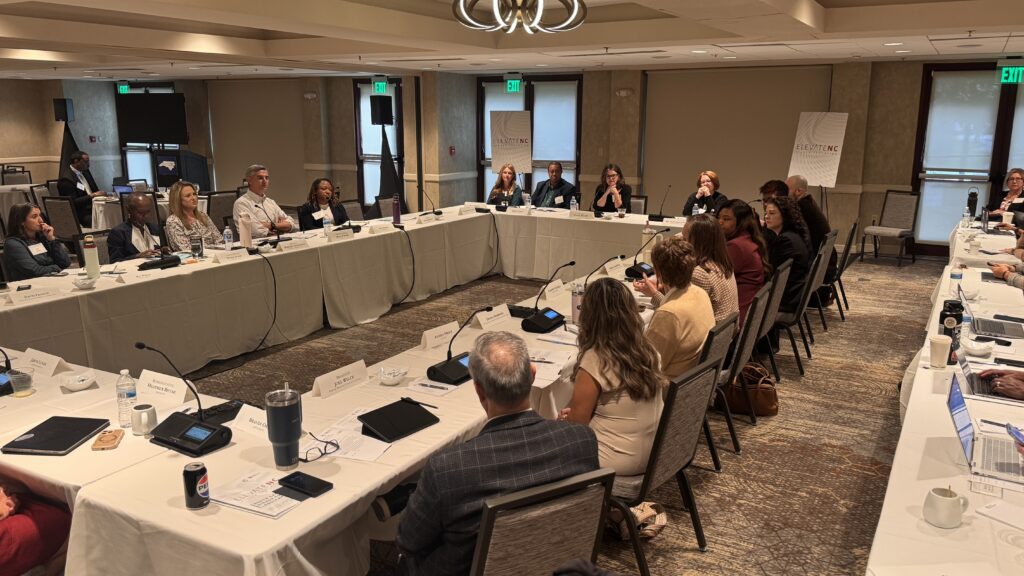
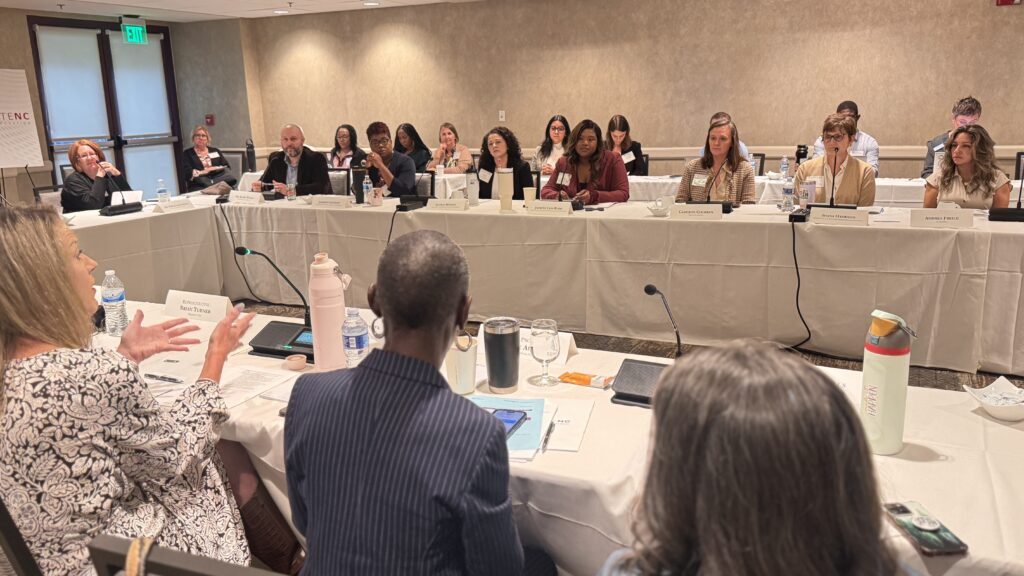
Dr. Margaret Annunziata, president of Isothermal Community College, has now sat on both sides of an ElevateNC table. In 2023, she was a member of the program’s fourth cohort. On Sept. 23, 2026, she came back as a resource expert, seated with Jasmine Cox-Wade, executive director of Gaston College’s Kimbrell Campus and Textile Technology Center, in the middle of a hollow square of tables at the Renaissance hotel in downtown Asheville.
Around them sat the members of Cohort 7.
ElevateNC: Higher Education is a leadership program from The Hunt Institute, launched with myFutureNC to help North Carolina reach its goal of 2 million people ages 25 to 44 holding a degree or industry-valued credential by 2030.
Each cohort pulls together a mix of people who have a hand in that goal, including legislators and college leaders. This year’s group includes three state legislators: Sen. Woodson Bradley, D-Mecklenburg; Rep. Brian Turner, D-Buncombe; and Rep. Heather Rhyne, R-Lincoln.
They’ll meet three times between September and March, and they began in the mountains, a few days before the second anniversary of Hurricane Helene.
 Sign up for Awake58, our newsletter on all things community college.
The session, “Building Talent Pipelines for Regional Prosperity,” was about getting colleges, employers, workforce boards, and economic developers pulling toward the same goal.
Isothermal Community College is part of Good Jobs Western North Carolina, a pilot that connects 11 community colleges and five workforce development boards around jobs in healthcare, manufacturing, and the skilled trades.
The college serves Rutherford and Polk counties, where Annunziata has noted that about half of graduating seniors leave high school without a plan for college or a job that pays enough to support a family.
That kind of data is where she starts.
Ask her how you get a college, its employers, and the economic developers pulling in the same direction, and that’s the heart of her answer.
Isothermal figures out which employers the region depends on most and where they’re short on skilled workers. It also asks students and working adults what they want from a job. Usually that’s decent pay and room to keep learning. Then it matches them.
“A vital role of community colleges is to connect our community members to the knowledge and skills necessary to successfully enter and advance in rewarding careers that provide family-sustaining wages,” Annunziata said. “To achieve this mission, we must work in tandem with employers, co-designing programs to ensure that we are preparing students with the specific competencies that are in demand and add value in the local workforce.”
Cox-Wade came to the Textile Technology Center in 2015 as a physical testing lab technician and now runs the Kimbrell Campus in Belmont. In Gaston County, a lot of families remember when the mills closed, and she said it was hard at first to get students to look at textiles as a career.
The associate degree program started in 2021 with seven students. Its first graduate, Kelly Moore, came back to school after being away for 30 years.
It hasn’t been simple. Cox-Wade didn’t dress it up.
The Textile Technology Center opened in 1943. By the early 2000s, manufacturers were leaving the country, and the degree programs went with them. Gaston has been building back ever since, with local manufacturers on a technical advisory board telling the college what they need and more of the training cut into short-term credentials students can stack.
The college then partnered with NC State University’s Wilson College of Textiles to launch the TextileREADY Education and Training Program, a flexible digital training platform that includes 21 training modules.
Cox-Wade’s advice for other colleges includes pulling every department in early, before a new program stalls somewhere between two offices.
Both women emphasized starting with employers, listening first and earning their trust before asking them for anything. A college that knows which skills employers need can build coursework around those and keep changing it as the industry changes. Building their trust is critical and can take time. Employers want to see a college fully committed with demonstrated follow through before they count on it.
Between now and March, each ElevateNC cohort member will develop their own actions, steps, and plans for their communities and region back home. Some of those plans may start with something said in Asheville, around a hollow square that turned out to be not so hollow after all.
Behind the Story
The author, former Sen. Deanna Ballard, moderated this session and was a member of ElevateNC’s inaugural cohort in 2020.
Editor’s note: Dr. Margaret Annunziata is the chair of EdNC’s board of directors.