
Davis: State’s K-12 needs go far beyond Mecklenburg

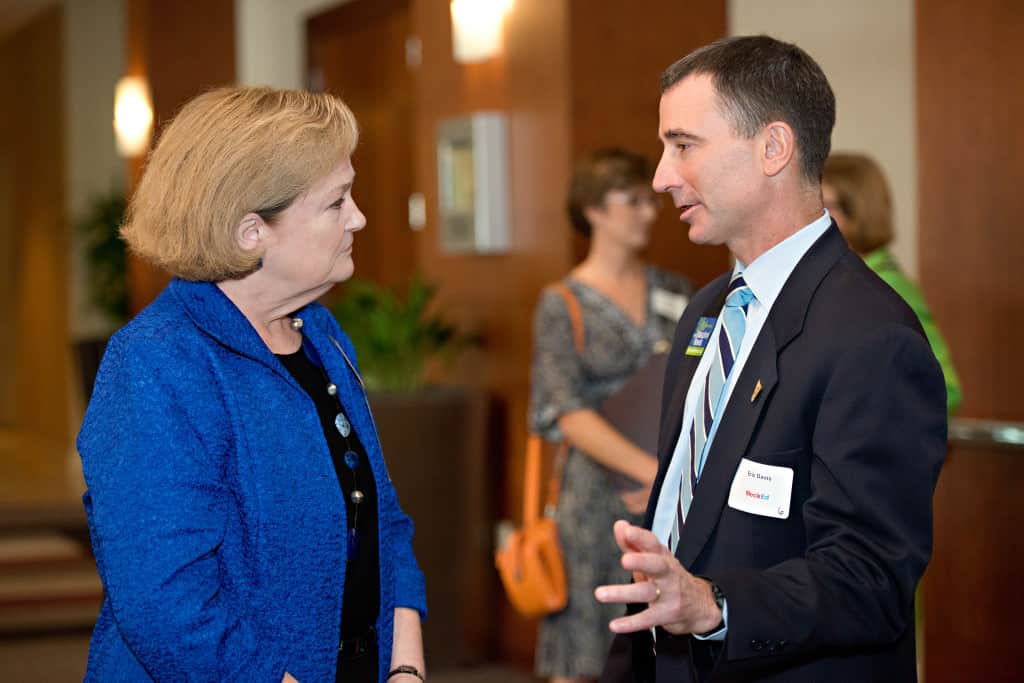
Eric Davis was at home, in the throes of the week-before-Christmas rush, when the phone rang.
On the other end of the line was Gov. Pat McCrory. Would you like to serve on the State Board of Education? McCrory asked. Three weeks later, Davis was in Raleigh, taking the oath of office and settling in for information overload during the two-day board meeting. Davis hadn’t been expecting the governor’s call.
“It must have been a Christmas present from him,” Davis said last week, laughing.
A “strong background” in oversight
Davis, a native Charlottean and West Point graduate, has served on the Charlotte-Mecklenburg (CMS) Board of Education since 2009, including a stint as chairman from 2009 to 2011. He is not required to leave the local school board to serve on the state panel, and does not plan to do so.
When McCrory announced the appointment, two days before Christmas, his office cited Davis’ “strong background in education oversight.”
He has developed a reputation as someone willing to dig deeply into his work not only to understand a particular issue—but also to understand its context, its place in the larger narrative of public education. Davis was critical of the way the CMS board handled the departure of former Superintendent Heath Morrison, and has pushed for changes to the district’s human resources policies, among others, in the wake of Morrison’s abrupt resignation.
Indeed, Davis’ experiences in Charlotte may prepare him well for what he will likely encounter in Raleigh. The Queen City’s education landscape reflects many of the top public school issues across North Carolina—from Common Core implementation to the growth of charter schools to challenges recruiting teachers.
“Mecklenburg County has a diverse constituency,” said Elyse Dashew, a public school advocate who has children in Charlotte-Mecklenburg Schools. “We’re a complex school system and Eric’s been through a pretty tough learning curve here.”
“Think about the bigger picture”
When Dashew first met Davis, in late 2009, her daughter’s middle school was at the center of a fight about a CMS cost-cutting plan that would change school bell schedules and cut transportation. The PTA was upset with the way central office staff proposed the changes. Davis, Dashew remembers, was willing to listen to the parents’ concerns and sought a compromise that would still save the district money while minimizing the impact on students.
“He kept admonishing us to think about the bigger picture,” Dashew said. Davis repeatedly told the parents to “balance what is best for your school with what is best for the whole system.”
Davis plans to use that approach while serving on the state board. His at-large seat means he is responsible for representing concerns from across the state, and while he believes his experience in Charlotte-Mecklenburg is an asset, he has been struck with the breadth of North Carolina’s statewide public education needs.
“We’re far from the spectrum of needs that cover our whole state,” Davis said. “There are 115 school districts and some of them are no bigger than one of [CMS’] high school feeder patterns. The state action, while it’s important to us in Charlotte, is even more so to most of the rest of the state.”
Davis said he is eager to tackle a handful of “challenges and opportunities” facing the North Carolina’s public schools, including charter school oversight.
He wants to seek more ways for charter schools and traditional public school districts to collaborate.
Mecklenburg County is home to the biggest surge in charter schools since the legislature lifted the 100-school cap in 2012. That decision was lauded as a way to jumpstart new and exciting ways to educate North Carolina children. Davis said he has been frustrated by the “inability to knowledge-share and tap into innovation by charters.” He wants to seek more ways for charter schools and traditional public school districts to collaborate.
He is prepared for long conversations about charter schools, partly because of his experiences in Charlotte; two charter schools have shut their doors in the last year amid financial and governance concerns. Davis said he is concerned about the extent to which the state is now providing schoolhouse-level management for some charter schools. “The state board is overwhelmed doing that,” he said.
Davis, like nearly all elected school board members in North Carolina, said he would like to see additional funding for teacher salary increases, particularly for veteran educators, but acknowledged that may be difficult this year.
He also wants to monitor the state panel tasked with reviewing the Common Core State Standards; CMS Deputy Superintendent Ann Clark, who is the acting superintendent following Morrison’s departure, serves on that panel. Denise Watts, who leads CMS’ innovative Project L.I.F.T. partnership, is also a member.
If Davis has learned anything from his five years on the Charlotte-Mecklenburg school board, it is how much information he must consume to stay knowledgeable about the wide range of issues education leaders need to understand. Fifteen days elapsed from the time McCrory announced Davis’ appointment to his first meeting. He knows his stack of “must-read” information grows by the day.
“I’m really drinking from the fire hose right now.”