
Brevard’s Through the Trees gives a second life to old devices, and a fresh start for neighbors who need them
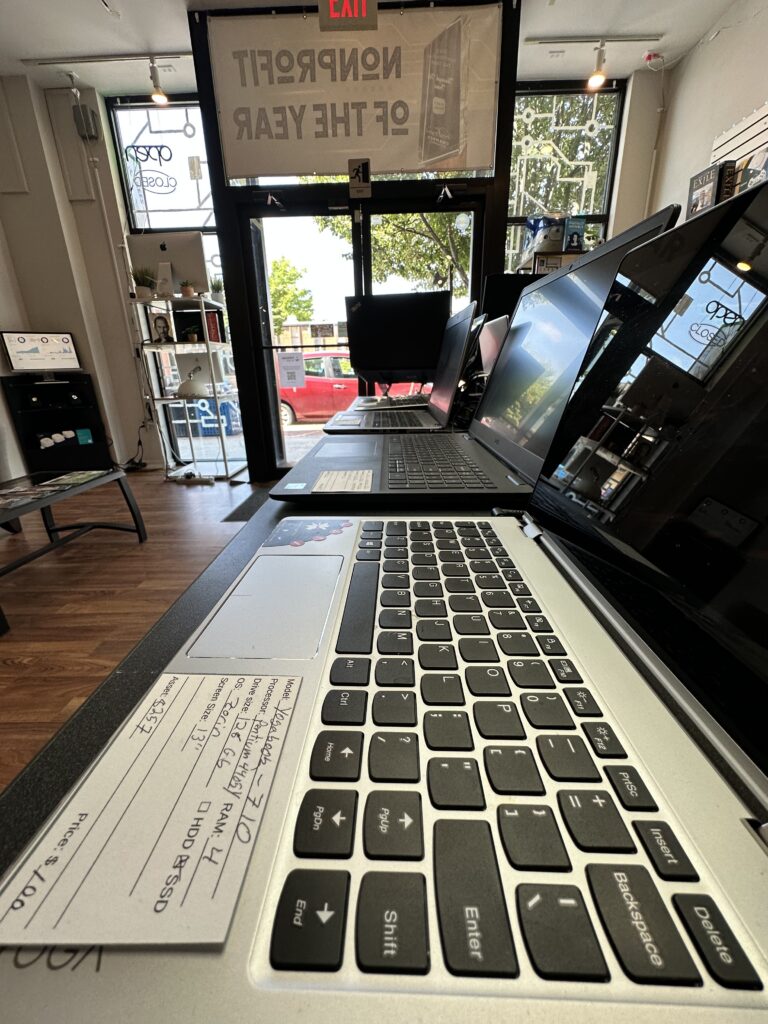
Walk into the Through the Trees storefront at 120 West Main Street in Brevard and the first thing you’ll notice is the gaming setup glowing in the window, and the circuitry painted across the glass. People slow down, peer in, and ask what exactly is going on in here.
Here’s how it works. The shop is a resale store — with refurbished laptops, tablets, and phones priced to be affordable — and anyone can buy one, which funds the mission. Getting one free is need-based: you qualify if you’re on a program like SNAP or Medicaid, a student on free- or reduced- lunch, a veteran, or unhoused. Those who qualify apply, join a waitlist, and pick out a device at no cost when their turn comes. Everyone else can still buy one, at affordable prices.
 Sign up for the EdDaily to start each weekday with the top education news.
Yvette Brooks, who founded Through the Trees and runs it as executive director, didn’t grow up in Brevard — she chose it, leaving Mesa, Arizona, with a “Goldilocks Town” list of what mattered most and a year in an RV to find the right fit.
She started the work in 2020, before it had that name. At the time she was managing the family resource center at SAFE, the local domestic violence agency — helping people file restraining orders, meet an attorney before court, and find housing and food. Then the pandemic hit and the phone stopped ringing. She kept thinking about the families she could no longer reach: parents leaving the workforce, and kids trying to get to school through a screen they didn’t own.
“There were a lot of families that had no internet access, or it was too expensive,” she said. The places they’d leaned on for free Wi-Fi were closing. Now they needed it at home.
So she started Through the Trees, refurbishing donated computers, first for Transylvania County, then Henderson and Buncombe counties. In April 2025, she moved into the Main Street store in Brevard, and the difference was immediate. She came in with 12 volunteers — now she’s up to 36. The old space, 800 square feet, meant packing one project away to start the next. Now, in the storefront, there’s room to refurbish, hold classes, and run a tech-help desk. Two full-time staff and four to six volunteers a day keep it going.
According to the nonprofit’s website, they’ve given away 1,650 devices and hundreds of hours of internet and digital literacy services to more than 2,300 people.
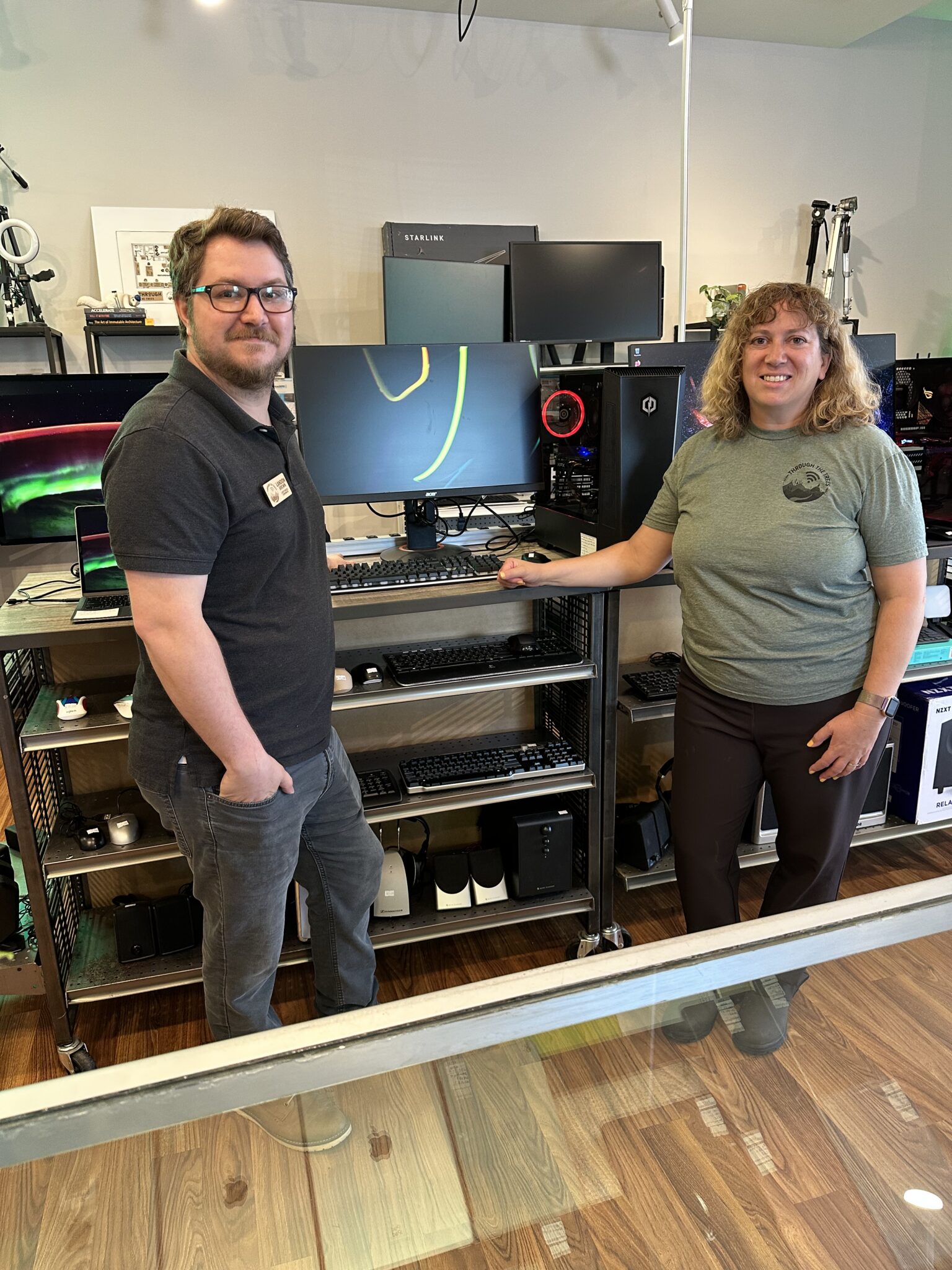
Landon Brown works the front. He spent eight years at the local Habitat for Humanity ReStore and walked in with no tech background at all. “I came here to try to learn something new,” he said. “And every day I’m here, I am learning something.”
A lot of his job is reassurance — seniors come in convinced their phones have been hacked — and a lot is managing the waitlist, around 40 people, mostly for laptops and cellphones. Phones are the tricky ones; they have to match a person’s carrier.
When people ask whether it’s safe to hand over an old device, Brown keeps the answer simple. “We do wipe everything before we do anything with it,” he said. A drill press takes care of the old hard drives — a newer degausser is cleaner, but the drill press has more flair.
The most common request Brooks fields? Someone who wants to go back to school, headed to Blue Ridge Community College, and needing a computer to start. “If I look at all the requests we’re getting, that’s the most common,” she said.
So she’s been building partnerships with the county schools, social services, and community colleges, where students might one day earn credit refurbishing alongside her crew.
That instinct — local work, bigger table — is how Brooks ended up in Washington, D.C., this spring. Through the Trees is part of the National Digital Inclusion Alliance, a nonprofit that helps communities close the digital divide, or the gap between those with a working device and reliable internet and those without. By one estimate, more than 1.1 million North Carolina households can’t afford or reach broadband.
In December, the national alliance launched its first Connectivity Policy Corps, a small group of advocates from 14 states trained to bring local stories into federal policy. North Carolina sent Brooks and Durham’s Kramden Institute, a refurbisher of more than two decades. They spoke at the offices of U.S. Sen. Ted Budd, R-North Carolina, and U.S. Rep. Tim Moore, R-North Carolina, the Federal Communications Commission (FCC), and at the Pew Research Center. She and two other refurbishers stood together and made a unified case for mitigating the digital divide.
The story she carried wasn’t a happy one. Last year, Through the Trees was a partner on a $7.7 million Digital Equity Act grant through the Land of Sky Regional Council; her share would have been $750,000. Then the federal government terminated those grants, and the money — hers, and the wider state funding alongside it — vanished. “We’re going to still do the work,” she said. “Just much slower.”
Brooks brings up the lost grant on purpose. The money’s gone, but the award was proof that someone had looked at Through the Trees and decided the work was worth investing in. The budget runs now on local and regional grants, including a few that have come through every year since she got her nonprofit status. And, she said, helping doesn’t always take money.
“Their old electronics can do more than gather dust,” she said of potential donors.
Donate a laptop or a phone you’ve stopped using, and it gets wiped, refurbished, and handed to a neighbor who needs it. The shop is open Wednesday through Saturday on Main Street in Brevard. Brooks thinks every community ought to have one. Stand in the doorway a while, watch who walks in, and it’s hard to disagree.
For more details or to make a contribution visit the nonprofit’s website.