
Governor McCrory signs budget providing monumental teacher pay increases and tax relief for middle class families

The following is a press release from Governor Pat McCrory
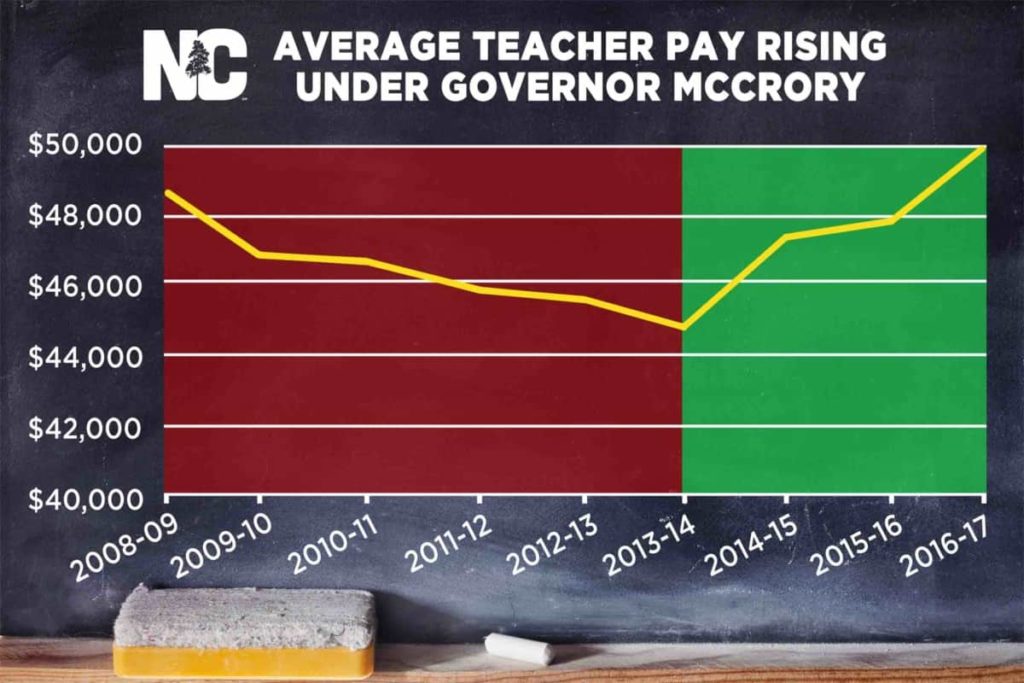
Average teacher pay in North Carolina will be more than $50,000 for the first time in state history under North Carolina’s newest bupresdget signed today by Governor Pat McCrory. The governor signed the $22.3 billion state budget today surrounded by teachers, local elected officials and legislators at Shiloh Elementary School in Union County. The budget makes key investments to strengthen education, provide tax relief for middle class families, make college more affordable and improve the health of our communities and bolster the state’s savings reserves.
“This budget further fulfills my vision to increase average annual teacher pay to $50,000 for the first time in state history, provides a middle class tax cut, makes college more affordable and makes much needed investments to improve mental health services, all while strengthening our position as one of the fastest growing economies in the nation,” said Governor McCrory. “We look forward to building on our successes through these important investments for North Carolina’s future.”
The highlight of this year’s budget is investing in North Carolina teachers to ensure it recruits and retains the best and brightest to prepare students for future success. Teachers will receive an average 4.7 percent pay increase, bringing average teacher pay in North Carolina above $50,000 for the first time in state history. When considering robust health and retirement benefits offered to every full-time teacher in our state, the budget will boost average total compensation to more than $67,000. Teacher pay in North Carolina is growing faster than in any other state in the country under Governor McCrory’s leadership. Since 2013, North Carolina has invested more than $1 billion in new funding for teacher raises.

The budget also provides funding to empower schools to trade textbooks for tablets so students can learn anytime, anywhere using the latest information available. When Governor McCrory entered office, just 22 percent of classrooms were connected to robust Wi-Fi. Investments included in the budget will help ensure 100 percent of classrooms are connected to Wi-Fi by 2018. The budget also increases funding in textbooks and digital resources, which has now tripled under Governor McCrory’s leadership to $71.5 million.

Additionally, the budget builds on the governor’s record of pro-growth tax reform by providing a middle class tax cut anticipated to save taxpayers $132 million over the next year. By increasing the personal income tax standard deduction by $2,000 for married filing jointly and proportionately for other filers, the budget puts more dollars in the paychecks of North Carolinians and eliminates income taxes for approximately 75,000 taxpayers.
To further support North Carolina families, this budget makes college more affordable. Starting with students entering this fall, this budget will freeze undergraduate tuition for students at all University of North Carolina schools who graduate in four years, or five years for those in five-year programs. Fee increases are now capped at 3 percent annually and tuition is dropped to $500 per semester for in-state students at Elizabeth City State University, UNC-Pembroke and Western Carolina University.
The budget also upholds Governor McCrory’s philosophy of helping those who can’t help themselves while encouraging those who can. The budget fulfills the governor’s call for much needed investments to help those with mental health and substance use issues across the state by investing $20 million to implement recommendations of the Governor’s Task Force on Mental Health and Substance Use.
The bipartisan budget grows responsibly by 2.8 percent, which is more slowly than the rate of population plus inflation and is balanced, consistent with the state constitution and responsible governance. In line with responsible fiscal management, the budget invests $473 million in the state’s rainy day fund, bringing the reserve to an all-time high of nearly $1.6 billion.