Update: The North Carolina House Select Committee on Property Tax Reduction and Reform has recommended a state constitutional amendment that would place limits on local property tax increases. If passed by the General Assembly this session, the amendment would be placed on the statewide ballot in November.
Ahead of the legislative short session, conversation in North Carolina is buzzing around property taxes. The taxes, which are levied by county and municipal governments on property owners, represent a “burden,” according to Senate President Pro Tempore Phil Berger, R-Rockingham, who said in February that he plans to file a bill that would halt property tax revaluation changes for 12 months.
“North Carolinians are shouldering the burden of massive increases in local budgets,” Berger said in a press release. “It doesn’t matter to our citizens if a tax is paid to the state or a local government; it’s their money coming out of their pockets.”
In the other chamber of the General Assembly, Speaker of the House Destin Hall, R-Caldwell, stood up the House Select Committee on Property Tax Reduction and Reform (PTRR Committee) in December. The committee has discussed amending the North Carolina constitution to require the General Assembly to limit local property tax rate increases.
Rep. Brian Echevarria, R-Cabarrus, said at a PTRR Committee meeting that North Carolinians are being forced to sell their homes and it is state legislators’ duty to “protect our neighbors.” He said increases in property taxes — spurred by higher tax rates and increasing property values — have exceeded inflation, and year after year, taxpayers are “losing.”
“Who is winning? Not the homeowner, not the business owner, not the renter. On this property tax issue, North Carolinians are not winning,” Echevarria said.
But lower property taxes — especially in conjunction with federal cuts and uncertain state funding — could represent losses to students and communities. North Carolina public schools receive more than $4 billion in local funds, the majority of which come from property taxes. As the primary funding source for local governments, property taxes also fund infrastructure, public safety, and other essential services.
Who will win, and who will lose, if local funding to schools declines?
 Sign up for the EdWeekly, a Friday roundup of the most important education news of the week.
Property tax crash course
Property taxes are levied annually on real estate and other property — think of the annual tax you pay if you own a vehicle or home. The amount taxpayers owe depends on the value of their property and the rate at which it is taxed, set by their county government.
The average county property tax rate was $0.58 per $100 of value in fiscal year 2025-26. See all county property tax rates on the North Carolina Department of Revenue website.
Property taxes make up most of the money in county budgets, which fund programs such as public schools, parks, environmental departments, police and fire departments, health departments, and many other social services.
See Mecklenburg County’s budget, for example. Property taxes contribute 58.7% of the county’s revenue, followed by sales taxes, fees, and other sources.
Fast-rising property values, higher tax bills
According to Zillow, the average home value in North Carolina is down slightly over the past year, but the value of land and housing is rising quickly in pockets of the state. In Wake County, for example, residential properties rose an average of 53% in tax value between 2020 and 2024.
Under the state’s Machinery Act, all property must be revaluated at least once every eight years, but counties have the option to revaluate more often. In fast-growing areas, such as Wake County and other places with rapidly changing property values, revaluations occur more often. Wake County has lowered its reassessment interval from four years, to three, to two.
A higher property value appraisal means a higher tax bill if the tax rate goes unchanged, but some counties have adjusted their tax rates to remain revenue neutral year-to-year as property values rise, mitigating the cost for property owners. Meanwhile, as property values increase, owners’ equity grows.
According to The Tax Foundation, local governments in North Carolina offset more than half of the potential revenue gain through lower tax rates between 2018 and 2023.
What is being proposed?
Berger’s proposal, which has yet to be filed as a bill in the General Assembly, is for a 12-month moratorium on property tax revaluation. “This action will pause any proposed property value adjustments prompted by a county property tax revaluation,” a press release from his office said.
During that time, the legislature “can examine and adopt needed property tax reforms.”
The PTRR Committee, meanwhile, has floated a constitutional amendment that would require the General Assembly to limit property tax rate increases.
There is already a limit on the property tax rate that counties can instate, but it could theoretically be repealed; the constitutional amendment would require a limit to be set. The current maximum rate is $1.50 per $100 of property subject to taxation, and the highest tax rate in the state is currently in Scotland County at $0.99 per $100.
Three-fifths of both chambers would need to vote for the amendment, and then a ballot measure would need to be passed.
The committee has also discussed fixing property tax loopholes and filed bills to do so. One such loophole related to affordable housing is taking away millions of dollars from Wake County this year.
Both the moratorium and constitutional amendment could affect the amount local governments can collect in future years. Some lawmakers have said local spending needs to be reined in.
“How do we come to a point where it forces our municipalities to relook at what they’re spending on?” said Rep. Jeff Zenger, R-Forsyth, at a PTRR Committee meeting. “How do we make it so that it doesn’t just absolutely crush our people when they get these tax bills?”
Read more about 2026 legislative priorities
Property taxes fund public schools
If property taxes bring in less revenue, what does that mean for public schools?
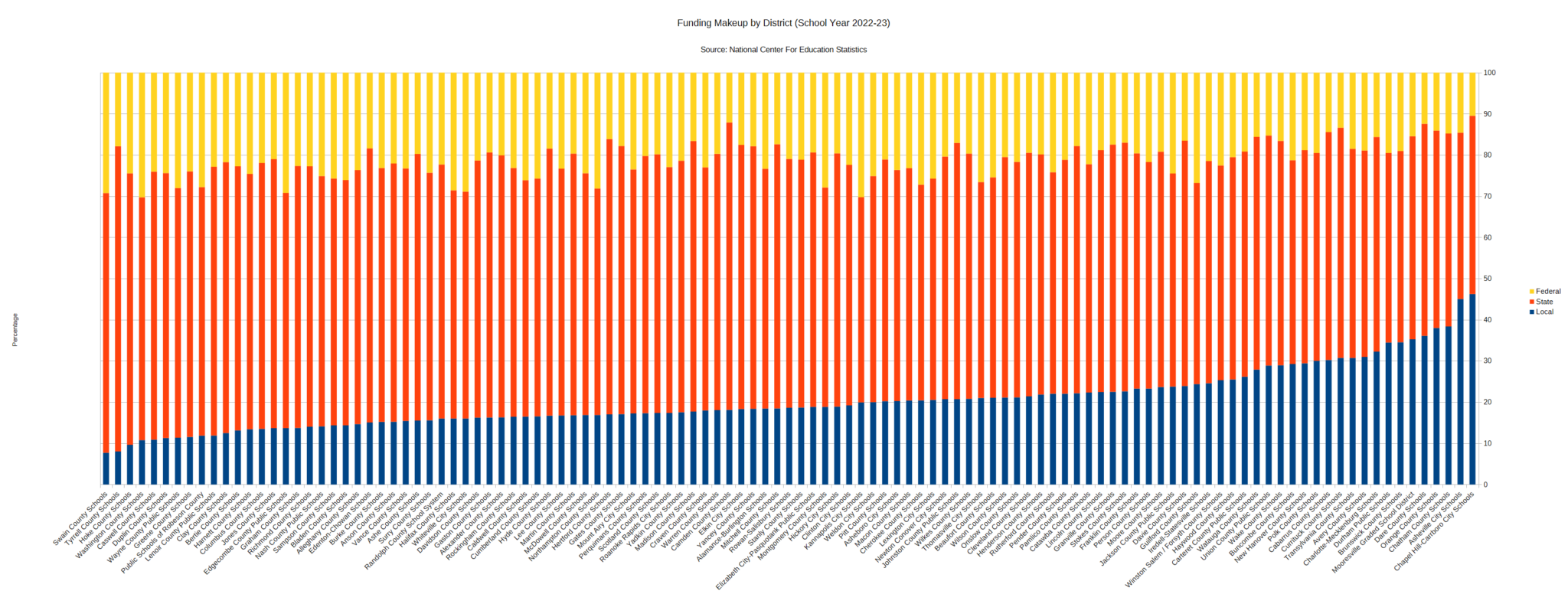
Public schools in North Carolina are funded by a mix of federal, state, and local dollars. The state provides most of the funding, followed by the federal government, with local funding usually being the smallest category according to data from the National Center for Education Statistics (NCES).
However, the proportion of local funding varies widely by district. On average, about 20% of North Carolina school district funding was local in the 2022-23 school year, but Chapel Hill-Carrboro City Schools gets about 46% of funding locally whereas Swain County Schools gets less than 8% of funding locally.
Property taxes are the largest revenue stream for local funding allocated to public school districts — funds go toward school facility maintenance and renovation, classroom supplies, and teacher salary supplements.
A decrease in property tax revenue for counties could mean lower allocations to school districts. In North Carolina, school districts don’t have the authority to levy taxes, so their funding is dependent on allocations from county commissioners.
Low Wealth Counties Supplement
Shifts in property values also introduce funding uncertainty for school districts due to how supplemental funding for low wealth counties is distributed.
A formula distributes this supplemental state funding to school districts based on a few factors including anticipated county revenue, tax base per square mile, and per capita income.
As property values rise, districts could potentially lose low wealth supplemental funding because the funding is distributed relative to other counties. The formula favors counties with less “ability to generate revenue.”
In 2025, Gaston County Schools froze hiring after losing $7.2 million in low wealth supplemental funding amid a rise in property values.
See how much each school district receives as part of the low wealth supplement on the Department of Public Instruction’s (DPI) allotment data website.
Other tax revenues are also declining
Amid potential limits on local property taxes, other taxes in North Carolina have been cut in recent years, and more decreases are on the horizon.
The corporate income tax rate, previously the lowest in the nation among states that collected corporate income taxes at 2.5%, is being phased out entirely by 2030.
And the personal income tax rate is also decreasing. A state budget passed in 2021 laid out a schedule to bring the personal income tax rate down from 5.25% to 3.99%. North Carolina forecasted a budget surplus this year, which could trigger a reduction to a 2.99% rate by 2028.
Gov. Josh Stein said in a press release that these income tax reductions could yield a $3.4 billion revenue loss by fiscal year 2028.
“Today’s forecast means that we will soon fall into a budget gap of at least $2.8 billion, causing the state to have to make painful cuts to critical services like public safety, education, and health care,” Stein said in the press release. “There is still time to act to keep up North Carolina’s positive momentum.”
Last year, no state budget was passed because of an impasse between House and Senate Republicans. One of the main sticking points is the triggers that would reduce the state personal income tax further and represent a loss of billions in revenue for the state.
Schools already facing harsh financial environment
According to NCES data, North Carolina public schools already receive fewer local funds than schools in other states. The average local revenue per North Carolina pupil in fiscal year 2021-22 was $2,895, compared to a national average of $7,419.
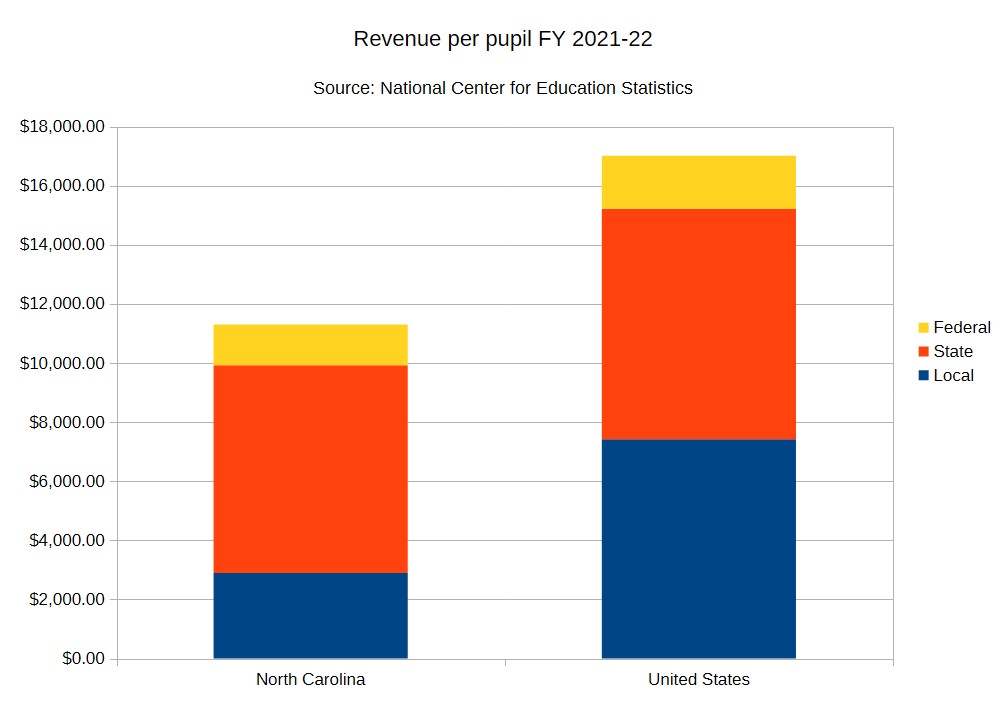
If local allocations decrease, school districts would need to receive more money from the state and federal government to maintain the same funding level. That seems unlikely; over the last year, school districts have seen cuts to federal education grant programs and no pay raises for teachers after the General Assembly failed to pass a state budget.
It remains to be seen if a budget will be passed during the upcoming legislative short session that begins in April. Meanwhile, schools are already budgeting for the 2026-27 school year.
“For the state and federal funds, one of the big difficulties this year has been unpredictability,” said Amanda Fratrik, business systems manager at DPI.
School districts negotiate with their counties and plan their budgets for the following school year in the spring, meaning they are doing so right now without knowing what kind of funding they may receive from the state. Fratrik said DPI gives information to school districts that assumes a continuing resolution — what would happen if no state budget is passed again.
She said that forces districts to plan conservatively. Being conservative means potentially cutting programs, offering teachers less money, and filling fewer teaching positions. By the time a state budget is potentially passed, the school year will be fast-approaching or already underway; teachers will be hard to hire.
Fratrik said that even putting the uncertainty of the state budget aside, 105 of the 115 North Carolina school districts are facing declining average daily membership (ADM). Lower ADMs mean less state money going to school districts.
Relatedly, EdNC previously reported on a Carolina Demography analysis that forecasted a possible drop in public school enrollment in North Carolina over the next five years due to the Opportunity Scholarship Program, which provides private school vouchers.
What will schools and school districts do?
As funding decreases, school districts face difficult decisions on cuts to programs and services. Many school districts are already facing hard choices this year.
To name a few:
- Wilkes County Schools is facing a funding cliff;
- In Haywood County Schools, 27 teaching positions were threatened by cuts;
- Wake County Schools considered cuts to special education and higher school lunch prices.
- Durham County Schools projected a loss in state funding and, with that, 61 classroom teacher positions.
Many school districts are also facing declining fund balances, which operate like savings accounts for local funding. That could restrict options if funding dries up or in the case of emergencies.
School districts such as Chapel Hill-Carrboro City Schools have proposed closing schools as a way to save on costs amid enrollment declines. Fratrik said school closures will likely become more common if funding declines.
Asked if there are any strategies districts could employ in the face of three-pronged funding pressure — local, state, and federal — Fratrik said closing or merging schools may be districts’ best option, as it could reduce capital costs while retaining some personnel.
“But as far as magic bullets or special tricks, I’m not sure I have any,” she said.

Recommended reading