
Perspective | Students find shared humanity and deepened learning through bilingual performance

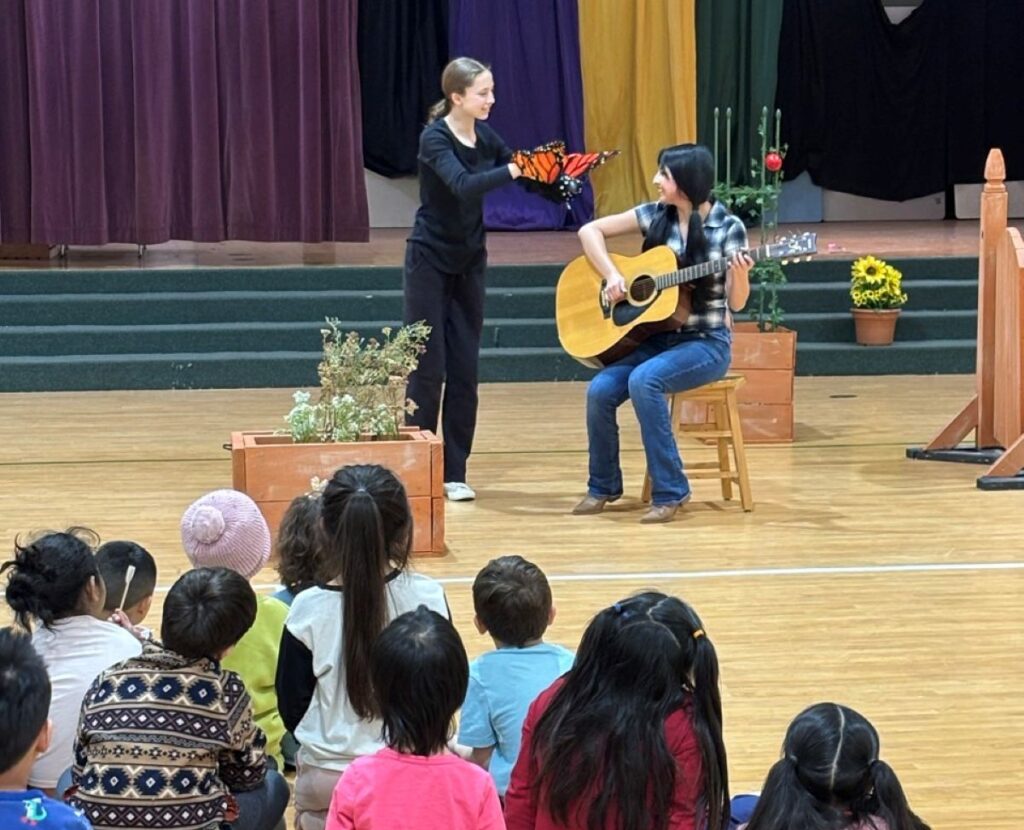
As kindergarten and first grade students file into the gym at New Hope Elementary in Orange County on a brisk winter morning, an excited buzz of young voices fills the air. For many of these students, it is their first time attending a live performance of any kind.
Meanwhile, students from nearby Orange High School’s theater and band programs, ready after weeks of rehearsal, head to their places with anticipation. For many of the high school students, it’s the first time performing a play for such a young audience.
For all of the students involved, regardless of age, it’s not only a shared day of “firsts,” but a day of deepened learning made possible by the art of live theater.
The show, entitled Mariposa/Butterfly, co-written by Sandra Fenichel Asher and Jose Casas, follows two neighbors — one a first-generation immigrant who speaks mostly Spanish, and the other a multigenerational Texan who speaks mostly English. When a butterfly arrives and takes up residence between their yards, a rivalry emerges as the neighbors argue, sometimes to comedic effect, (albeit with a language barrier) over who gets to claim the butterfly as their own.
Eventually, the butterfly departs for its seasonal migration leaving the two neighbors saddened by their loss and with the realization that the butterfly was never theirs to “own” in the first place. In its place, however, is the discovery of a new friendship rooted in their love of the butterfly and a shared understanding of both each other and the beauty of the world the two neighbors share.
As the show begins, the room immediately falls to a hush as a flute flourish, played from offstage by a member of Orange High School’s band program, signals the arrival of the butterfly, portrayed with a dance-like gracefulness by a puppeteer. The story unfolds, with the characters speaking in both Spanish and English, navigating the language barrier with a combination of facial expressions and nonverbal communication. The students’ attention is captivated as the butterfly silently, and sometimes playfully, floats and darts between the two yards, seemingly oblivious to the rivalry that its presence has prompted, its movements punctuated by expressive music from the live musicians.
As the butterfly departs for the final time and exits through the audience, the students’ attachment to the character is evident as they turn to watch it go, as if saying goodbye to a good friend.
 Sign up for the EdDaily to start each weekday with the top education news.
On the surface, the story is a simple one: two strangers who learn to appreciate their differences and become friends. But on a deeper level, when presented through the medium of theatrical performance, the story captures the relationship in the way that real life often happens — in the unspoken moments, large and small, where words are insufficient or perhaps even unnecessary.
Just as the neighbors find connection in ways that go beyond language, the students in the audience learn to understand and care for the butterfly, even as it never utters a single word during the entire performance. Live theater shows us that we have the ability to connect with others, even if we cannot always communicate with words.
As New Hope principal, Dr. Meredith Maier, noted, “One of the most powerful aspects of the performance was the embedded accessibility for all learners; the high visual content, live action, and live music supported a wide range of ages, languages, and abilities. The performance was also particularly impactful for our dual language students, as the combination of expressive visuals and physical storytelling supported comprehension beyond verbal communication, and allowed students to connect deeply with the experience.”
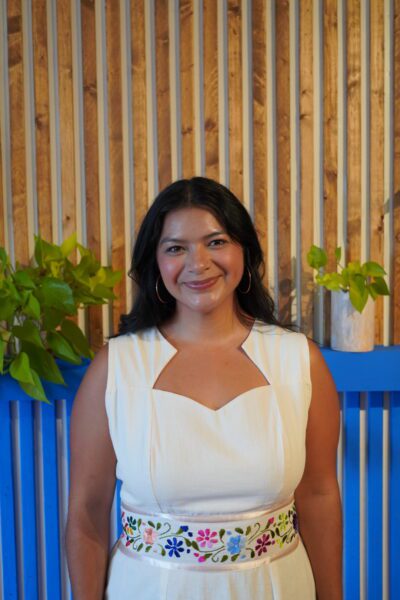
The value of the performance extended beyond storytelling, comprehension, or even accessibility. The performance was also a powerful testimony to the power of representation. During the performance, one could see many students turn with pride to their neighbors when they heard Spanish being spoken on stage, eager to share their understanding with their classmates. And during a post-show meet-and-greet, one young student eagerly approached the high school performer who played the Spanish-speaking neighbor (junior Brianna Olguin Hernandez), and proudly noted with a smile, “I speak Spanish too!”
Read more

Importantly, however, the learning was not limited to the elementary students in the audience. The high school students gained valuable insights into their performances, learning how their choices affect audiences, especially young ones.
“I learned that my acting choices shifted when performing in front of kids,” noted junior Daphne Tyll. “One of the challenges with the show for me personally, was trying to clearly portray the neighbors’ relationship and how it evolved throughout the play in a way that the students could follow easily.”
This meant really delving into the finer physical details of the performance and clarifying each character’s intentions from moment to moment. Performing children’s theater, therefore, required even greater sensitivity and attention to detail, rather than less, as some may assume.
In a time when arts programs are often viewed as “extras,” this production illustrates that theater — and the arts more broadly — can often provide a crucial link between topics and human experiences that deepens students’ ability to grasp important concepts.
Along the way, it serves to remind us of our shared humanity.
“I am so thankful that I did this show because it was an amazing experience and it gave me a new perspective of theater, and (this play) gave the message that theater is for everyone,” Tyll said.