For Anthony Jackson, it was no surprise that a North Carolina-educated astronaut was onboard NASA’s Artemis II mission, which earlier this week discovered previously unseen parts of the moon and marked the farthest humans have ever traveled into space.
“North Carolina has the talent, the resources, and the values to lead the Southeast and the nation in educational outcomes,” Jackson, the incoming CEO of the Public School Forum of North Carolina, said during an event on Tuesday.
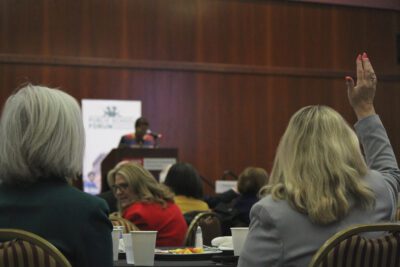
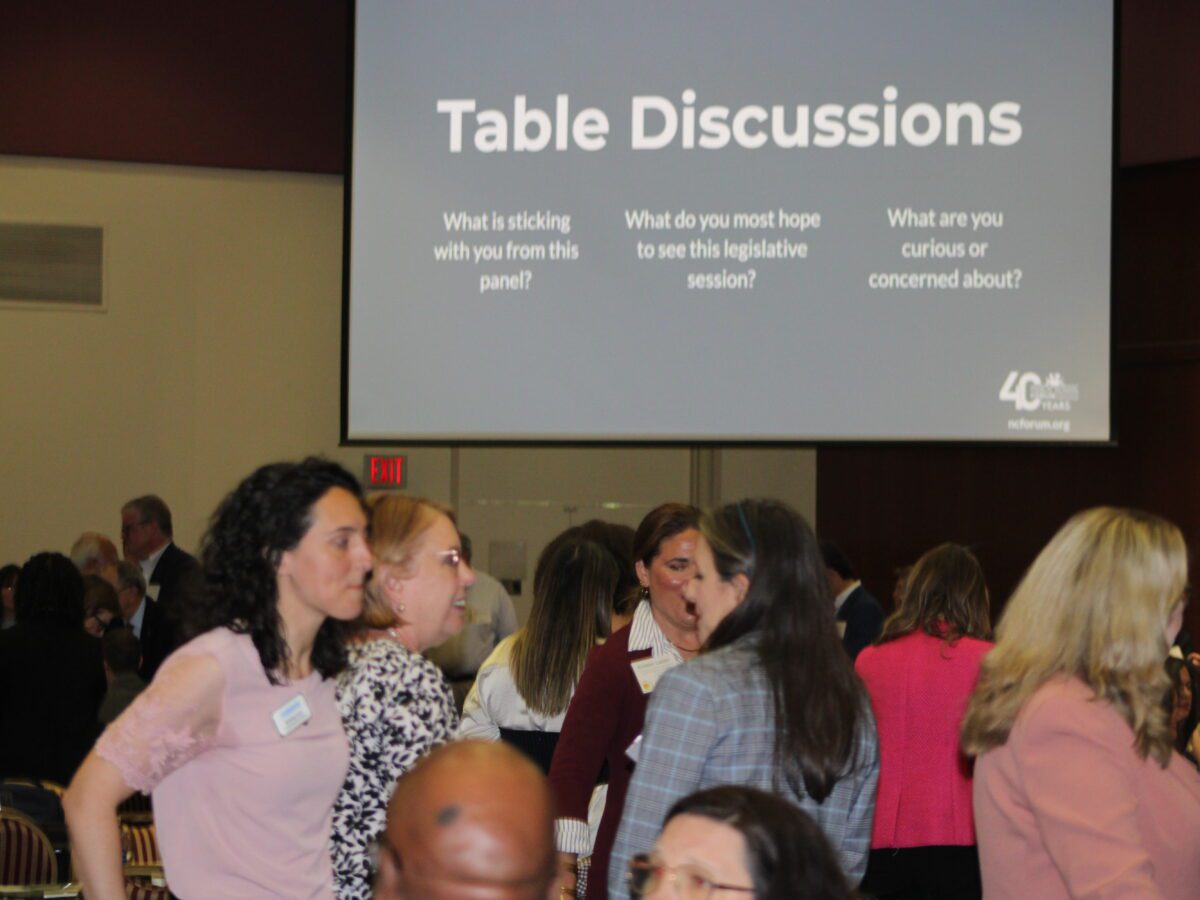
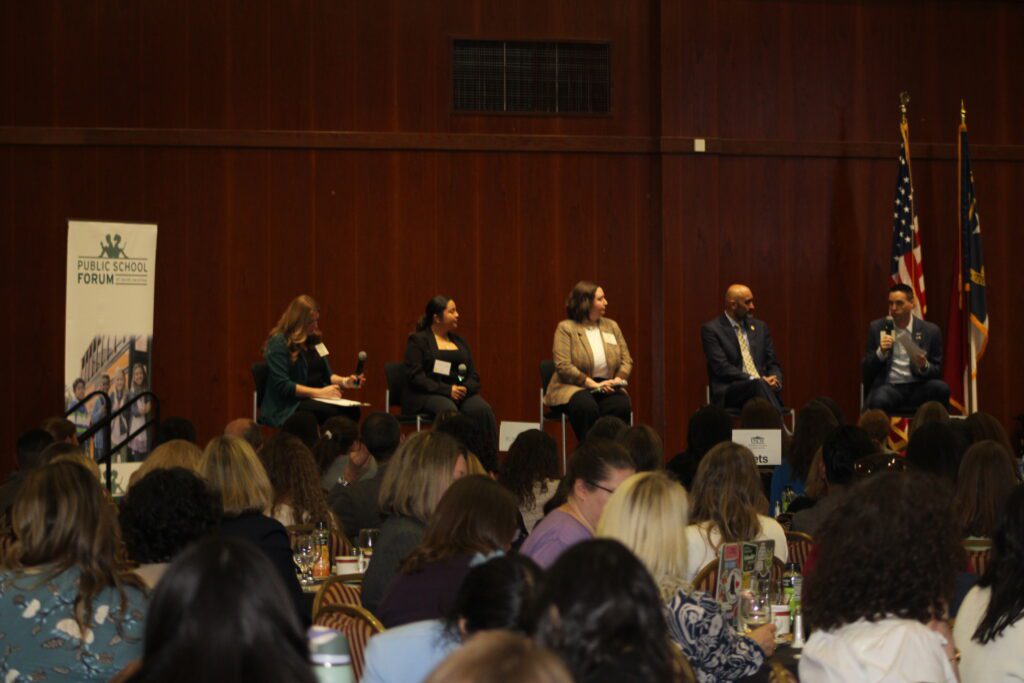
His statement was one of many made by stakeholders at the Forum’s annual Eggs and Issues breakfast, held this year on April 7. This year’s event covered subjects from school funding and teacher retention to supporting child well-being and educators being their own advocates.
 Sign up for the EdDaily to start each weekday with the top education news.
Among those topics, one of the most pressing items was that North Carolinians are awaiting a state budget from the General Assembly.
North Carolina was the only state to not pass a budget for fiscal year 2025, and teacher salary increases and tax cuts are at the root of the divide between the House and the Senate. EdNC’s previous coverage of both proposals can be found below.
Read more
At the beginning of each legislative session, the Forum outlines for Eggs and Issues attendees priorities they believe should be addressed in the upcoming session’s education policy decision-making.
Here are the four top education issues the Forum named:
- Ensure our school funding system is equitable, adequate, and flexible to meet students’ needs.
- Make educator pay competitive in North Carolina.
- Address critical needs to support child well-being and success in and outside of school.
- Adopt assessment and accountability policies that are fair and effective.
The Forum’s 2025-26 report found that minimal or no progress had been made on their policy recommendations. Lauren Fox, interim director of the Forum, said this was a critical time to collaborate.
“We’re here today because we know that supporting our public schools isn’t a partisan or political issue, and it’s not optional. It’s an absolute necessity, and it requires all of us to come together, no matter our role,” Fox said.
More details about progress made toward each of these priorities can be viewed in the report here.
Several attendees told EdNC the Forum’s priorities are “right on track,” with Elaina Irving saying students need to have the “platform to use their voice.” Another attendee, Sean Bulson said, “It’s time for the legislature to put these kids first again.”
Referring to legislators, attendee John Hensley, a Southeast Raleigh Magnet High School teacher, said, “It’s frustrating … we still don’t have a budget, and the problems that have persisted have been with us for 15 years.”
Bright spots and good news
Fox also named things the state can be proud of when it comes to our public schools. Among those is the success of the NC College Connect program, a record number of public school students passing college-level courses, and leading the country in number of national board-certified teachers and CTE credentials.
Throughout the event, attendees also heard presentations from students about school programs they were proud to participate in.
Three students from Durham Public Schools spoke about their experience in the City of Medicine Academy’s Science Sidekicks program. The program gives high school students the opportunity to teach elementary school students about STEM.
Student Chinaza Okpalakunne said a goal of the program is to, “address chronic absenteeism in schools. During Science Sidekicks Days events, students participate in these experimental lessons. This shifts school from a place of obligation to a place of discovery and curiosity.”
Odaly Torres-Herrera, a Wake County Public Schools System student, shared the impact of being on the high school media team. Torres-Herrera described the club as being similar to a yearbook club, but there is no class dedicated to it. The students hope to use their content to counteract the negative media attention schools sometimes get during isolated incidents.
“When we publish content showing students participating in academics, excelling in the arts, creating projects, or simply supporting one another, we counter misrepresentation with real and authentic stories,” Torres-Herrera said.
Students from Washington High School who participated in a local Mayoral Forum talked about the importance of civics education. The group holds events to keep students informed about history and the current political environment so they leave as prepared citizens, students said.
“It is one thing to sit in a civics class and learn about it, but it’s a whole entirely different thing when you go out and you put yourself and your knowledge toward the betterment of the community, on whatever scale that may be,” said Jasmine Figueroa, a student speaking on behalf of the group.
Looking ahead to the short session
A panel of legislators discussed revenue, spending, and policy priorities going into the legislative short session — which is scheduled to last between April 21 and June 30.
To begin, Rep. Brian Biggs, R-Randolph, said it was important to mention the ongoing needs of western North Carolina after Hurricane Helene.
“It’s a complex issue. We’ve got a $34 billion budget, and you say, ‘Well, that’s a lot of money.’ Well, western North Carolina has a $60 billion problem right now,” Biggs said. “I’m saying that it all comes into play when you’re dealing with those issues.”
Rep. Heather Rhyne, R-Lincoln, mentioned her past experience of building relationships to accomplish objectives on the Lincoln County Schools Board of Education. As for at the General Assembly, Rhyne said that, “Blame is the parking brake to change.”
Some education-related items Rhyne mentioned advocating for were increasing teacher pay, expanding advanced teaching roles, and the ApprenticeshipNC program.
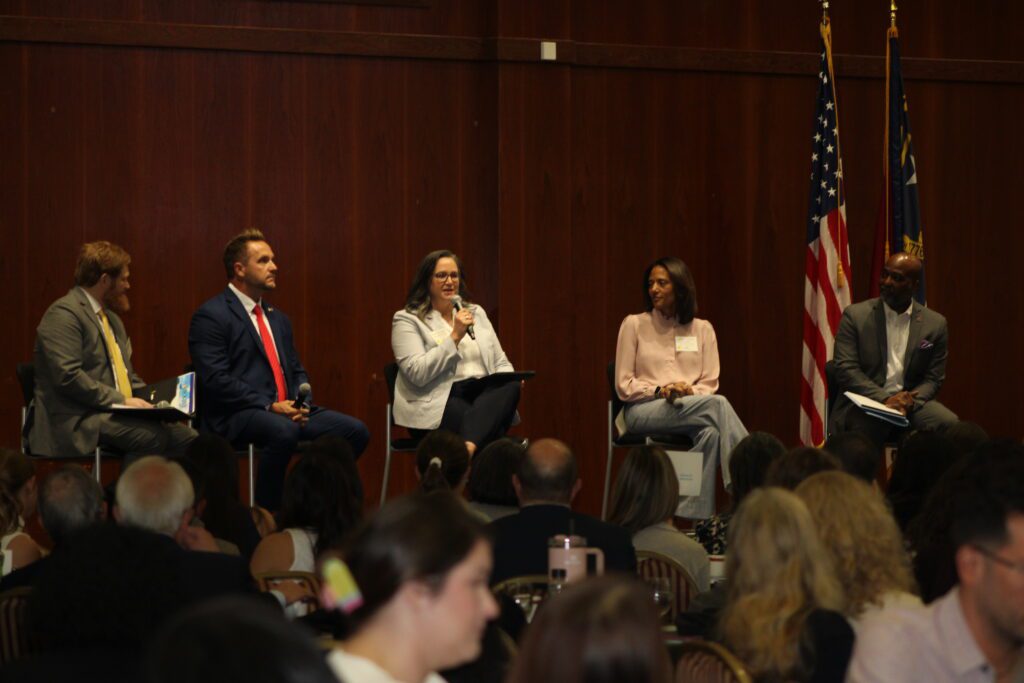
Teacher pay is also a concern for Senate Democratic Leader Sydney Batch, D-Wake. She drew several comparisons between how teachers are compensated in N.C. public schools and how they would be compensated in another state, or even the private sector.
“We have CTE teachers that can make three times the amount of money if they leave the classroom and go into private service, right?” Batch said. “You can be a welder and make $200,000 — but they’re sitting here making $50,000 teaching our students. And so we have to give people the respect that they deserve.”
For Rep. Zack Hawkins, D-Durham, the recruitment and retention of a diverse group of educators was top of mind.
“What is good for the recruitment and retention of teachers of color is good for all teachers,” Hawkins said.
The legislators said they hope now that the primary elections are over in North Carolina, it will make it easier to come to an agreement on a state budget.
Read more

Forming connections as advocates
Later in the program, another panel spoke about advocating for education policy changes in their perspective roles.
A through line for the panelists was taking advantage of the opportunities to advocate when they have them.
Ashtyn Berry, who was Southwest Regional Teacher of the Year in 2022, talked about multiple tiers of contact for reaching out to legislators. This could look like inviting them into the classroom, visiting them in Raleigh, or events such as board meetings and Eggs and Issues.
“This is the partnership. You can’t just build the bridge. You have to maintain the bridge, and you have to use the bridge,” Berry said.
At the state level, N.C. State Board of Education Director Rupen Fofaria said one of the barriers to advocacy is the complexity of the process. It can be difficult choosing which space to start with; between elected officials, a state board of education, 115 school boards of education, and over 200 charter school boards, Fofaria explained. At the same time, Fofaria said there is currently not as much collaboration happening across party lines or legislative chambers.
“What gives me hope in all of that is that student voices differ. It is the direct experience of those living in our public school system,” Fofaria said. “It is the experience of those who we have designed the system to benefit, and that authenticity can cut through the noise.”
In Monserrat Castrejon’s view, students can advocate for themselves. The North Carolina School of Science and Mathematics student said that they just need mentorship and inspiration to do so.
“At the end of the day I do think that yes — teachers understand a lot, but students can be the best advocates for themselves,” Castrejon said. “We need the space to do that”
Panelists also briefly discussed the impact of the Community Schools framework. Community schools serve as a hub for resources within their locale. The Forum recognized the framework’s implementation in 28 school districts as a “bright spot” that addresses critical needs to support child well-being.
For Jamie King, Sampson County Schools superintendent, parents should not have to go to five or six places to get community assistance. He said the framework “allows communities to help the design process of their school, and then really gives staff the resources that they need to help kids.”
Read more
An example of what their district has done with the framework is a plan for a day of service for the community. The district asked students to sign up and spend a day with local businesses to help with tasks like stocking or “beautifying” their properties.
At the end of discussion, panelists agreed that advocacy was a collaborative process.
Reactions to Leandro ruling
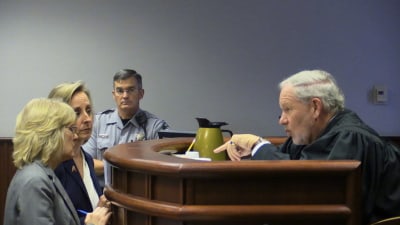
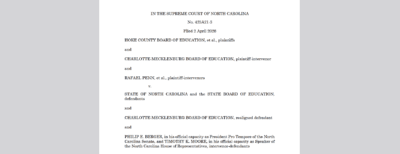
Last Thursday, the North Carolina Supreme Court, in a 4-3 opinion, issued their decision on the Leandro litigation. There was no possibility to address procedural flaws identified by the court. It also ruled that the 2022 Supreme Court Leandro IV ruling was void with no binding legal effect.
“I’m disappointed, not discouraged,” Bill Harrison, chair of the Forum’s board of directors, said in his address to the audience. “I’m optimistic, because the ruling does not change the fact that there remains a constitutional obligation for the state to provide sound, basic education. I’m optimistic, because of the thousands of competent, caring, and committed educators.”
Ann McColl, an attorney and constitutional scholar who previously served as interim director of the Forum, gave a rundown of the decision to the audience.
“Please make no mistake, this was a political decision cloaked in procedural language,” McColl said.
McColl’s reporting on the recent opinion can be read here, along with her perspective on the ruling here.
The full report of the Forum’s top education issues of 2026 and previous years can be found on their website.

Recommended reading