
Family Forward NC® Summit celebrates family-friendly business practices, highlights need for child care support
More than 100 business leaders from across the state came together in High Point on Wednesday to recognize the family-friendly policies they’ve already adopted, and learn more ways they can support working families.
The event was organized by Family Forward NC®, an initiative administered by the North Carolina Early Childhood Foundation (NCECF). Businesses and communities that participate can earn a Family Forward NC certification, recognizing businesses that offer a full suite of family-friendly benefits.
Examples include paid family leave, scheduling practices that accommodate family needs, health and wellness benefits, child care support, and accommodations for pregnant and breastfeeding workers.
During the event, investment in child care was identified as one of the main needs for improving working conditions of parents.
“Parents and caregivers need support and employers need talented employees,” said Lisa Finaldi, manager of the Family Forward NC initiative. “Employers that understand and act on that synergy have a competitive advantage.”
 Sign up for Early Bird, our newsletter on all things early childhood.
Family-friendly success stories
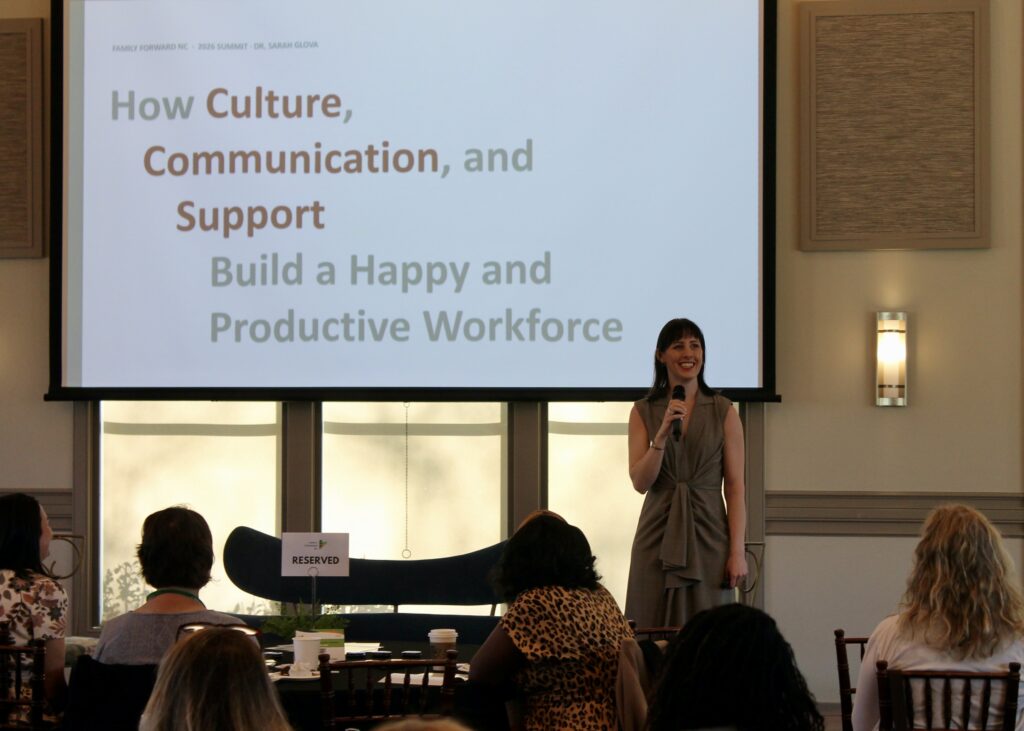
The first part of the summit focused on the best practices that are already helping businesses be family-friendly for their employees. It included a keynote presentation from Sarah Glova, a researcher and educator at North Carolina State and Duke universities, who shared strategies for building workplaces that people don’t want to leave. Her session was followed by a panel discussion with two Family Forward NC certified business leaders.
Pam Genske, vice president of human resources for Capital Broadcasting Company (CBC), was one of the panelists who shared examples of family-friendly policies that helped her company, which employs hundreds of North Carolinians, become Family Forward NC certified.
Genske highlighted CBC’s flexible paid leave policy, child care reimbursement of $200 per month per child, a $1,000 investment in a 529 college savings account for employees who have children, plus savings on YMCA memberships and pet insurance.
“Being family forward means thinking about the entire family,” Genske said, specifically noting that employees approaching retirement are often caring for older family members and need the same flexibility as parents of young children.
Amy Rawls, vice president of organizational effectiveness at Pocket Prep, said she is especially proud of her company’s parental leave and caregiver leave policies.
“For parental leave, we offer 14 weeks for birthing parents and eight weeks for all other parents, recognizing that families come in a variety of different shapes, and that is fully paid,” Rawls said. “And in addition to that, we have caregiver leave for anyone who needs to provide their family with caregiving support, and that is also eight weeks of 100% paid leave.”
Rawls pointed out that for small companies like hers, which employs around 40 people, “You don’t have to be thinking about any of this in an all-or-nothing manner; you can take little steps that make a huge impact.”
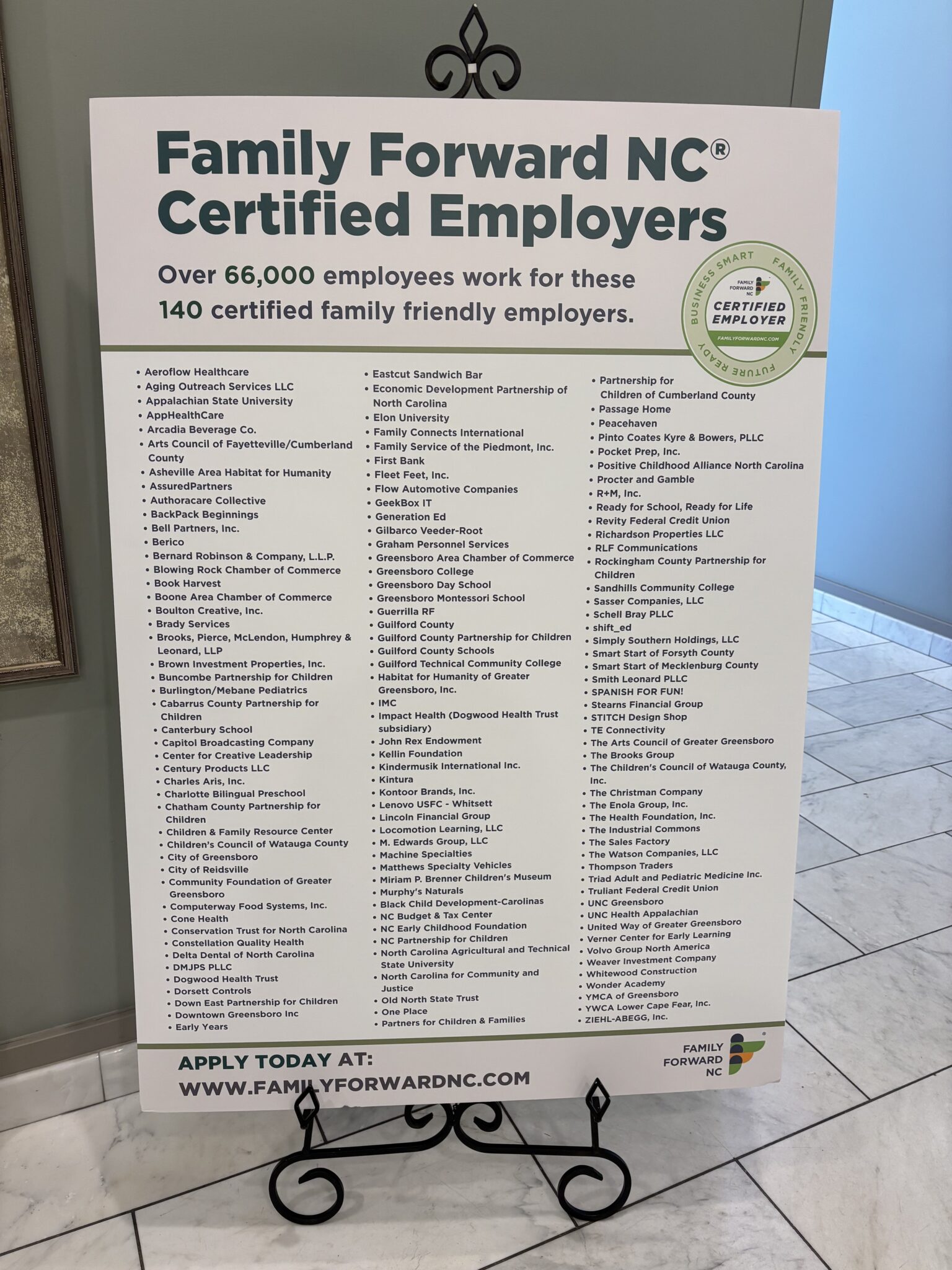
To become certified, business leaders submit an application and have employees complete an anonymous survey to be evaluated by the Family Forward NC team. The results of the survey are shared with the company and help determine where that company is on the path to being a family-friendly workplace.
Family Forward NC then connects the business to appropriate resources related to the specific needs of their employees. Businesses pay a fee that corresponds to the size of their company before receiving their certification, which is valid for two years. Learn more or start the process here.
“This is bragging rights for us,” said Lecia Marsh, director of talent acquisition for Cone Health, a Family Forward NC certified business with about 15,000 employees. “It’s a way to entice employees in, being a great place to work, having this designation as well.”
Kristen Lowers, an HR generalist at Weaver Investment Company, which has about 50 employees, described the process of getting employees to take the survey, and then receiving the results.
“How Family Forward NC communicates those responses, that was great information, and some of their questions I would never have thought to ask,” Lowers said.
She said it got her thinking about how else her company could support employees, even after earning Family Forward NC certification.
Ashley Monthie is the director of administration for Schell Bray, a law firm in Greensboro and Chapel Hill with 44 employees that is also a Family Forward NC certified employer.
Monthie said that employees such as accountants and IT professionals could work anywhere, not just at law offices, so offering competitive benefits is important for recruitment and retention.
“We don’t have a lot of turnover, but we still want to hire the best talent out there,” Monthie said. “And if we don’t have flexibility, nobody’s going to want to work here.”
More opportunities to support working families
In addition to celebrating success stories for family-friendly policies, Family Forward NC also released its first benchmarking report, analyzing the policies and practices of certified employers along with about 8,000 employee survey responses.
The report identified areas where businesses are leading, as well as areas where employees continue to need support.
“We can’t continue to be a top state in business if we aren’t also a top state for families,” said Rosa Sorto Brown, employer relations specialist for NCECF.
Family Forward NC emphasized these key findings in a summary of the report:
- Paid leave: Seventy-four percent of certified employers offer some form of paid parental leave. Still, only 22% offer at least 12 weeks of paid leave, the length recommended by the American Academy of Pediatrics and others. Employees report needing longer leave and broader access beyond birth parents.
- Wages: Most certified employers offer a living wage or higher, outperforming the statewide rate. Even so, 11% of employees surveyed reported earning below a living wage, and wages remain a top concern for workers.
- Flexible work and scheduling: Certified employers prioritize flexibility as a recruitment and retention strategy, and most employees report being satisfied or extremely satisfied with scheduling policies. The full report also shows that 85% of certified employers offer hybrid or fully remote arrangements for some or all employees.
- Child care supports: Only 23% of certified employers offer some form of financial assistance or on-site child care, while 29% offer no child care benefits at all. Employees say they need more support and more clarity on what is already available.
- Health and wellness: Certified employers are going beyond minimum requirements. Eighty-two percent cover a significant share of employee medical premiums, and many offer Employee Assistance Programs. Still, employees report wanting better coverage options and more financial help for dependent coverage.
Child care emerged throughout the summit as a key area in need of greater support — both from employers and from policymakers.
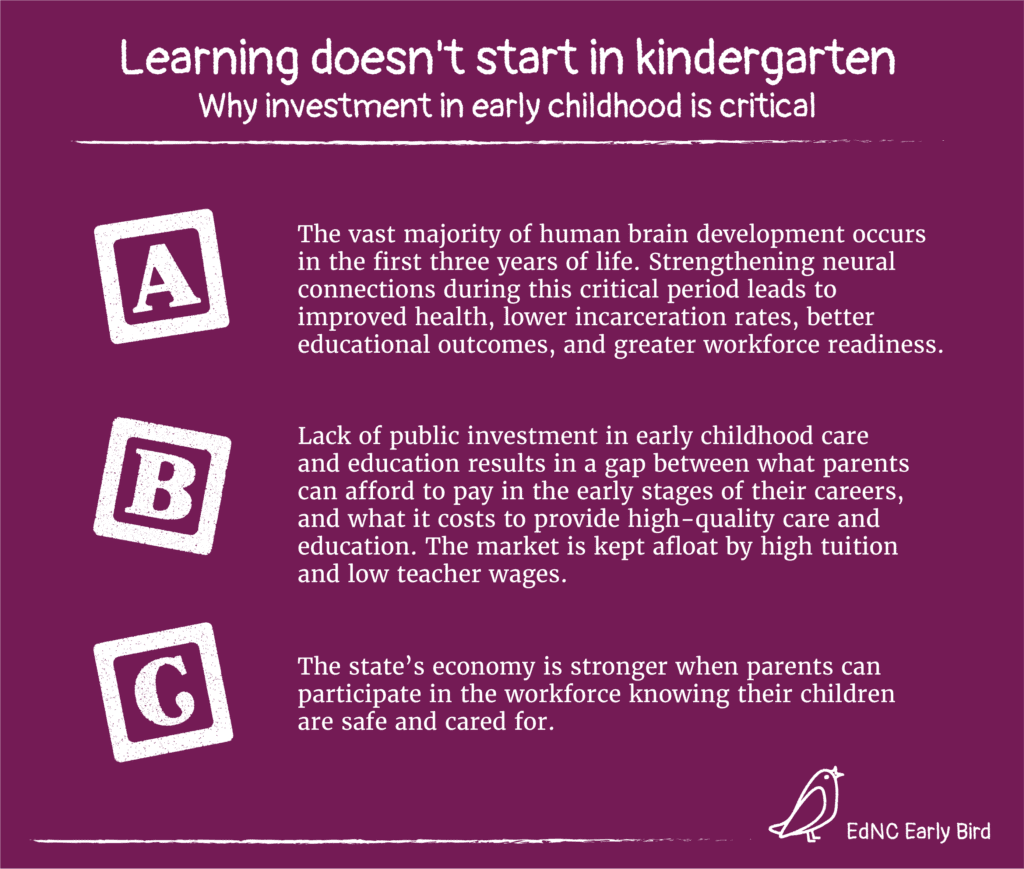
According to a fact sheet accompanying the benchmarking report: “What is abundantly clear is that the complicated nature of our child care system leads to confusion on what to offer, how to offer, and how to communicate to employees what is available.”
Nina Smith, associate dean of the College of Health Sciences at North Carolina Central University, pointed out during her presentation of the report: “Child care is an investment that can save the state billions of dollars in the long run.”
During the final panel of the day — titled, “Stay First in Business, Be First in Families” — Beth Messersmith, N.C. senior campaign director for MomsRising, emphasized the need for public investment. She said family-friendly policies are “economic infrastructure, just the same as broadband or bridges.”
Before the group of business leaders broke out to participate in action labs toward the end of the day, the emcee of the event gave them a reminder. Devonya Govan-Hunt, executive director of Black Child Development Institute — Carolinas and NCECF Board Chair, said:
Let’s remember that child care should not be considered a luxury, but a public good. You can’t ask our team members, our employees, to come and give you their whole best if they don’t even know 100% that they have access to affordable, high-quality early care and education.