
NC forecasts budget surplus, but warns tax cuts could impact future revenue

The state’s nonpartisan Consensus Forecasting Group (CFG) released a revised consensus General Fund Revenue forecast for the 2025-27 biennium on Tuesday, predicting expected overcollections over the next two years.
According to the consensus, North Carolina has a projected surplus of $370 million in state revenues through Fiscal Year (FY) 2026, reflecting a 1.1% increase from the certified budget.
“The upward revision is due to stronger economic growth than expected at the time of the last consensus forecast in May 2025,” the forecast webpage says. “Year-over-year, this represents a 1.5% increase in total General Fund revenues compared to FY 2024-25.”
For FY 2026-27, there is an estimated $951 million surplus, which is a 2.8% increase from the forecast.
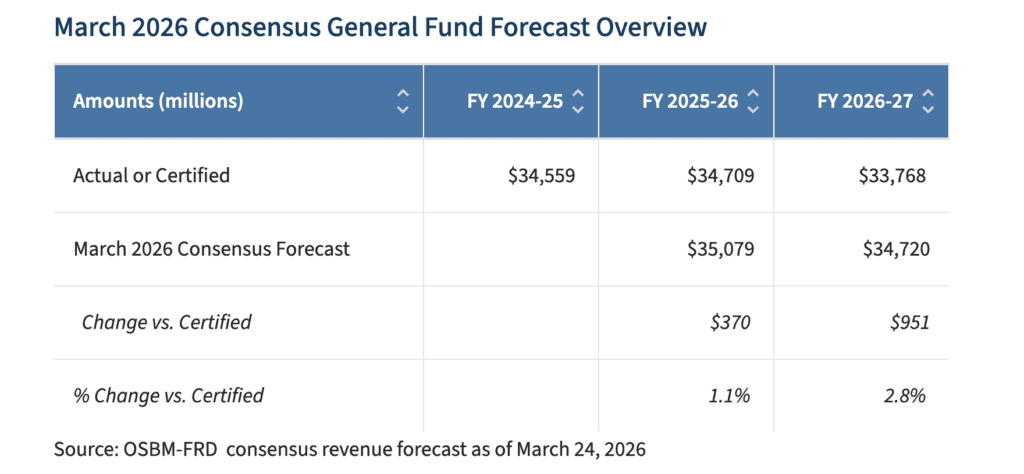
While the forecast predicts growth in the general fund over the biennium, it cautions that FY 2026 is set to see “a 1% ($360M) decrease in revenues compared to the consensus forecast for FY 2025-26.”
The forecast says that previously enacted reductions in income tax rates will further reduce revenue collections in FY 2026-27. The Republican-led General Assembly previously passed a series of scheduled tax cuts to go into effect when certain triggers are met.
“Individual income tax rates fell from 4.25% in 2025 to 3.99% in 2026, and the consensus forecast anticipates revenue collections in both FY 2025-26 and FY 2026-27 will be high enough to trigger two additional 0.5% rate reductions,” the forecast says. “This will lower the personal income tax rate further to 3.49% in 2027 and then to 2.99% in 2028.”
In a press release, Democratic Gov. Josh Stein said these income tax reductions could “yield a $3.4 billion revenue loss by fiscal year 2028.”
“Today’s forecast means that we will soon fall into a budget gap of at least $2.8 billion, causing the state to have to make painful cuts to critical services like public safety, education, and health care,” Stein said. “There is still time to act to keep up North Carolina’s positive momentum.”
What’s next?
North Carolina is the only state that has not yet passed a comprehensive state budget for FY 2025-26. During the long session, disagreements about pay raises, personal income taxes, and other budget items led to delays in the negotiation process.
The short session starts April 21, and budget negotiations are expected to continue.
While the forecast is positive news for the biennium compared to the May 2025 forecast, it doesn’t necessarily remove the cause of disagreements between the House and the Senate, according to budget consultant Dan Gerlach.
Any surplus is good, he said, but much of the surplus will likely go toward additional state Medicaid funding and a raise for teachers and other state employees. After 2027, the effects of the tax triggers will also likely mean less revenue for the state.
“What you’ve done is grown your way into another tax reduction — but if I’m a state budget maker, this makes my life more difficult,” Gerlach told EdNC. “Since 2011, budget growth has been very modest, so its not like there’s a lot of fat there. It’s not easy to find reductions.”
If there are any economic recessions, he said further cuts or identification of new revenues would be needed.
The CFG forecast includes a list of variables that could impact the accuracy of Tuesday’s estimates, both negatively and positively.
— CFG forecast
- Upside Risks:
- Last year’s strong stock market performance and rising corporate profits could lead to a positive “April surprise” with higher-than-expected income tax collections.
- Sustained, strong productivity growth, whether driven by widespread AI adoption or other factors, poses a potential upside risk to personal and corporate income revenues if the result is higher wages and business profits.
- Further increases in equity values could push incomes and consumer spending higher, boosting personal income and sales tax revenues.
- Downside Risks:
- The forecast assumes the ongoing conflict in the Middle East will stabilize and move toward resolution by mid-April. A prolonged Iran conflict could lead to persistently high prices and potential shortages of energy commodities. This would raise prices for businesses and consumers across the globe, reducing business investment and consumer spending on other goods and services and raising the risk of global recession.
- By many measures, stock prices for major U.S. corporations are historically high relative to corporate earnings. A sustained correction in equity values would lower taxable income from capital gains, slow business investment, and reduce spending by high-income consumers.
- Productivity gains from AI adoption may not translate into strong wage growth and could instead reduce job growth, limiting upside to personal income and sales tax collections relative to forecast.
- Additionally, changes in federal policy could alter the timing of state income tax payments, which poses a potential downside risk to April income tax payments.
The website says the CFG will consider revising the consensus forecast again in May if “the economic or revenue outlook change substantially by the time the Department of Revenue finishes processing April income tax returns.”
You can read the full forecast — including a look at lottery projections — on the Office of State Budget and Management’s website.