
NC Military Interstate Children’s Compact Commission highlights Onslow County

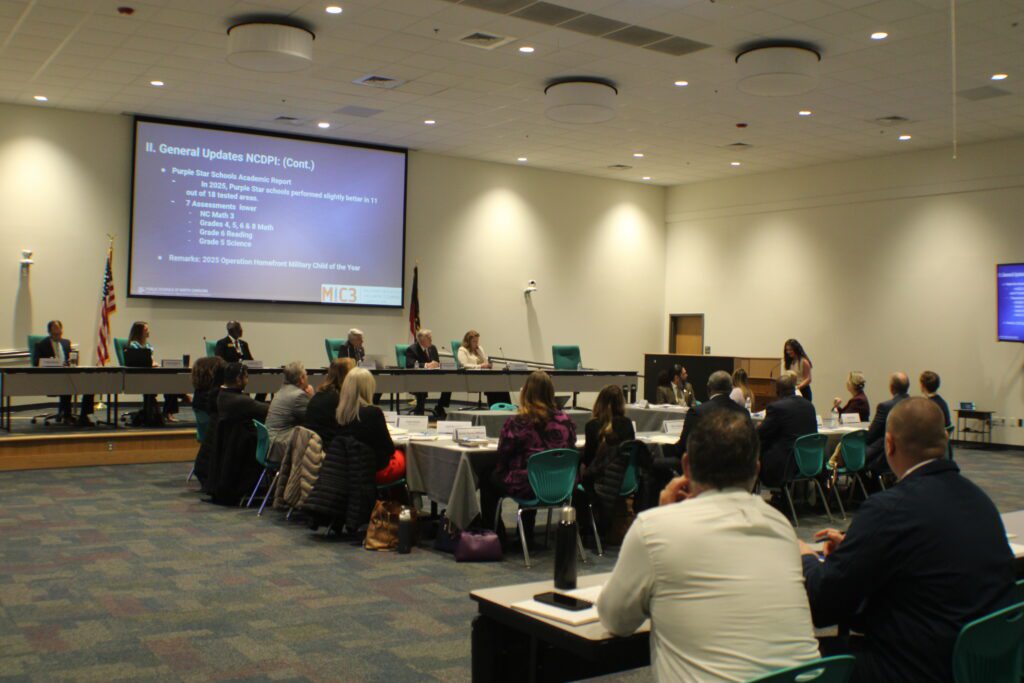
The North Carolina State Council for the Interstate Compact on Educational Opportunity for Military Children met in Onslow County on March 19 to discuss policy priorities and military friendliness in schools.
The Military Interstate Children’s Compact Commission (MIC3) is the governing body of the Interstate Compact on Educational Opportunity for Military Children. In 2006, the compact was drafted to address educational challenges faced by children of military families. The language was then finalized and adopted by state legislatures over the following six years. All 50 states and the District of Columbia are currently members of the compact.
 Sign up for the EdDaily to start each weekday with the top education news.
An interstate compact is an agreement among states to follow a specific set of administrative rules surrounding a specific issue. This allows states to collaborate with each other to resolve complex policy challenges while still retaining their sovereignty. The governance of the commission is led by member states and administered without federal intervention.
The following issues are addressed in the MIC3 compact: student eligibility, enrollment, placement, and graduation.
North Carolina became one of the first 11 states to adopt the compact in 2008. The N.C. council is currently led by Nick Sojka, Jr., who also serves as board attorney for Cumberland County School’s Board of Education.
“North Carolina is a proud member of the Interstate Compact on Educational Opportunity for Military Children,” the state website for the commission says. “North Carolina is committed to the education of the children of our military service members while their home is in our state.”
Military-connected students in Onslow County Schools
During last week’s meeting, Christopher Barnes, superintendent of Onslow County Schools (OCS), said the district’s call to action for the 2025-26 academic year is “Unlocking Student Potential.”
“I think the expectations and the guardrails of the compact and work of this state council aligns well with the concept of unlocking student potential. It’s a very clear connection,” Barnes said. “At Onslow County Schools, that alignment is reflected in how we support our military kids and families across the district and in many of our partnerships.”
Barnes said that OCS reached several milestones this year. Southwest High School opened a Marine Corps Junior Reserve Officers Training Corps (JROTC) unit, he said. Every school in the district has been recognized with the Purple Star Award for the fourth consecutive year. All of district’s schools have also been formally adopted by a military unit.
Additionally, all eligible high schools in OCS are Chapter 35 approved. Chapter 35 refers to an educational assistance program for children and spouses of service members who are deceased, captured, missing, or permanently and totally disabled due to a service-connected disability.
“This is an ongoing commitment, and it requires partnership, consistency, and intentional care,” Barnes said, regarding how the compact serves military-connected students.
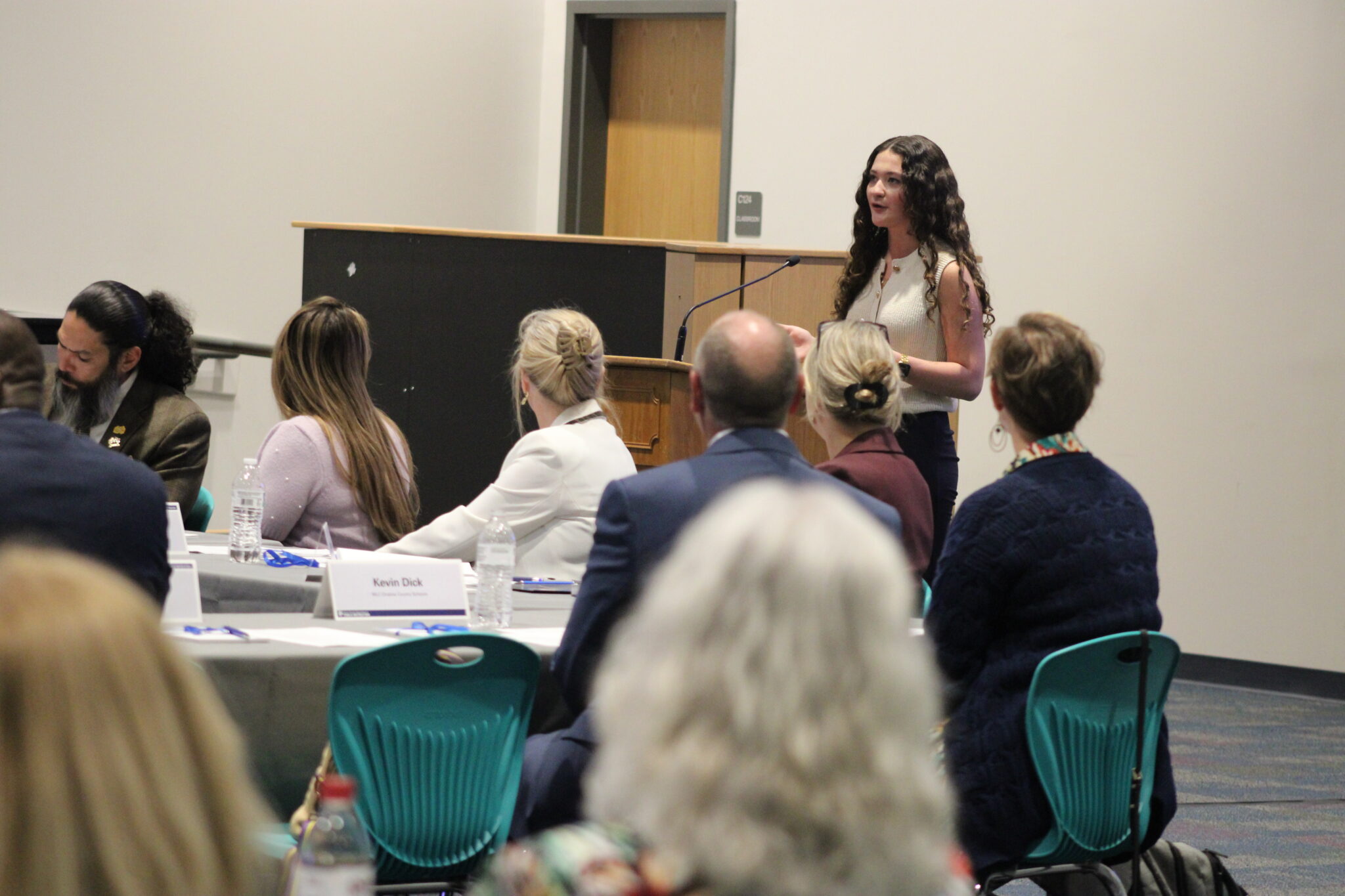
In Onslow County Schools, 45% of students are considered military connected, according to data from the 2024-25 academic year. Last spring, two of their students were selected as semifinalists for the Operation Homefront Military Child of the Year Award, and Isabella Smith of Swansboro High School received the top award — representing the Marine Corps.
“Military children grow up learning to adapt before they even know what that means,” Smith told the council at last week’s meeting. “And we learn how to walk into unfamiliar environments and make the belonging that we want to have. We learn resilience, not because we choose to, but because we have to. And when resilience is met with support — like I’ve seen and like I’m a testimony for Onslow County, it turns into leadership.”
Impact of Purple Star Schools
Howard Lattimore, state military liaison consultant for the Department of Public Instruction (DPI), also presented data on the Purple Star Awards initiative. Schools are awarded for demonstrating military-friendly practices and a commitment to military students and families.
“North Carolina is home to a large population of active duty, guard, reserve, and veteran armed services members, and the state’s public schools reflect that,” DPI’s website says. “In 2019, The North Carolina Department of Public Instruction launched the Purple Star Award Designation initiative to recognize the state’s strong military presence and its support for military families.”
Examples of practices that make schools eligible for the Purple Star award include having a military resource page on their website and a transition program for inbound and outbound families. Awarding-winning schools must have a staff member liaison for military families, and districts must also have a central office employee who serves as a point person for those liaisons. Finally, there must also be annual professional development addressing special considerations for military students and families.
On April 24, 598 schools are expected to become Purple Star Award recipients, according to the presentation, which is 143 more schools than last year and about 46% more schools than from the inception of the awards in 2019.
Lattimore attributed the growth to the work of school liaisons across the state. He also said that the growth was a sign of educators understanding the interstate compact more.
“That’s 143 more schools that are aware of the interstate compact,” Lattimore said. “I get more calls now about how to apply it, not what it is.”
Lattimore also reported that in 2025, Purple Star schools performed slightly better in 11 out of 18 state tested areas. The council requested further discussion about their lower performing areas at its next meeting.
Read more

Legislative updates
The council received an update from legislators Rep. Erin Paré, R-Wake, and Rep. Donnie Loftis, R-Gaston. The legislators said that a priority of theirs would be addressing the shortfall of funding for the Scholarships for Children of Wartime Veterans program, which is referenced in the Military Veteran Support Act, also referred to as Senate Bill 118.
According to its website, the Department of Military and Veterans Affairs (DMVA) has prorated current scholarships for the spring 2026 semester, covering only 75% of the statutory amount. Applications will not reopen unless additional funding is approved by the General Assembly.
DMVA has worked with the North Carolina State Education Assistance Authority (NCSEAA) to ensure the universities and colleges where these students are enrolled cover the shortfall so that the students do not feel the impact. DMVA has not awarded any new scholarships while it awaits increased recurring appropriations to cover demand. Funding for the program was highlighted in Gov. Josh Stein’s critical needs budget proposal.
“The scholarship issue is something that’s really been hard to understand — that we don’t have money to support those individuals whose parents have lost their life in service to our country,” Loftis said. “I can guarantee you that we’re going to fix that, so it never runs out of money again.”
The council also heard from the Director of Legislative Affairs of Marine Corps East, José Vasquez. Vasquez shared insights from a meeting the state’s installation commanders held with DPI.
A common theme among military installation commanders was concern about school funding, Vasquez said. This comes following the release of the Education Law Center’s “Making the Grade” report released in December.
“We can do better than this, and we should be doing better than this. So what they expressed to (DPI’s) Dr. (Maria) Pitre-Martin is ‘We’re with you. How do we get there? How do we do the things that we need to end up doing?’ We can only do that with our bill writers and our legislation to ensure that we can continue to go further,” Vasquez said.
Class size flexibility, course credits, and school safety
Megan Fahy, school liaison for Marine Corps Base Camp Lejeune, shared the installation’s perspective regarding education policy concerns.
Fahy started by mentioning the benefits of the enrollment flexibility the Military Veteran Support Act provides. Under the new law, military-connected students are able to enroll in North Carolina schools and have up to a year before they have to provide proof of residency. Fahy said this helps students whose parents have a Permanent Change of Station (PCS) in the middle of the school year.
“This flexibility has removed stress from families PCSing. Instead of delaying enrollment while navigating temporary lodging or housing, families can get their children settled into school immediately,” Fahy said. “Which has made a meaningful difference in both student stability and, of course, family-readiness. We truly appreciate the leadership of North Carolina policymakers and education partners who recognize the challenges military families face and work collaboratively to create solutions like this.”
The council went on to discuss class size flexibility for grades kindergarten through third. Julie Fulton, who represents the Camp Lejeune School Liaison Office, described state law about class size — laid out in North Carolina General Statute 115C-301 — as something with “good intentions, unintended consequences.”
The statute says that the average class size must not exceed the funded allotment ratio. Fulton explained how in military-connected districts, enrollment fluctuations may occur due to mission-related transitions such as PCS or deployment. This results in schools splitting classes or reassigning students to comply with state law.
Fulton said that one of the stated purposes of the compact is to “facilitate the student placement process” so that children of military families are not disadvantaged by changes in attendance requirements, scheduling, sequencing, grading, course content, or assessments. The additional transition caused by class changes may undermine the stability military-connected students need to get back on track.
“We all know that we have seasons of PCS and cycles where people tend to come and go and are looking for more flexibility with the districts,” Fulton said. “The districts are definitely not looking for a wide open… scenario. They’re looking for just a little bit of flexibility, whether that’s averages among the district or some waivers. There are several waivers in the statute. Unfortunately, there is not a waiver for our highly mobile communities.”
The council is also working on a draft proposal letter to address giving half-course credits to military-connected students who are transitioning into the North Carolina public school system.
“In many states, schools have the flexibility to award partial credit or half credit for coursework that has already been completed. In North Carolina, however, credits are typically awarded as full credits only, which can make it difficult to recognize partial completion when students transfer midyear,” Fahy said.
Jamie Livengood, who sits on the council and is leading a working group regarding the issue, said transcripts should “tell the story of the student.” The council plans to revisit the topic during its November meeting.
Another issue the council plans to advocate for is more school safety grants for military-connected schools. Council members talked about prioritizing schools near military installations that may become targets and partnering with local law enforcement to plan how to handle any threats.
Sojka, the commissioner of the council, said this is an area that can be looked at for all districts “in terms of a long-term, predictable stable funding stream, built into continuation budgets — not so heavily dependent upon these year-to-year grants to fund our SROs (school resource officers) and other school safety and security.”
The council is set to meet again on Nov. 19, 2026 in Raleigh.