
Brief | Principal Recruitment Supplement Program offers hopeful turnaround for North Carolina’s lowest-performing schools

As many as 30 of the highest-need schools across North Carolina have a great opportunity for the 2026-27 school year. The state provides these schools with $30,000 per year for three years to recruit proven, high-performing principals whose leadership can change the trajectory of a school.
Since its launch in 2019, North Carolina’s Principal Recruitment Supplement Program has sought to address one of the most persistent challenges in education — ensuring that the schools facing the greatest academic challenges have access to the strongest leadership.
 Sign up for the EdDaily to start each weekday with the top education news.
Highly effective principals — identified through supervisor evaluations, teacher survey results, and licensure exam performance — are not evenly distributed across schools. Research consistently shows that experienced, high-performing leaders are less likely to serve in schools with higher concentrations of low-performing students, students from low-income families, and students of color. This inequitable pattern, known as principal sorting, leaves the students who most need strong leadership least likely to have it.
Evidence is clear: Principals with a demonstrated record of turning schools around can produce both immediate academic gains and lasting improvement. Yet one of the greatest barriers to school transformation remains the limited supply of experienced turnaround leaders — making strategic recruitment not just important, but essential.
Principal recruitment supplement
To address these challenges, the General Assembly created the Principal Recruitment Supplement Program — established in N.C. Session Law 2019-247 — which provides a $30,000 annual salary supplement to a qualifying administrator who accepts a principal position in a qualifying low-performing school. The supplement is paid monthly if the principal remains employed as the same low-performing school, up to a maximum period of 36 months.
In districts that have leveraged this investment, many schools have reported better student growth scores, teacher retention rates, and other positive results.
Qualifying schools
Qualifying schools, as defined in G.S. 115C-105.37, include low-performing schools receiving an overall School Performance Score in the bottom 5% of all schools statewide in the prior school year. Given low utilization (below 50%) of the program over the past five years, the State Board of Education recently recommended expanding the program’s eligibility to include all low-performing schools.
- State statute defines low-performing schools as schools that earn an overall School Performance Grade of D or F and a School Growth Status of “met expected growth” or “not met expected growth.”
- Eligible schools are announced to districts between January and April. District leaders are encouraged to reach out to the N.C. Department of Public Instruction (DPI) in January to learn if they have qualifying schools in their district.
- Around 120 schools across North Carolina have been eligible under the current statutory definitions. DPI recommends expanding the program to all low-performing schools, which is over 628 schools in the 2025-26 school year.
Qualifying principals
Qualifying principals include those who are paid on the “Exceeded Growth” column of the Principal Salary Schedule.
A principal’s placement on the salary schedule is tied to the performance of their school. If a school exceeds growth for two out of the previous three years, they receive the “Exceeded Growth” payment on the salary schedule.
Funding and availability
There is $1.3 million in recurring funds available for this program, enough to support about 40 principals to participate in the program each year. If fully implemented, about 13 new principals would be added each year, with 13 first-year, 13 second-year, and 13 third-year principals utilizing the program at any given time.
However, the program has not been fully utilized since its inception. Low utilization can be attributed to a variety of factors, including district priorities, superintendent awareness, and logistical or cultural challenges in implementing the program.
Only three principals began the program in 2024-25, and eight principals began the program in 2025-26. With eight principals completing their 36-month bonus period this year, 29 slots are estimated to be available for the upcoming 2026-27 school year.
Student and school outcomes
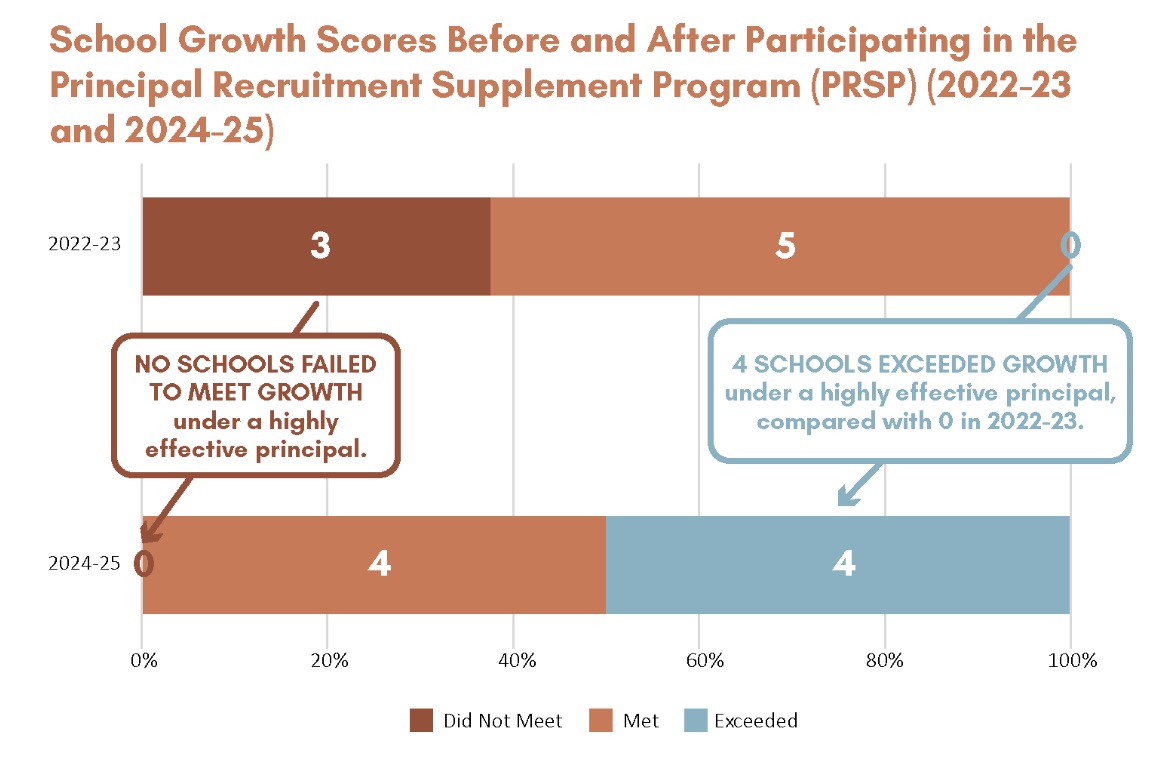
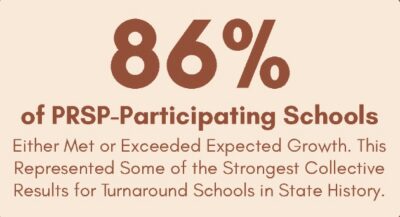
Despite low utilization of the program, the recruitment supplements are producing results: 86% of participating schools have met or exceeded growth — representing some of the strongest collective results for turnaround schools in state history. School performance scores also increased by an average of 16 points for the 2023-24 cohort from their qualifying baseline.
At least 50% of participating schools have exceeded growth, meaning they exit their status as a low-performing school. Among the 2023-24 schools, six schools’ growth scores improved in 2024-25 over the 2022-23 baseline, while two remained at “met growth.”
Participating principals have reported other positive results besides better growth scores, including dismantling long-held assumptions about student potential, shifting belief systems among staff, strengthening community trust, and building a culture of high expectations. Additionally, teacher retention rates increased at these schools, providing necessary stability for their students. Principals also saw increased family and community engagement.
The most recent report by DPI on the impact of the Principal Recruitment Supplement Program can be found here. While program participation is currently limited to the very lowest performing schools, its high level of investment in the schools who need it most has proven effective in turning these schools around.