

New report sheds light on NC’s Boost implementation
A note from us
Welcome to Awake58 — a weekly newsletter where you’ll find the latest updates on community college related news and events around the state. Plus, a look at what’s trending nationally in higher education.
If you’re new to Awake58, welcome! If you were forwarded this email, you can sign up for the Awake58 newsletter here. You can also find the latest edition on our website.
The Presidential Search Committee will meet this week… Gov. Josh Stein announces a “critical needs budget” proposal ahead of short session… Initial study on Boost complete… Boost implementation at Cape Fear Community College… EdNC’s recap of primary election results… U.S. House Appropriations Committee considers needs of community colleges… Duke and Durham Tech partner to create transfer pathway for engineering students… NCCCS announces conference keynote speakers… Plus, State Treasurer Brad Briner’s office is prepping a State Health Plan RFP…
Hi all, Emily Thomas with Awake58.
A new report from the Belk Center for Community College Leadership and Research, the research and evaluation partner for Boost, sheds light on initial findings and recommendations for the program.
Last year, the North Carolina Community College System (NCCCS) launched Boost, the state’s accelerated college-to-career program funded by a grant from Arnold Ventures.
It marks the first statewide replication of the CUNY ASAP model, a nationally acclaimed and evidence-based program that increases three-year community college graduation rates. Boost launched at eight colleges in fall 2025, with seven additional colleges to join in fall 2026.
Report insights were collected through site visits to the initial eight colleges. Belk Center staff toured campuses and interviewed both staff and Boost students. Representatives from EdNC and the NCCCS joined the Belk Center on these visits, conducting meetings concurrently.
The report’s findings are categorized into four sections: Staffing, student eligibility and recruitment, program benefits, and recommendations. You can read more — and find the full Belk Center report — on our website.
EdNC continues to cover the launch of Boost through profiles of the eight community colleges in the 2025-26 cohort. Be sure to check out our latest profile on Cape Fear Community College to see how their recruitment strategy has been the biggest factor in their momentum.
The State Board of Community College’s presidential search committee meets in-person this Thursday. According to State Board of Community Colleges Chair Tom Looney, the committee will identify semifinalists for the next system president by May 15. You can read EdNC’s latest presidential search update here.
In other news, Gov. Josh Stein held a news conference yesterday to present a “critical needs budget” proposal ahead of the upcoming short session. Among other things, the proposal included funds for a 2.5% raise for state employees, and $319 million to fully fund Medicaid following federal funding cuts. Stein said this proposal is meant to “fill the gap” for the most pressing state needs, and that his office also plans to work with the legislature regarding priorities for a comprehensive state budget.
Additionally, State Treasurer Brad Briner’s office announced it is preparing a request for proposals (RFP) for the State Health Plan. While Aetna has been administering claims for the State Health Plan for just over a year, Briner’s office is already looking ahead to a potential replacement.
Be sure to check out more news stories from across the state in EdNC reads and AroundNC.
Until next week,
Emily Thomas
Regional Director of Western North Carolina — EdNC.org
EdNC reads
Belk Center releases initial study of Boost, North Carolina’s replication of CUNY ASAP
According to the report, many colleges leveraged customer relationship management (CRM) tools to identify potentially eligible students and send them personalized recruitment contacts. Although this technology allowed for the easy distribution of mass email campaigns, the report finds that “relying too heavily on automated contact may not capture the interest or attention of all eligible students.”
Instead, colleges found that in-person efforts, including attending registration events and visiting classrooms, resulted in the most applications.
How Boost helps Cape Fear Community College students stay on track to work in high-demand fields
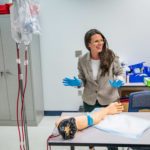
CFCC’s Boost Director Lauren Goalder said the college’s Boost recruitment strategy was the biggest factor in that momentum. She and the college’s Boost adviser, Tyler Perry, pulled rosters for first-year classes in programs that are Boost-eligible and then visited classrooms to share information on the financial and advising benefits of Boost. When time allowed, the Boost team would pre-vet the eligibility of students prior to visiting their classes.
Goalder said these targeted classroom visits yielded the most recruits compared to other strategies like mass emails and tabling at events — though they did those things, too.
US House Appropriations Committee considers needs of community colleges, including Pell Grant funds
The U.S. House Appropriations Committee met on Wednesday, March 4, to hear from community college leaders across the country on how the federal government can best support these institutions. The committee raised questions about the current needs of community colleges, the value of college education, and the student-to-workforce pipeline.
Four community college leaders and advocates appeared as witnesses, including Dr. Patricia Sims, president of Drake State Community & Technical College in Alabama; Dr. Brad Hall, president of Blackfeet Community College in Montana; Shawn Morgan, vice president of workforce and strategic initiatives at Bevill State Community College in Alabama; and Shalin Jyotishi, founder and managing director of the Future of Work and Innovation Economy Initiative at New America.
At the same time the appropriations committee met, Wake Technical Community College President Dr. Scott Ralls testified before the U.S. House Committee on Education and Workforce. He discussed how schools should handle preparing their students for the influence artificial intelligence (AI) will have on the workplace. Ralls said Wake Tech is seeing a renewed interest in technical education and skilled-trade programs.
ICYMI: Berger-Page race likely to go to a recount, and other NC primary election results
The unofficial results are in for the 2026 primary elections in North Carolina. Now, most are looking ahead to the Nov. 3 general election.
However, county boards of elections and the North Carolina State Board of Elections (NCSBE) still need to certify the results in the coming weeks — and before that, a key race might develop further.
The Republican primary for N.C. Senate District 26, between Senate President Pro Tempore Phil Berger, R-Rockingham, and Rockingham County Sheriff Sam Page is nearly tied; Page had the lead by two votes as of Wednesday, before some provisional and overseas absentee ballots were counted. As of Friday, that lead had widened to 23 votes, according to WUNC report.
Duke, Durham Tech launch guaranteed transfer pathway for engineering students
Duke university is close to finalizing an agreement with Durham Technical Community College to guarantee admission into the Pratt School of Engineering for select community college students graduating with an Associate of Engineering degree.
Should Duke finalize the partnership, it would be the first formalized community college transfer agreement for full-time undergraduate students among universities in the U.S. News and World Report’s ranking of Top 10 colleges and universities; it would also be one of the first guaranteed admission programs among elite private universities in the country.
Around NC
Perspective | Blue Ridge Community College President Dr. Laura Leatherwood writes in this EdNC perspective about the importance of public-private partnerships when it comes to building a “dynamic and sustainable workforce pipeline,” highlighting the college’s partnership with over 600 businesses and organizations across the region.
NCCCS Conference | The NCCCS announced keynote speakers for its biannual conference this October. Featured keynote speakers include: Drs. Hana Lahr and Davis Jenkins from the Community College Research Center, moderator Dr. Lisa Chapman, president of Central Carolina Community College, and Dr. Laura Ullrich from Indeed Hiring Lab. The 2026 conference is currently accepting program proposals through March 31. You can find out more about conference speakers, proposals, and registration here.
HER Impact spotlight series | GEAR UP North Carolina is spotlighting “the trailblazing women shaping higher education in the North Carolina Community College System” this month. You can view GEAR UP’s first spotlight here.
ApprenticeshipNC nominations | The 2026 ApprenticeshipNC Awards nomination period is now open. Nominations for outstanding apprentices and employers can be submitted online by 12:00 p.m. on March 27.
MerleFest | Wilkes Community College’s annual music festival and fundraiser kicks off April 23. You can view the lineup and purchase tickets here.
Achieving the Dream recognitions | Achieving the Dream (ATD), a partner and champion of hardworking leaders at more than 300 community colleges, announced that 68 colleges across the country have earned Leader College or Leader College of Distinction status. Five North Carolina community colleges are listed in ATD’s press release, including Durham Technical, Forsyth Technical, Stanly, Halifax, and Wake Technical community colleges.
Community college police department | Guilford Technical Community College’s police department recently became the first community college police department in North Carolina to be accredited by the North Carolina Law Enforcement Accreditation (NCLEA) program, according to a recent college press release.
N.C. Gateway Math in CTE initiative | Randolph Community College is one of seven community colleges statewide to participate in N.C. Gateway Math in CTE, “a Perkins Leadership project designed to directly connect gateway mathematics instruction with real-world career applications,” a recent college press release says.
Excellence in Innovation award | Fayetteville Technical Community College recently received PWC’s Excellence in Innovation Award at the Greater Fayetteville Chamber’s Annual Awards 2026. According to a college press release, the college “was recognized for its role as the region’s workforce engine and its aggressive adoption of emerging technologies in 2025.”
Fellowship opportunities | Applications for the LatinxEd fellowship are now open. The fellowship is centered around equipping Latine youth and education professionals with the skills, community, and resources to create change in education across North Carolina. Read more about the fellowship and application process here.
As a reminder, applications for the John M. Belk Impact Fellowship are open. The 10-month paid fellowship is a “training ground for future generations of social impact leaders” who will have the chance to deepen their experience across a wide array of focus area and gain marketable skills toward future employment. Full-time community college, undergraduate, or graduate students at an accredited North Carolina college or university interested in fields of education, public policy, political science, data analytics, psychology, or related fields can apply. The application portal closes March 20, 2026. You can find out more details about the fellowship and how to apply here.
Other higher education reads
 Sign up for Awake58, our newsletter on all things community college.