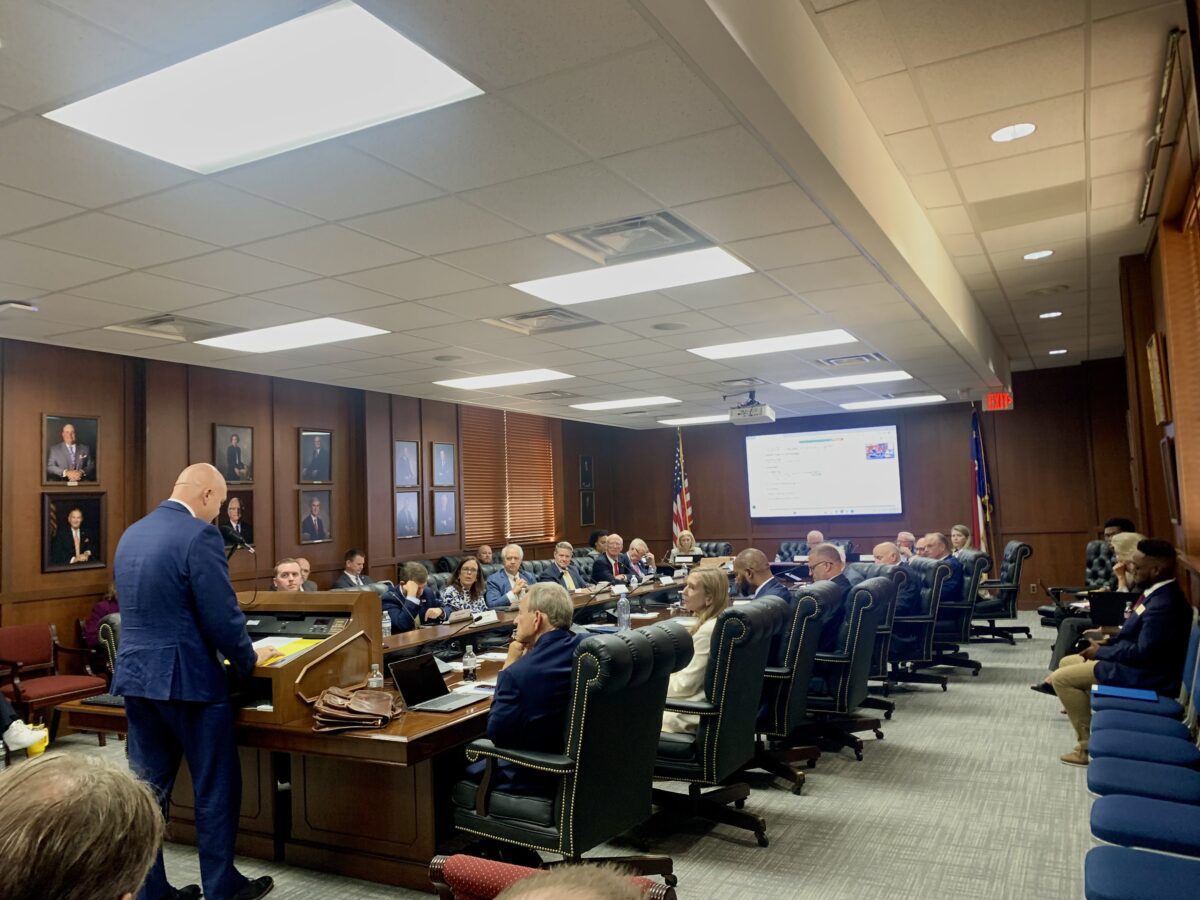
The State Board of Community Colleges’ meeting last week underscored efforts to increase the community college system’s financial resources, including a presentation on a national fundraising campaign and a legislative agenda anchored in the Propel NC funding model.
The Board meeting also featured updates on the search for President Dr. Jeff Cox’s successor after his retirement, effective June 30. On Friday, Board Chair Tom Looney presented an updated timeline for the search process to bring on a new president in July. Initially, Looney said the Board hoped to hire a new president by April.
On Thursday, a new executive committee created by Looney met for the first time. The committee aims to “ensure alignment, speed, and clarity of decision-making during a pivotal period of leadership transition and system-wide transformation,” according to its charter.
NC Community Colleges Foundation fundraising update
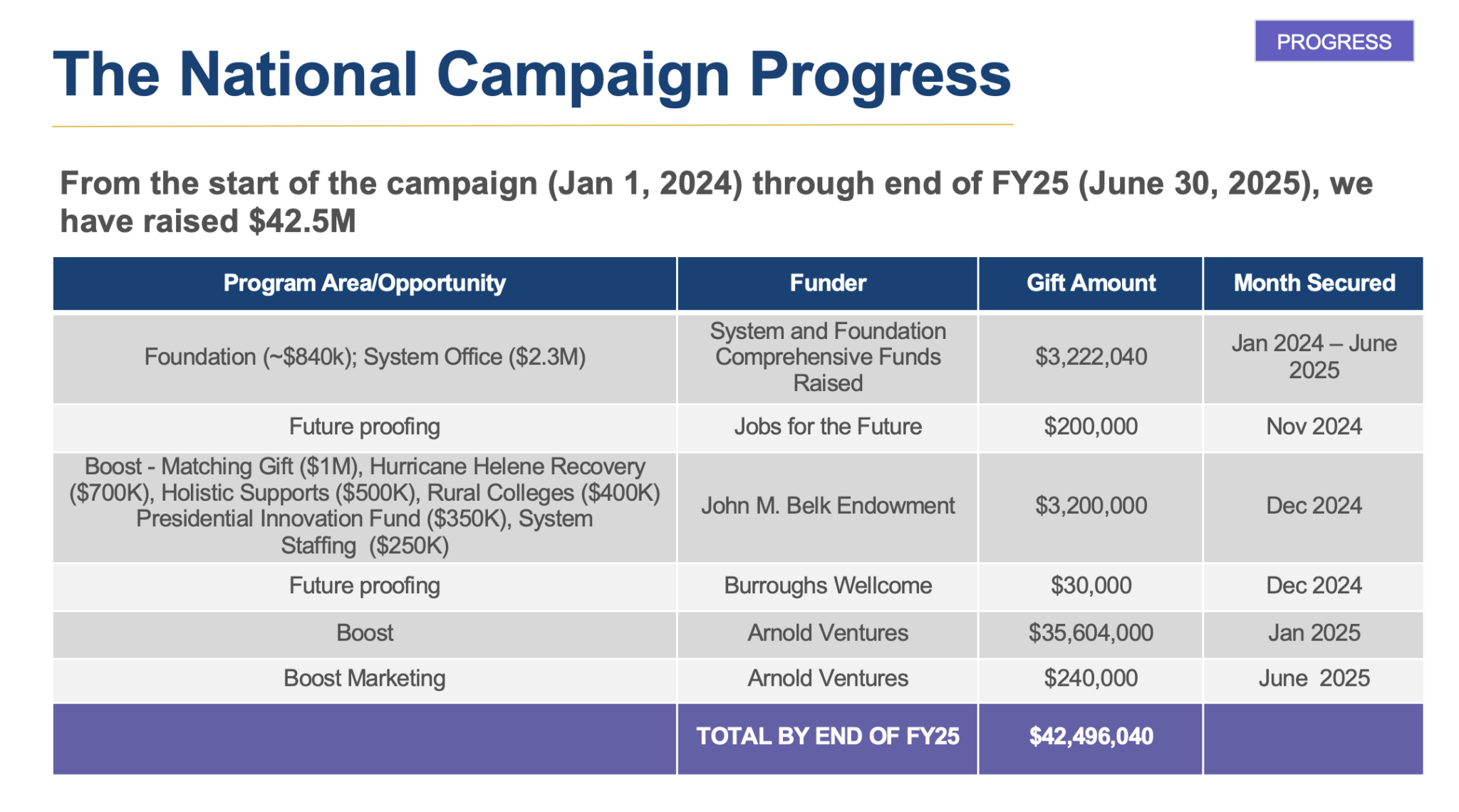
Founded in 1986, the North Carolina Community Colleges Foundation is a nonprofit organization that raises funds to advance the mission of the N.C. Community College System (NCCCS). Katie Loovis, executive director of the foundation, gave the Board an initial look at the foundation’s multiyear campaign to raise $75 million from national and multinational funders. Loovis said these funds focus on increasing opportunity, strengthening student success, and advancing mobility.
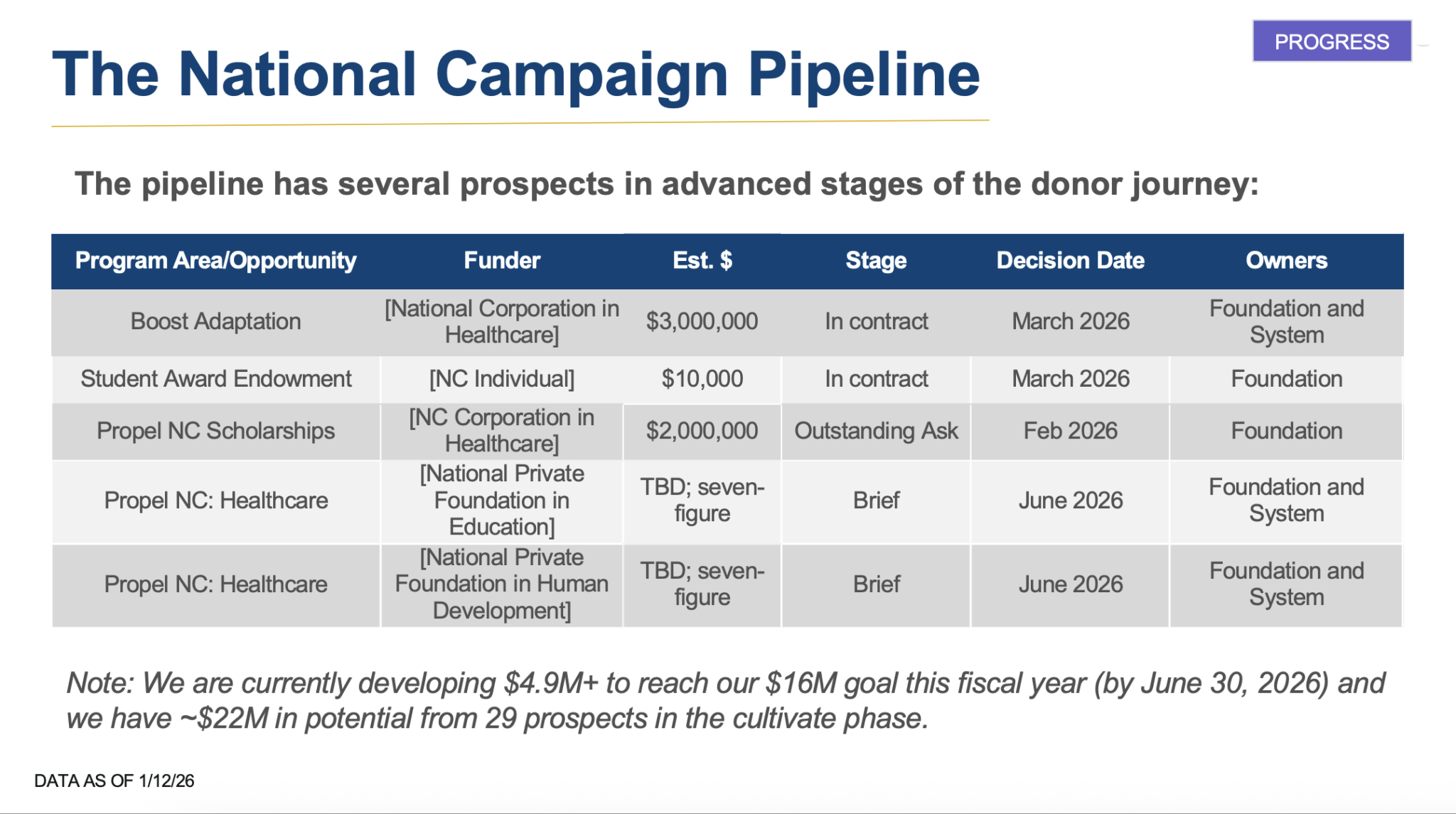
As of January, the foundation has raised $53.6 million, she said, 71% of the way to the total goal. Two-thirds of those funds come from a $35.6 million donation from Arnold Ventures to support Boost, the state’s college-to-career initiative designed to increase completion rates and move students into high-paying, in-demand jobs. According to the presentation, upcoming donations in the campaign’s pipeline include scholarships aligned with Propel NC, including investments focused on health care.
Loovis said some colleges have expressed sensitivities around ensuring the foundation’s campaign does not cannibalize college-level fundraising efforts. She said the foundation has taken steps to address those concerns and align their activities with colleges’ needs, including bimonthly calls with all college presidents.
“I would say things are on track, but it’s been bumpy — but we have some continuous improvement underway,” Loovis said.
She also said the foundation will be embarking on a “national reputation effort” by holding panels and receptions at prominent national conferences to elevate the system’s work among funders outside of North Carolina.
Loovis also said that a recent 40-year review of financial statements and tax filings revealed that last year was the foundation’s strongest year to date, including funds raised and dollars distributed to colleges.
“We were able to push out nearly $5 million dollars to our colleges, and when you stack them up, all the colleges and how much they got, it really feels great,” Loovis said. “And we want to do more and make sure we’re helping all 58 of them.”
Legislative agenda announced
Alex Fagg, the system’s vice president of government and external relations, said the system’s legislative agenda for the General Assembly’s upcoming short session will remain consistent with its focus on Propel NC, the proposed overhaul of the system’s funding model.
The largest request is $68.5 million in recurring funding to modernize the workforce sector funding formula, incentivizing continuing education and programs tied to high-wage industries. The agenda also calls for $24.4 million in recurring funds to strengthen the system’s base funding and ensure colleges have the staffing, tools, and services to support students and boost program completion. Another nonrecurring $6 million request would create an enrollment growth reserve to help colleges manage increases in enrollment.
The system will also continue to ask legislators to revise state law to redistribute excess tuition receipts proportionally to all colleges based on actual receipts collected by colleges.
The system’s agenda also includes funding for Board-approved multicampus centers at Alamance, Forsyth Technical, and Wake Technical community colleges, as well as salary increases for community college employees in line with state employee rates.
Additional requests include a $3.1 million recurring investment in ApprenticeshipNC to make the program less reliant on federal funds. According to the legislative agenda, this would increase the state’s recurring investment to $4.3 million.
“If you move from federal to state opportunities, you add more flexibility, growth, improvement,” Fagg said.
The agenda also asks legislators to include community colleges in capital and equipment funding proposals to address the $3 billion in infrastructure needs identified across all colleges.
Fagg said the system is exploring multiple pathways to get its priorities approved, despite the ongoing state budget impasse.
“Right now, our mindset is to prepare for anything and everything,” he said.
 Sign up for the EdWeekly, a Friday roundup of the most important education news of the week.
Fagg also gave leaders their first overview of January’s federal appropriations bill. He said the budget largely maintains existing funding levels and program structures affecting community colleges. Several grants that the system had been monitoring remain intact as well, he said.
“Things can always change, but right now, (we are) very fortunate,” he said.
Federal apprenticeship funding remains a focus for the system, he said. Roughly $50 million will be given to states through formula allocations, but $235 million will be distributed through competitive grants — including $145 million already available through the U.S. Department of Labor’s Pay-for-Performance Incentive Payments Program. The system is also interested in the new Strengthening Community College Training grant available for individual colleges or cohort applications.
Other business items
Anita Bachmann, chief executive officer of UnitedHealthcare Community Plan of North Carolina, announced a $500,000 investment to launch the Future Leaders in Health Scholarship Program. The scholarship program will support 400 students over the next three years across 35 community colleges in areas facing health care workforce shortages. Scholarships will cover tuition, basic testing costs, and basic living supplies for students pursuing certifications and degrees in health care roles.
“Across North Carolina, as we all know, we’ve continued to see meaningful economic growth and opportunity,” Bachmann said. “But we also know that sustaining that growth and ensuring the health and the well-being of our local communities requires access to a strong, reliable health care workforce.”
The Board approved an allocation of $24,573,657 in enrollment growth reserve funds, which will be distributed between 47 colleges that experienced enrollment increases greater than 5% of budgeted enrollment levels in fall 2025.
The full Board meets next March 19-20.
Editor’s note: Arnold Ventures supports the work of EdNC.


Recommended reading