
Global early childhood insights & an update from Gov. Stein’s task force
'Teaching thinking' in early childhood within and outside of the classroom
Early Bird readers, hello again. Newcomers, welcome! If you were forwarded this email, you can sign up here to receive it every two weeks, and join our conversation on issues facing North Carolina’s young children and those who support them. If you’re already a subscriber, please help us reach more people by sharing this with your friends and coworkers interested in early childhood education.
In mid-November, I had the privilege of attending a global early childhood conference in London, co-hosted by Bright Start Foundation and the Higher Colleges of Technology in Abu Dahbi. It was refreshing and inspiring to hear about the leading global research on best practices in early childhood, and the challenges and opportunities that span across geographies and cultures. I also sat next to an attendee from North Carolina on my first day. I felt right at home. Here are some themes that have arisen as I’ve reflected on my learnings over the last few weeks:
- High-quality early learning is child-led, play-based, and intentional, researchers and practitioners said. Listening to several sessions from pedagogical experts reminded me of conversations in North Carolina on quality and the balance between academic instruction and play. One of early care and education’s goals should be “teaching thinking,” said Esteban Morales, who presented on creating professional development for early childhood educators at CentroNía, a community-based child care program in Washington, D.C. The group’s research found their educators scored higher in care-based components of early learning, but not as well in intentional interactions that develop cognitive skills. So they created tools that help educators plan and execute lessons, field trips, and “classroom transformation” with helpful questions along the way that guide the kinds of teacher to child interactions that accelerate learning.
- Physical movement and outdoor experiences are crucial to healthy development and learning. My favorite presentation was from Katharina Ehrenfried, a head teacher from Berlin Cosmopolitan School in Germany. The school is taking outdoor learning to the next level and created an entire “forest campus.” She argued that outdoor environments not only helped engage neurodiverse children, but that the forest is all children’s “natural habitat.” North Carolina early childhood educators know this, and many are involved in efforts like NC State University College of Design’s Natural Learning Initiative.
- Researchers are developing artificial intelligence tools and robots for early childhood settings. The leading models do not replace but enhance interactions between children and both their teachers and their peers. Across the educational continuum, AI uses should be designed with educational goals in mind instead of user satisfaction and profit. Multu Cukrova, professor of learning and artificial intelligence at University College London, said this of the most commonly used AI tools like ChatGPT: “An educational AI tool would never give immediate response to the information request questions, but would work with the child to co-construct meaning together. These tools give immediate responses and outcomes that are answering all the key questions that the children should be answering in the first place.”
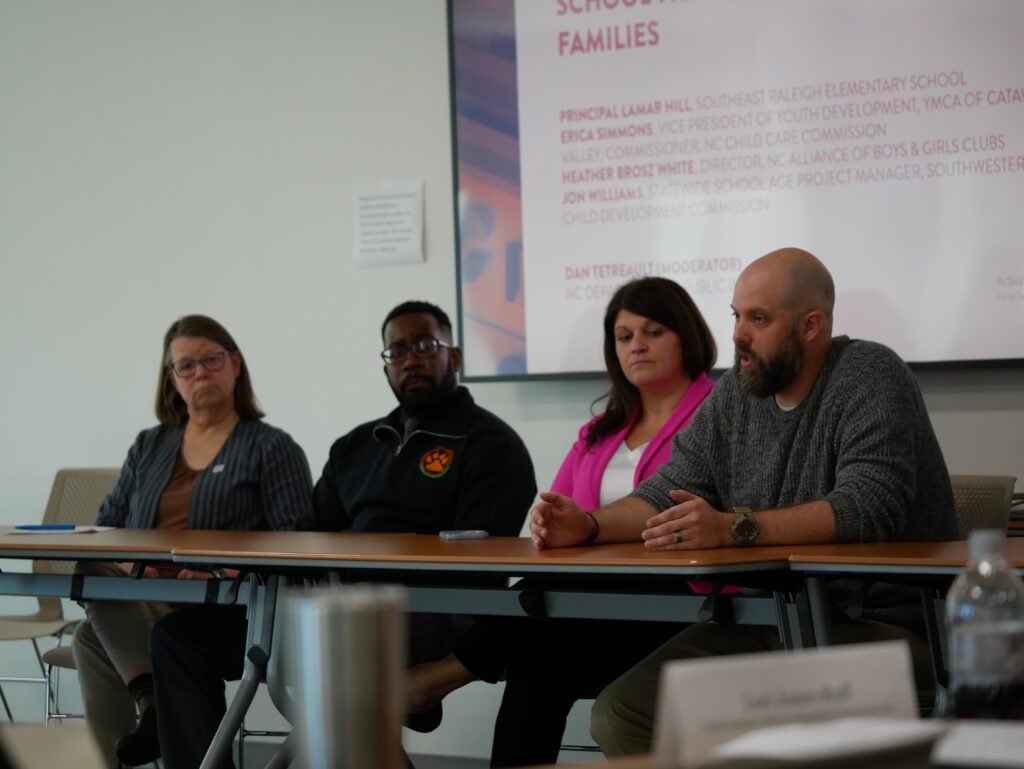
As we came back from Thanksgiving break, I attended the latest meeting of Gov. Stein’s Task Force on Child Care and Early Education, which focused on families’ needs for after-school and summer care. Much of our child care coverage centers on the first five years, but parents do not experience child care challenges only in that time frame. Check out what after-school program advocates and providers said about what supports they need from the state to keep children safe and engaged outside of the school day.
Do not miss Katie’s recent piece from Bladen County on an innovative partnership between the local community college, school district, local government, and Smart Start partnership “with the goal of educating students from birth to adulthood” in a former elementary school building with layers of history. The model is an example of the creative solutions localities are finding to expand access to child care.
Our team is winding down and working on a special project this month on lessons learned across the educational continuum from Hurricane Helene. Early Bird will be back in your inboxes in January. I am grateful to be in community with the state’s early childhood educators and supporters after another year of spending time in your classrooms and neighborhoods. EdNC is wishing all of you a happy holiday season, and thanking you for all you do for our students, our state, and our future.
More from EdNC on early childhood
Child care needs don't stop at kindergarten, after-school program leaders tell Stein's task force
For the first five years of children’s lives, many families are experiencing child care challenges — which have been at the center of discussions among the NC Task Force on Child Care and Early Education since Gov. Josh Stein established...Bladen Community College is bringing a century-old school out of ‘retirement’ to serve children, families, and their community
Editor’s note: This article is part of a series on the intersections of community colleges and child care. Other articles in the series are available here. The Booker T. Washington School had been part of the Clarkton community in Bladen...Perspective | What Latino families teach us about early care and education in North Carolina
Today, Jose turns 5 months old. His mother, an immigrant from El Salvador living in Durham, rocks him gently while scrolling through her phone, searching in Spanish for “programas para bebés en Carolina del Norte.” Like so many new mothers,...U.S. Department of Education moves many programs to other agencies 'to break up federal bureaucracy'
The U.S. Department of Education (DOE) announced on Tuesday six new interagency agreements (IAAs) with four federal agencies “to break up the federal education bureaucracy, ensure efficient delivery of funded programs, activities, and move closer to fulfilling the President’s promise...Chirp! Chirp! Opportunities to share your voice
What are your biggest accomplishments this year in your work to support young learners? Respond to this email and let us know.
The big picture for little kids
News & Research
- Are AI Toys Safe for Children? - From Parent Data
- Child care workers are building a network of resistance against ICE - From The Hechinger Report
- Hunger is increasing among those who provide care to young children - From The RAPID Survey Project at the Stanford Center on Early Childhood
- Why Parents Aren’t Reading to Kids, and What It Means for Young Students - From zero2eight from The 74 Million
- RFK Jr. wants to delay the hepatitis B vaccine. Here's what parents need to know. - From CBS News
- What you should know about the hepatitis B vaccine for newborns - From The 19th
Taking flight! Opportunities to spread your wings
Thursday, Dec. 11, 12:30 to 3 p.m.
This webinar will bring state and national early childhood leaders together to update practitioners on the biggest challenges and opportunities in the field and in the policy landscape. Admission is $25 to $35 depending on the attendee’s role.
From the organizer: “Think of this as your direct line to what’s happening at the state and national level, translated into what it means for you and the children and families you serve — and the early childhood workforce making it happen each day.”
The last of three events, sponsored by Blue Cross Blue Shield NC and the Diaper Bank of North Carolina, distributing free supplies like diapers, formula, wipes, and parent resources is in Charlotte on Dec. 12 from 10 a.m. to noon. Find more details at the link above.
Find simple, helpful tips for reading with toddlers in English and Spanish. I’m using these over the holidays with my 4-year-old nephew!
Wednesday, Dec. 10, 7 p.m.
From MomsRising:
“We must work together to make sure schools and childcare centers are safe places for kids, families, and child care workers.
Join us for a special training created for our early childhood community. Our webinar will cover:
- Up-to-date information on the community response to increasing ICE presence in NC.
- Perspectives from child care providers and parents on how they are meeting the moment.
- Know your rights information and best practices for centers and family child care homes to keep children, their families, and workers safe.”
 Sign up for Early Bird, our newsletter on all things early childhood.