
HB 657: Connecting policy to the practice of teaching math in the classroom
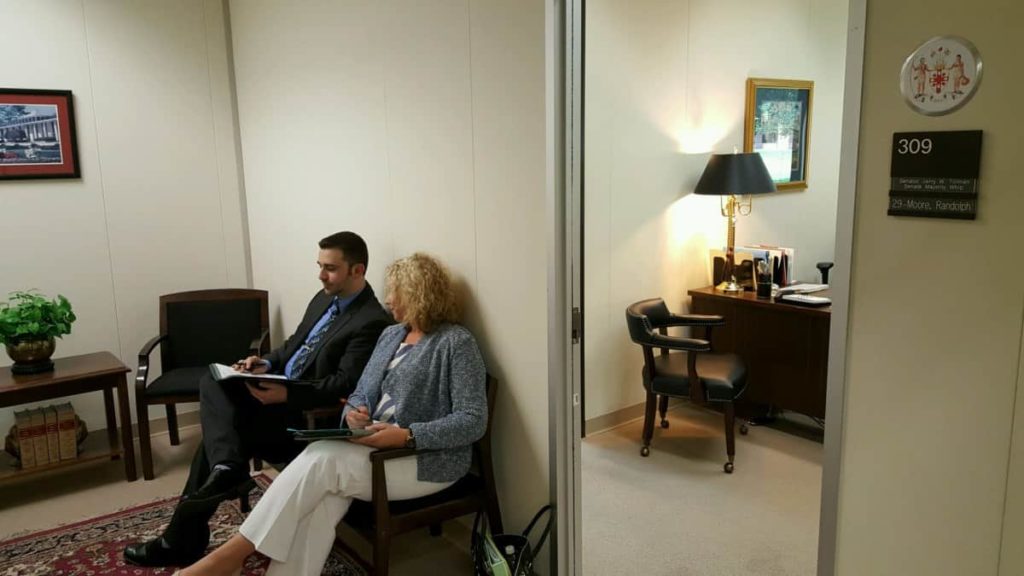

With sore feet propped up on my coffee table and a head reeling from the day’s activities, I am beginning to think we should not only have a “teacher for a day” program for legislators, but the inverse as well. Spending yesterday trying to keep up with my colleague, Christina Hoy from DignifyTechers, as we voiced our opposition to House Bill 657: Math Standard Course of Study Revisions to various legislators, I have a new appreciation for the legislative process.
The wide variety of individuals competing for our policymakers’ time was astounding — and I’m not so sure Ms. Hoy and I didn’t cut a lobbyist group off to see Rep. Michael Lee, R-New Hanover.
However, the common theme between the conversations with my new friends and legislators was a genuine concern over all students and their learning.
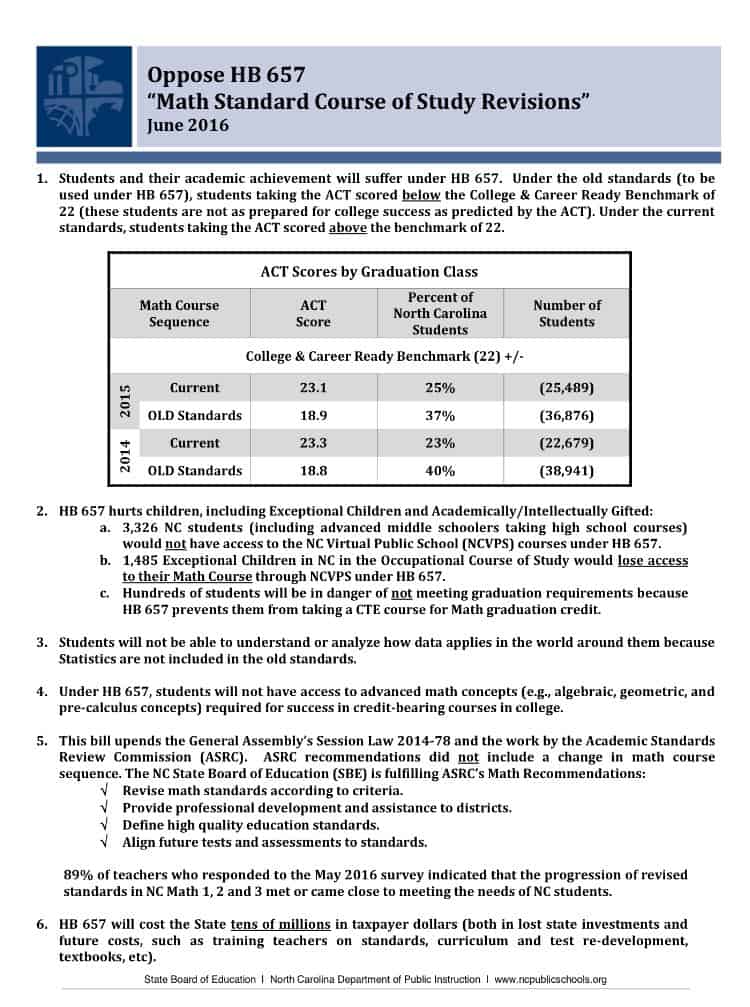
Many policymakers voiced anxiety over the high school math course sequence and its impact on our states’ students, citing a December survey from the Academic Standards Review Commission, where 70 percent of teachers support reverting to the old math sequence, even though a more recent survey from DPI reports 89 percent of teachers feel the revised standards meet or exceed their students’ needs.
As the Senate Education Committee meets today to discuss (and possibly vote on) HB 657, I want to clear up one particular misconception I heard about our State’s integrated approach math…
“’Higher’ students do better with integrated math, ‘lower’ students do better with a traditional approach.” This is far from the truth.
Research has shown an integrated approach fosters greater student understanding and has decreased (an in some cases eliminated) the achievement gap with under-served student populations. In fact, N.C. students who took integrated math courses in 2015 scored 4.2 points higher on average on the ACT than students following the old course sequence (an assessment all N.C. juniors take).

To appease the differing views on the subject, one legislator proposed an idea to allow individual students (and their parents) the choice to select the course sequence they wished to be in. But in some cases, this could result in teachers teaching two courses (with two very different chunks of standards) in the same class. The legislator responded,“Good teachers are good teachers,” noting the ability of teachers to accommodate the individual needs of their students.
While logistics of this would be a nightmare for schools and districts (essentially putting us back in the same situation as three years ago with standards from 2003), the intentions of this proposal were pure.
The logic that underperforming students do better in the old way of teaching math is perpetuated by the idea “these students need more skills practice,” and that’s not wrong. However, Algebra I and II, and Geometry do not give students more opportunities to practice math, the teacher does.
This misconception comes out of a fundamental misunderstanding of how an effective teacher runs their classroom. For me and my PLT, we spend approximately 55-75 percent of class time using an investigation or teacher-facilitated discussion to discover a concept or explaining why it exists in the first place. Many times this utilizes geometric properties or other prerequisites skills. Then the rest of class time (and homework) is the skills practice, reinforcing the actual concept. This frees my time to work with groups of students, all with varying abilities, to ensure understanding and application tailored to those students.
This is referred to as differentiation of instruction, and all effective teachers do it. It is not synonymous with integrated math or traditional sequencing, and certainly cannot be legislated. However, what can be legislated is the consistency of standards, greater access to quality resources, and professional development funds.
As the committee meets today, I hope our legislators will take into account the support the revised standards have garnered from the business community, local colleges, various school districts, and educators.
Yesterday helped me gain a greater appreciation for the work of our legislators, I only hope they appreciate mine.