
Asheville-Buncombe Technical Community College braces for the road ahead after Hurricane Helene
Sunday, Oct. 27, marks one month since Hurricane Helene ripped through western North Carolina. While recovery efforts are underway, needs will continue to surface in the weeks and months ahead — everything from professional counseling to dehumidifiers to warm clothing as the winter months approach.
As community leaders process their own trauma from the storm, Dr. John Gossett, president of Asheville-Buncombe Technical Community College (A-B Tech), said one thing has been resonating with him, and that’s the heroes during and after Helene.
“Think about who went running,” Gossett said. “It was our law enforcement, EMTs, fire, rescue — all these people we have trained. They were the ones who ran immediately into the storm.”
These efforts have been led by many of North Carolina’s current and former community college students, including emergency management personnel and electrical lineworkers, all helping western North Carolina recover.
 Sign up for Awake58, our newsletter on all things community college.
Responding in crisis
A-B Tech has four campuses and serves Buncombe and Madison counties, two areas that saw some of the storm’s worst impacts.
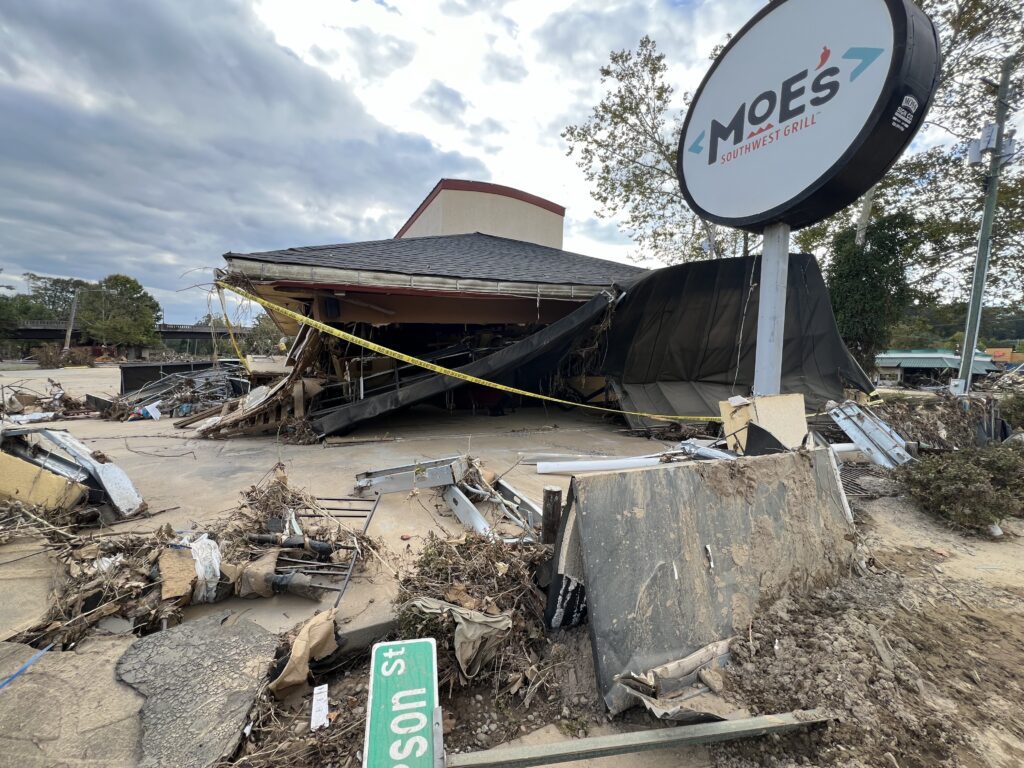
There are places that are simply gone — buildings and homes wiped away, roads missing, and areas that have endured complete shifts to their geography.
Some people thought they were far enough away from the river that water wouldn’t make it to their doorstep, Gossett said, but not everyone thought about the hill behind their house turning into a mudslide.
“This isn’t just another hurricane, this is more water than we’ve had in 100 years.”
Dr. John Gossett, president of A-B Tech
Kerri Glover, A-B Tech’s executive director of community relations and marketing, grew up in the mountains but spent much of her time in Charleston, South Carolina. She was one of the first on-the-ground reporters when Hurricane Hugo hit the Carolinas in the 1980s and covered the aftermath for two years.
“When you live at the beach, at least in the back of your mind, you know it can happen,” Glover said. “But up here, nobody thought it would ever happen. That’s the big difference.”
During the storm, Gossett received a call from the Buncombe County manager asking to use A-B Tech’s facilities.
The answer was an immediate yes.
“We are blessed with space that not a lot of people have,” Gossett said.
Since the onset of Helene, all four of A-B Tech’s campuses have been used to some extent to aid in rescue and recovery.
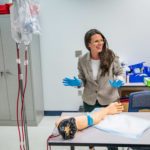
The bottom floor of A-B Tech’s allied health building became a regional emergency hub, sheltering displaced individuals and providing medical assistance. When the building was constructed, it was done so for times like these, Gossett said.
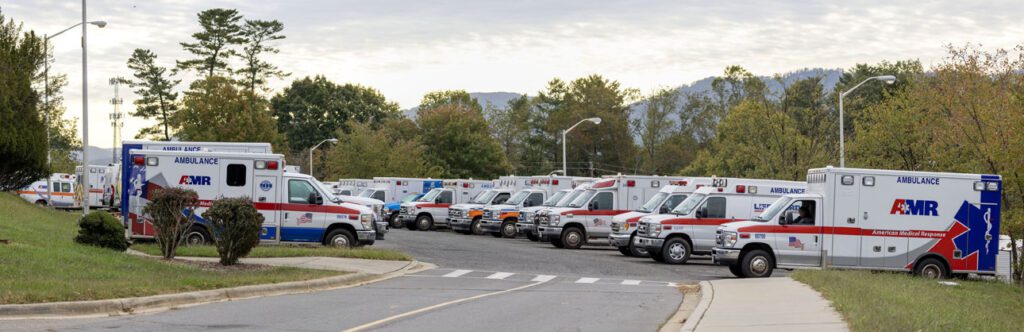
The college staged 300 ambulances to assist with evacuations, and some campuses provided shelter for emergency personnel.
A-B Tech’s Madison County campus is currently hosting the Marshall town hall along with disaster response, disaster relief, and early voting. Another campus is being used as a temporary holding site for vegetative debris.
College personnel are also stepping in. Faculty and staff have helped with clean-up efforts across the county, and nursing faculty volunteered their time, often working 12-hour shifts in the makeshift medical shelter.
“I can’t mandate volunteerism, but I can celebrate it and encourage it,” Gossett said.


Bringing students back
In the 2023-24 academic year, 615,508 students enrolled in North Carolina’s community colleges.
A-B Tech makes up over 30,000 of those enrollments — 10,000 curriculum students annually and about 25,000 students across continuing education and basic skills programs, on average.
After a month-long closure, the college will reopen across all campuses and programs on Oct. 28. Power, non-potable water, and internet access are available at all locations, according to a press release.
Since the storm, A-B Tech has been working to contact students and connect them to resources, including sending a survey to all curriculum students. As of Oct. 16, about a third had responded, and roughly 40% of respondents had internet access.
As students make their way back to campus, Gossett is encouraging faculty to not jump back into coursework immediately.
“Students need to talk,” he said. “Everyone can be a listening ear and be empathetic.”
A-B Tech has professional counselors onsite, but leaders said they are looking for even more because they know students are going to need this type of support. Students who were identified as more vulnerable, even before the storm, are already being contacted by counselors.
“We’re doing the best we can to find our students, find out their needs, and get them connected,” Gossett continued.
And while the college is poised to help, the needs will be great.

Bracing for the road ahead
We didn’t anticipate some of the challenges of bringing students back and transitioning the Helene support to other locations, Gossett said. While a lot of the immediate needs are being taken care of, the coming weeks will be telling as A-B Tech learns more about how their student population was impacted.
Helping will go beyond the basic essentials and include things like getting roofs fixed, finding generators, and other things you may not immediately think of in the midst of disaster but that will be important in the weeks and months to follow, Gossett said.
And there’s another challenge surfacing.
About 70% of A-B Tech’s students work, and a vast majority of them are in the hospitality industry. More than 10 million people visit Buncombe County each year, making tourism a primary driver of economic growth. Due to Helene, however, many popular attractions and restaurants are closed.
Enrollment at A-B Tech was up about 7% this fall, Gossett said, but they are hearing from more and more students that they aren’t coming back.
North Carolina’s community colleges receive most of their funding from state appropriations, which are largely based on full-time equivalent (FTE) student enrollment. Colleges are also funded in arrears, which means they are funded based on the current year’s FTE or an average of the previous two years’ FTE.
If students don’t return or push pause on their education, the dip will have implications for years to come.
Following Hurricane Florence in 2018, the last major hurricane to hit North Carolina, the General Assembly allocated $6.4 million to offset FTE losses caused by the hurricane.
At the October State Board of Community Colleges meeting, North Carolina Community College System Vice President of Government and External Relations, Alex Fagg, said,“We are in constant communication with the General Assembly about our recovery package,” including how to “support our colleges through stabilization dollars due to FTE (full-time equivalent) loss from the storm.”
While they figure out how the storm will impact their enrollment, Gossett said community college students and graduates will help rebuild Asheville, pointing to their culinary program and small business center, both of which will help businesses retool and rebuild.