
Why students should learn to write computer code

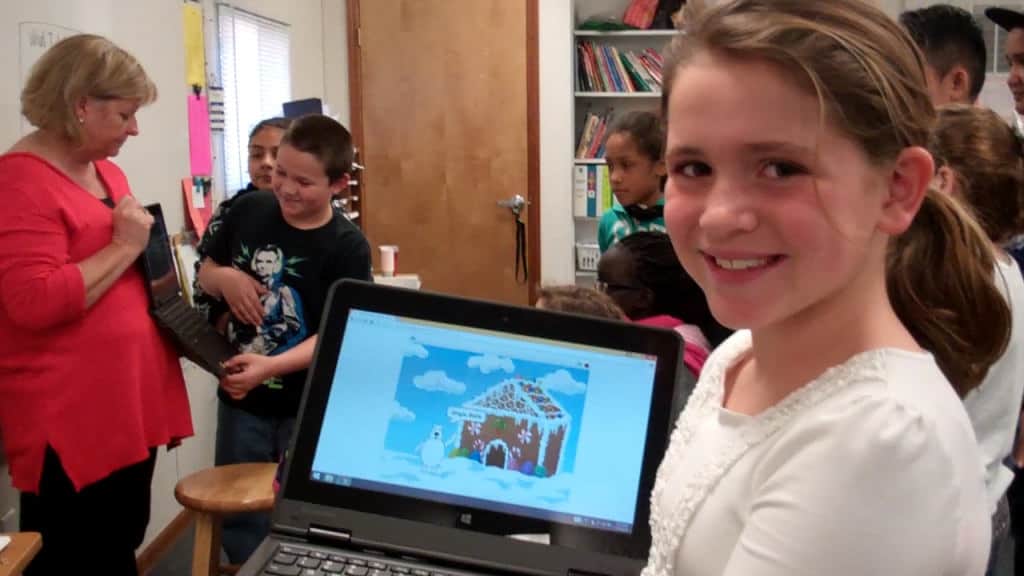
It was time for language arts in Ms. Slomski’s class at Oak View Elementary School in High Point, North Carolina, and although fifth-grader Rifqa was having trouble making her little squirrel behave, she wasn’t about to give up.
“I want my squirrel to appear as soon as I hit the space-bar and then follow my mouse pointer wherever it goes,” said Rifqa, who was creating her own interactive story using Scratch, a program developed by MIT to teach students of all ages the basics of writing computer code.
Rifqa and her classmates like learning to program, in part, because the process reveals to them the secrets behind their favorite video games and apps. Learning to write the computer programs that make the games work is an evolutionary leap, one in which the students move from merely being passive consumers of content into active producers.
Furthermore, once students make new discoveries through programming, they are more likely to be curious about other aspects of their world. Teachers report a noticeable change in the thought process that occurs once students begin to manipulate computer code.
“Coding not only improves students’ problem solving skills, it improves students’ creativity and communication skills. Students begin to understand logic and think in terms of if-then-else, a logic chain. This is applicable to everyday life,” commented Mrs. Slomski.
Today, more educators and, increasingly, parents, are encouraging their students to try their hand at writing code, a process that helps students develop problem-solving skills and reinforces the valuable 21st century skills of critical thinking, creativity, communication, and collaboration.
While most classroom teachers agree that these skills are vitally important for student success, some fear teaching kids to code means giving up precious class time to activities not directly tied to their required curriculum. This apprehension is likely due to the pressure teachers are under to prepare their students to perform well on end of grade tests, despite the fact that many stakeholders have for years questioned whether the results of a single test can accurately measure student progress and academic achievement for an entire school year.
Indeed, in a recent survey conducted by Hope Street Group, a national nonprofit, nonpartisan organization dedicated to expanding the access of every American to the tools that lead to economic opportunity, North Carolina teachers expressed concern over whether standardized tests alone can offer a clear picture of student knowledge and growth.
In addition to providing teachers with formative assessment data, activities like coding can provide necessary challenge and motivation for students, as well as opportunities for cooperation and recognition.
Now, with the implementation of Every Child Succeeds Act, an overhaul of No Child Left Behind, states have the freedom to supplement test results with additional indicators, such as levels of student engagement during tasks like writing original computer code, in assessing overall school performance. In addition to providing teachers with formative assessment data, activities like coding can provide necessary challenge and motivation for students, as well as opportunities for cooperation and recognition. Also, a curriculum that integrates coding can satisfy student curiosity, enhance decision-making abilities, and improve competencies related to self-control and autonomy, like time and project management skills.
From posters on hallway walls to posts on social media, tech-savvy celebrities like Nobel-prize winner Malala Yousafzai and Facebook founder Mark Zuckerberg encourage students to participate in Hour of Code, an annual series of events hosted by libraries and schools during Computer Science Education Week that strive to get kids from all around the country interested in computer science.
President Obama is a fan. Speaking to students in a YouTube video to promote Hour of Code, the President said, “Learning these skills isn’t just important for your future, it’s important for our country’s future. If we want America to stay on the cutting edge, we need young Americans like you to master the tools and technology that will change the way we do just about everything.”
Rifqa and her classmates, not to mention her newly trained virtual squirrel, would most certainly agree.