
Perspective | What’s at stake as community colleges reach a pivotal moment

In a letter to Republican leaders in the General Assembly, five former governors warn that proposals to give the legislature dominant authority in appointments to major boards and commissions threaten “the constitutional separation of powers” as well as “real chaos and harm” to North Carolina citizens.
Since its emergence as a two-party state 50 years ago, North Carolina has had persistent power struggles between its executive and legislative branches. The struggles often arose out of the ebb and flow of elections in a state of closely competitive Democratic-versus-Republican politics.
Now, a Republican legislative majority, veto-proof strong, seeks to exercise its muscle as Democratic Gov. Roy Cooper serves the final two years of his eight-year tenure. Under pending bills if enacted, the legislature would gain extensive power in governing community colleges, regulating utilities, building highways, and protecting coastal and wildlife resources — an enhancement of power that would carry on indefinitely into the future.
In offering a bipartisan front in defense of a governor’s authority to implement laws, the five former governors — Republicans Jim Martin and Pat McCrory; Democrats Jim Hunt, Mike Easley, and Bev Perdue — explain a real-life consequence of diminishing a governor’s appointive power.
“For example,” they write, “the governor is the state’s top economic development recruiter. Attracting businesses frequently involves provision of access roads and timely partnerships with community colleges to provide targeted workforce training. These partnerships occur early in the recruitment process, and the stripping of gubernatorial appointees to the DOT board or state and local community college boards puts our state at an unmanageable disadvantage.”
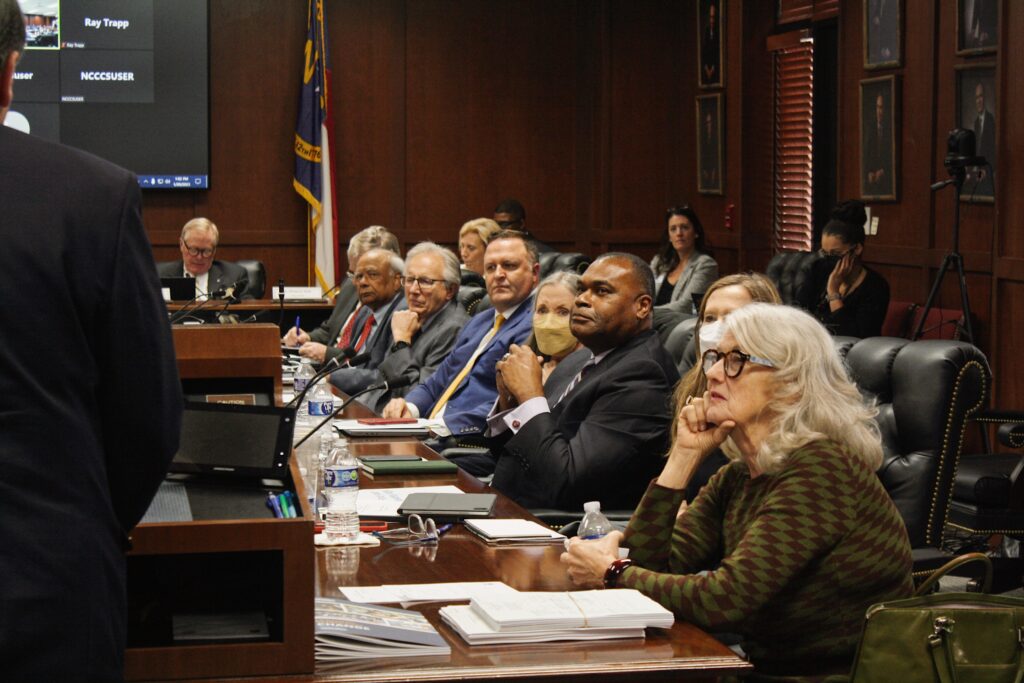
The governors’ letter went out as state senators took up a bill that would lead to a State Board of Community Colleges composed entirely of legislative appointees. It would give the General Assembly the authority to confirm the president of the community college system and give the president more administrative clout.
The legislation comes at a transitional moment fraught with uncertainty for the 58 colleges with more than half a million students. Over the past decade, the system has seen “permanent” presidents and “interim” presidents come and go in relatively quick succession. As the board votes to pick a candidate selected by a search committee, the new president will be the ninth in a decade.
At stake is not simply stabilizing the system’s leadership but also responding to the economic and demographic trends challenging colleges in both the state and nation. The myFutureNC organization recently reported that North Carolina has fallen behind in its goal
of 2 million North Carolinians, age 25 to 44, with postsecondary degrees or credentials by 2030.
In North Carolina as in the U.S., college enrollments had declined even before the COVID-19 outbreak. As EdNC has reported, the number of students served across the North Carolina system increased 3% this fall, but remains 10% below fall 2019 head count.
To inform my own thinking about how North Carolina could navigate and make the most of this key moment for its community colleges, I recently contacted several people, both inside and outside the system, for their perspectives on workforce development and postsecondary education. No consensus or silver-bullet solutions emerged from these informal, on-background conversations by phone and email. But here is a word-cloud in random order of observations and comments:
- Can we afford to get this wrong again? The system needs a vision; it needs to create its own future rather than have it imposed.
- What does success look like? And how do we evaluate success of leadership?
- Now is a real opportunity for fresh, young leadership.
- Resources are too meager.
- Confront a defensive, deficit mindset. Stress optimism, not panic.
- More attention is needed to moving families out of poverty.
- Community college education is not a single-player sport. More collaboration is required. It’s time for colleges to reinvent themselves.
As is often the case, legislation on who appoints is about process and power. An overarching question lingers, power and process to what end?