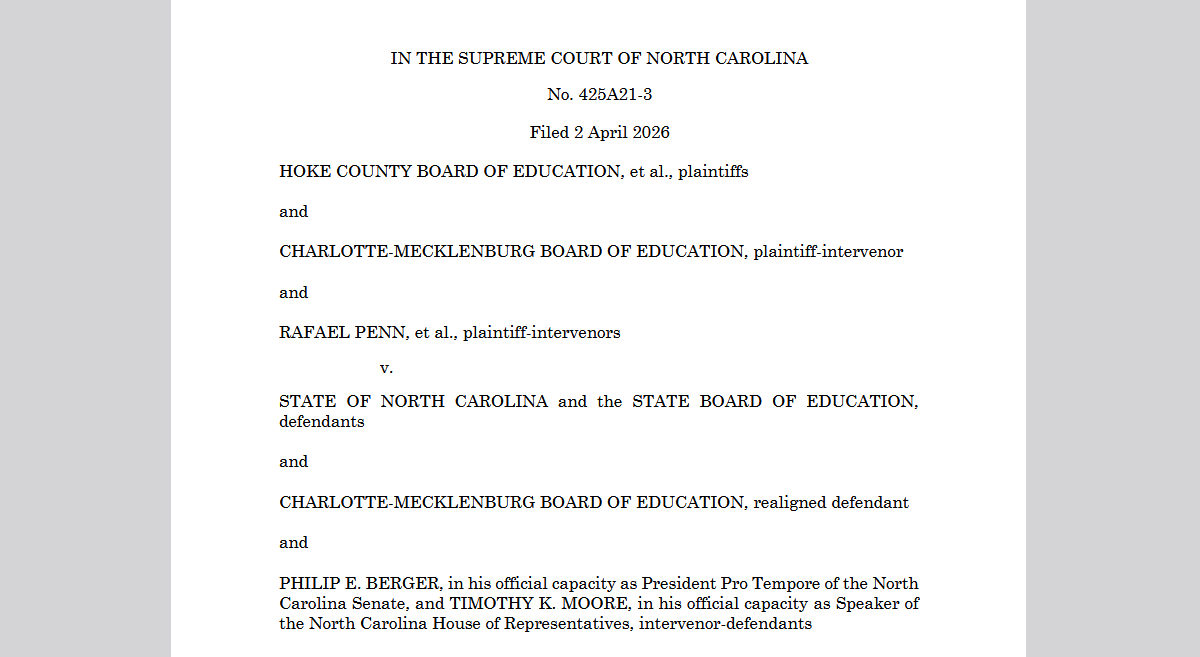
Today, the North Carolina Supreme Court, in a 4-3 opinion, brought an end to the Leandro litigation with no possibility to address procedural flaws identified by the court. It also ruled that the 2022 Supreme Court Leandro IV ruling was void with no binding legal effect.
In the opinion written by Chief Justice Paul Newby and joined by Justices Philip Berger, Jr., Tamara Barringer, and Trey Allen, the court focused solely on procedural issues, not the substantive constitutional right to education.
The court wrote that the lawsuit had transformed from one about the application of the constitution to specific students and school districts to a challenge of the education system across the state. The court held that the trial court lacked the authority, or subject matter jurisdiction, to rule on this much more expansive case. It further noted that the plaintiffs had failed to address the issue of the court’s authority in their pleadings as the case changed.
In its analysis, the court distinguished between constitutional challenges “as applied” in specific instances to “facial” challenges that raise the constitutionality of the entire system in all its applications. The court held that the more expansive case shifted to a facial challenge that was beyond the authority of the trial court.
This analysis is criticized by two of the dissenting justices, Justices Anita Earls and Allison Riggs. Earls said that the majority’s reliance on distinctions between as-applied and facial challenges was “apparently concocted from thin air.” Riggs stated “[t]he majority distorts the facts and history of this case, hides behind technicalities rather than addressing the core issue affecting our children, and looks for a reason — any reason — to ignore the problem instead of fixing it.”
The court, after reaching its conclusions regarding the trial court’s lack of subject matter jurisdiction, could have dismissed the case “without prejudice” to allow the plaintiff parties to correct these procedural flaws. Instead, the court dismissed the case “with prejudice,” meaning that this decision is the final decision and the plaintiffs cannot pursue their claims. It also means that the court did not allow the case to proceed on a much more limited basis of addressing claims within the plaintiff school districts.
The court also determined that without subject matter jurisdiction, any court decision in Leandro after July 24, 2017, is “void ab initio, meaning it is a ‘nullity anywhere, at any time, for any purpose.’”
Justice Philip Berger, Jr., wrote a concurring opinion, arguing that the court should have gone further and explicitly disavowed the reasoning of Leandro IV (also referred to as Hoke III). Even if Leandro IV is no longer binding, Berger expressed concern that the court’s reasoning in the opinion may show up in future lawsuits.
Where does this leave Leandro or other constitutional claims? The first ruling in this litigation, Leandro v. State, established the constitutional right to access the opportunity to a sound basic education, based on provisions in the North Carolina Constitution. That right, as provided in the constitution and interpreted by the court, remains.
Additional analysis in Leandro II (or Hoke I) and the Leandro III (or Hoke II) ruling which was a more limited ruling on prekindergarten also remain in effect.
Leandro V does not preclude the possibility of other claims of constitutional violations of the right to a sound, basic education, but it does make it more difficult.
The third dissenting justice, Justice Richard Dietz, offered a possible path forward of a “special, streamlined class action.” He disagreed with his Republican colleagues in the majority opinion, arguing that the court should have allowed procedural flaws to be corrected. He outlined what this could look like, giving a possible roadmap for future lawsuits.
Dietz also chastised all of his colleagues for the tenor of their opinions. He wrote:
The heart of Leandro is the notion of a sound basic education. But the Enlightenment principles that form the building blocks of that education — rationality, objectivity, tolerance, skepticism — have been abandoned by all sides in this long-running lawsuit. Instead, this case and the discourse around it have become a study in the opposite — partisanship, bias, generalization, straw-manning, and appeals to ignorance.
This opinion was the only opinion issued today by the court before a state holiday. EdNC will provide additional coverage and analysis in the coming weeks.
Read the opinion issued by the the N.C. Supreme Court here.
See the full list of issued opinions on the N.C. Supreme Court website.
Here is Gov. Josh Stein’s statement.
Here is Speaker of the House Destin Hall’s statement.
Here is a joint statement from North Carolina State Board of Education Chair Eric Davis and North Carolina Superintendent of Public Instruction Maurice “Mo” Green.
Links to previous decisions and other historical information can be found in this article, “Everything you need to know about Leandro.”
If you are a reporter and would like to connect to Ann McColl for a quote or context, please email mrash at ednc.org.

Recommended reading