Are community college students doing better than traditional measures suggest?
A 2025 survey by the Federal Reserve Bank of Richmond, which collected data on 189 community and technical colleges — including North Carolina’s 58 community colleges — offers a new measure of student success. That rate covers more pathways offered by community colleges, which a traditional graduation rate might not capture.
The results? Students’ success rate for the 2020-21 was higher than a traditional graduation rate.
 Sign up for Awake58, our newsletter on all things community college.
The Survey of Community College Outcomes, which launched in 2021, aims to create new evaluation methods to measure community colleges’ performance. By 2024, the survey included 121 colleges across North Carolina, the District of Columbia, Maryland, South Carolina, Virginia, and most of West Virginia. The 2025 edition also includes schools from Arkansas, Iowa, Massachusetts, New Jersey, and Texas.
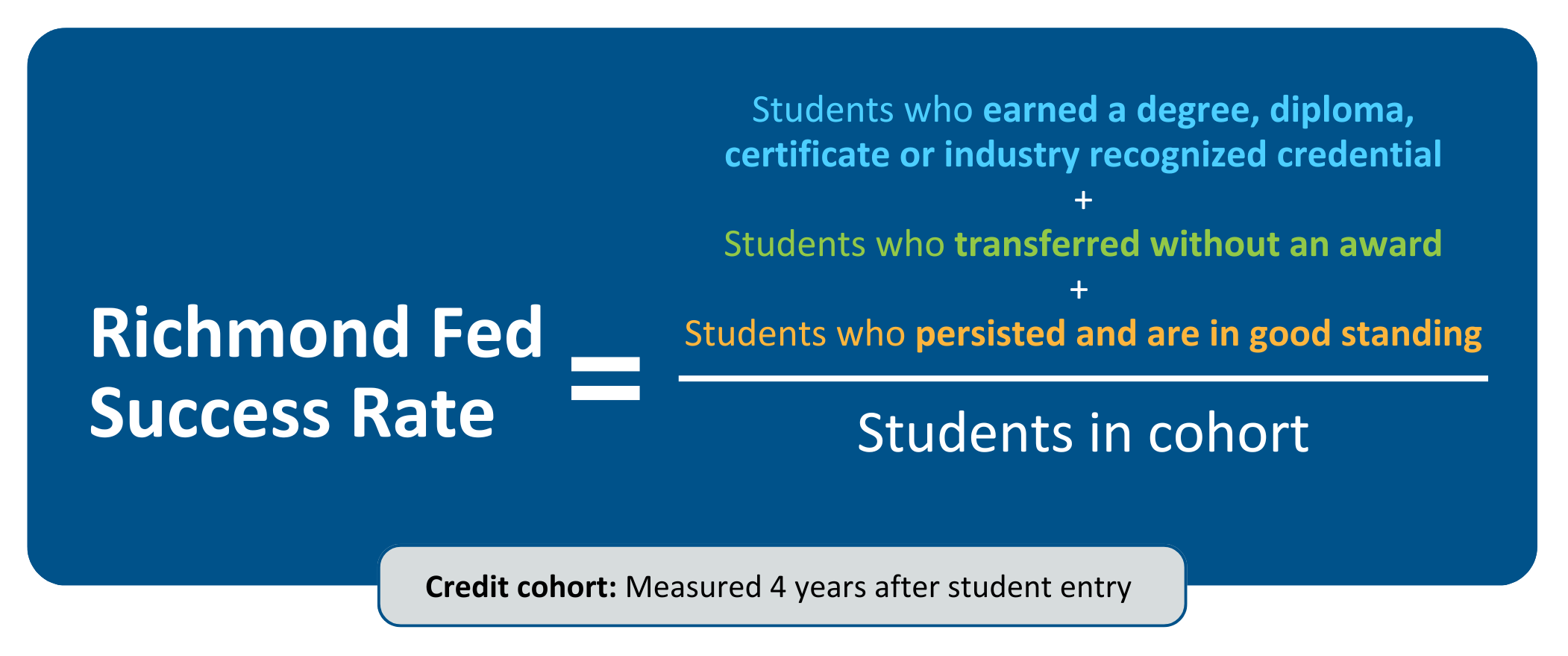
The Richmond Fed set out to create a new success rate that would reflect more pathways offered by community colleges than a traditional graduation rate.
The rate aggregates students who received a degree, diploma, certificate, or credential; students who transferred, even before receiving a degree; and students who are still enrolled, completed at least 30 credits, and had at least a 2.0 GPA.
Survey results
Across the survey’s 189 colleges, the Richmond Fed’s success rate was 49.8% for students who entered in 2020-21, compared to the traditional graduation rate of 33.8%, according to the U.S. Department of Education’s Integrated Postsecondary Education Data System (IPEDS).
For North Carolina, the Richmond Fed’s success rate was 49.1%, compared to the traditional graduation rate of 36.5%.

According to the survey, student success across geographic classifications — rural locales, towns, suburban areas, and cities — was similar, ranging from 48.8% to 52.8%.
In North Carolina, success rates among colleges ranged from 39% to 57%, though college names were anonymized in the survey report. For the state’s full-time community college students, the success rate was nearly 58%, compared to 42% for part-time students. Across all 189 colleges in the survey, the part-time rate was 43.6%, lower than the full-time students’ success rate by nearly 13 percentage points.

The survey also analyzed success rates across three age groups: those under 18 who had already graduated from high school, those ages 18-24, and those 25 and older. The youngest students had the highest success rate, while the oldest cohort had the lowest.
The report says this trend is likely due to these learners’ additional responsibilities outside school. Age-level data for North Carolina was unavailable due to reporting inconsistencies, the report says.
“The ways we assess and understand these institutions matters,” the report concludes. “… The Richmond Fed methodology and Richmond Fed Success Rate take us closer to accurately evaluat(ing) the unique role of community colleges in our workforce development system.”

Recommended reading