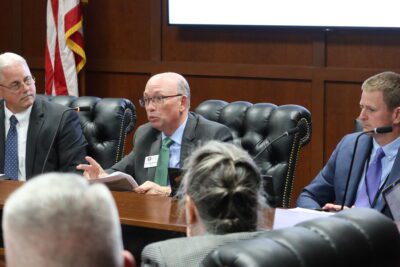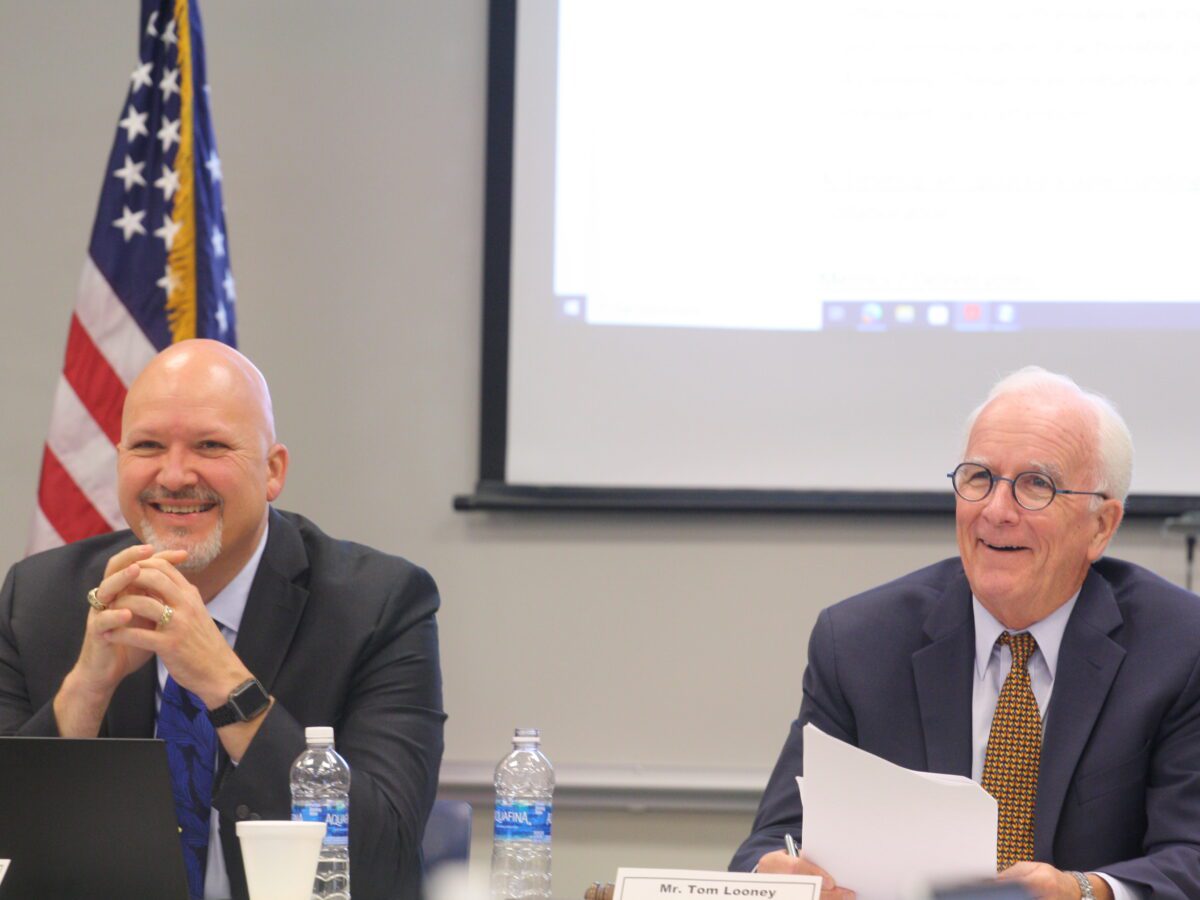
As the North Carolina Community College System (NCCCS) navigates a leadership transition and pushes for a new funding model, the State Board of Community Colleges advanced a series of changes during its March meeting. Those efforts included codifying the formation of a new executive committee, investing in student experience initiatives, and pushing to improve how colleges engage and communicate with students.
The Board’s new executive committee approved its charter Thursday morning after meeting for the first time last month. The special committee aims to “ensure alignment, speed, and clarity of decision-making during a pivotal period of leadership transition and system-wide transformation,” the charter says.
Those transformations include a search to replace system office President Jeff Cox after his upcoming retirement, creating a new 2026-29 strategic plan, and implementing a major technological overhaul.
 Sign up for Awake58, our newsletter on all things community college.
The executive committee charter describes the committee as the Board’s “coordinating body,” and states it will “not replace the full Board’s authority.”
During the executive committee meeting, Board Chair Tom Looney said the presidential search timeline has been pushed back again. The Board will complete a profile by April 17, informed by ongoing interviews with key stakeholders. Candidate interviews will start in May. Then, the presidential search committee and its advisory committee will conduct three finalist interviews in June and rank the finalists for Board approval. Once the Board has approved a finalist, that recommendation will go to the General Assembly for approval.
Looney said the new president would go through an onboarding process in July and August. Given Cox’s retirement effective June 30, Looney assured the committee that the Board would have a plan in place if the system faces a gap in leadership during the transition. He did not specify what that plan would include.
Committee members also discussed whether the next president should be from North Carolina. During listening sessions to inform the presidential profile, some stakeholders expressed that the candidate needed to be from North Carolina, which Looney said was attributed to how complex the system is. However, Looney emphasized that the search will be national and include potential candidates both within and outside of the state.
“We’re looking for someone who is currently employed and sees this as a great opportunity to come to North Carolina — either in North Carolina or externally,” said Looney.
The committee also discussed a brochure that will be part of an advocacy push for the General Assembly to fund Propel NC, the system’s proposed funding model that would “align funding with labor-market data to support historic enrollment growth and high-demand industries.” This is the system’s top legislative priority during the upcoming short session.
That push comes as new enrollment data shows the number of students earning credentials in high-wage, high-demand fields has not kept pace with available job openings — indicating an opportunity for growth with additional funding, system leaders said.
CRM survey results
In February, the system conducted a survey to assess colleges’ Customer Relationship Management (CRM) adoption, usage, challenges, and support needs. These platforms can be a hub for colleges to track student data and communications before, during, and after enrollment.
The survey report concluded that around 85% of the 53 respondent colleges use a CRM, though nearly 40% said their usage was partial or limited. Brian Merritt, senior vice president and chief academic officer for the NCCCS, said the system faces an urgent need to improve its CRM use for student engagement, enrollment, and retention.
Merritt also said progress has stalled due to thin staffing and limited CRM expertise — only 13% of colleges have a CRM team or administrator — resulting in steep learning curves, cultural resistance to the tools, training gaps, and slow adoption.
Data integration has been a major pain point, and advanced functions go largely underutilized, Merritt said. Colleges also face significant variation in their annual CRM costs, ranging from $30,000 to over $100,000.
To support CRM adoption, the system has piloted support cohorts that subsidize CRM costs and provide hands-on technical assistance, created a task force to collaborate on CRM implementation and training for colleges using Element451, hired college practitioners to provide hands-on support, and held a statewide convening.
Merritt concluded his presentation by proposing next steps for a system-led procurement process for a shared CRM platform, including taking inventory of existing CRM contracts and spending across the system and completing an analysis to determine the funding need. He said this plan would be co-designed with colleges and that his team would present a funding request to the Board for approval in May.
“The survey confirmed that the need is real — but we think the next step is building the case to do it right, at scale, for 58 colleges, and to develop a deployment plan that fits into the overall transformation roadmap,” said Merritt.
Short-term workforce development grant program update
Last year, the system dispersed $917,121 in funds to 1,645 students through the short-term workforce development grant program, according to a report presented to the Board.
The program offers up to $750 per course to students enrolled in short-term, noncredit, industry-recognized credentials aligned with the highest demand occupations in the state, as determined by the system and the Department of Commerce.
More than 1,000 students used grant funding for health care credential programs, per the report, followed by nearly 250 who received funds for trades and transportation credentials.
The concentration in health care “reflects sustained statewide demand for entry-level clinical, allied health, and emergency services credentials,” the report says. “This participation trend aligns with the State’s recent investment in high-cost healthcare program start-up and expansion efforts.”
Those investments have made community colleges a key player in meeting local health care workforce needs across the state, as EdNC has previously reported. In 2024-25, more than 44,000 students were enrolled in health care programs across the system.
Beginning in July, Workforce Pell will provide federal financial aid assistance to students in short-term workforce training programs for the first time, a historic expansion of Pell Grant funding.
Andrew Gardner, associate vice president of workforce strategies for the NCCCS, emphasized that state funds from the short-term workforce development grant will still be critical to supporting students since many workforce training programs do not meet the stringent eligibility requirements for Workforce Pell.
The public comment period for the proposed Workforce Pell rules is open now through April 8. Merritt said the NCCCS plans to submit a comment to the rules based on feedback it is collecting from colleges.
Endowment for Student Experience and Innovation
A $100,000 donation from Looney and his wife, Lucy, will fund the establishment of the Student Experience and Innovation Endowment, Looney announced last week.
The endowment will support technological improvements and student-centered initiatives across the system, including the creation of a Student Experience Council. The council will gather input from students on system decisions and on their college experience.
“This endowment is a commitment to funding real-world, scalable technology projects that will transform the entire student journey from recruitment to career placement, and turn our system into a responsive, connected, and truly customer-driven organization,” Looney said.
Katie Loovis, executive director of the North Carolina Community Colleges Foundation, said the system’s goal is to grow the endowment to $1 million as part of its broader fundraising campaign.
Cybersecurity update
A cybersecurity update included discussion of growing concerns among system leaders about fraudulent student applications.
The system is still working to determine the scale and cost of fraud, but free or low-cost applications at community colleges have made fraud cases more frequent than in the UNC System, said Stephen Reeves, chief information security officer for the NCCCS.
The goal of these fraudulent applications, Reeves said, is to access federal aid such as Pell Grants. Since February, colleges have been able to flag specific student records as possibly fraudulent, which feeds into the system’s data warehouse to run reports.
The cybersecurity update report says colleges can access free cybersecurity training from Texas A&M at no cost. Scheduling is ongoing, and so far Bladen, Blue Ridge, and Durham Technical community colleges have hosted training sessions.
The Board also approved a new three-year contract with cybersecurity platform KnowBe4 to deliver cybersecurity awareness training across all colleges.
Vocational Rehabilitation Counselor Pilot Program
The Board also heard a report on the challenges facing the Vocational Rehabilitation Counselor Pilot Program, designed to assist students with Intellectual and Developmental Disabilities (IDD) in getting competitive integrated employment, as well as supporting their mental health and well-being. The pilot began in 2023 with a $750,000 appropriation to operate the Bridge2Success program across six community colleges.
Lisa Estep, chair of the finance committee, described the report’s data as “disheartening,” as it revealed the program had low engagement and only generated one successful case in which a student was employed at least 90 days after the program.
Estep called for additional analysis into the program’s challenges and low success rate.
“To me it was important to get this right, and since it looks like we really were not that successful with it, to analyze why that was,” Estep said. “I would love to see another analysis of that to see what were the barriers that didn’t allow us to get to success.”
A representative from the Employment and Independence for People with Disabilities division at the Department of Health and Human Services, which partnered with the system on the program, said counselor staffing was a major challenge.
Other business items
- The Board approved two applications from Cooperative Innovative High Schools seeking approval for supplemental funding for the 2026-27 school year. The applications, submitted by Durham Early College of Health Sciences and The School of Inquiry and Life Science at Asheville, will now go to the General Assembly for final approval and funding.
- The Board also approved a request to create a new curriculum prefix enabling the system to create courses and credentials for microelectronics manufacturing (MEM) — a field commonly associated with the semiconductor industry. MEM will now have a “Sector 1 (Tier 1a)” designation, meaning it aligns with “priority occupations” that face “skills gaps and pay higher wages.”
- The Board approved $19,000 in reserve funds to Wayne Community College to coordinate course development and provide instructor professional development for the Residency Teachers Licensure courses.
- The Board approved a $659,367 allocation per year of state funds for a new cohort of nine NC Career Coach Program, which has funded 49 colleges to place career coaches in high schools.
- The Board also approved $550,000 in awards to a grant program providing financial assistance for students in low-enrollment programs that prepare them for high-demand fields, students with disabilities, and students enrolled in fewer than 6 credit hours per semester who would otherwise qualify for need-based aid.
The full Board’s next meeting will be on May 14-15. The April Board meeting dates are canceled due to the system’s awards dinner on April 15, 2026.
EdNC’s Sophia Luna contributed reporting to this article.


Recommended reading