Dr. Jason Wood, former president of Southwest Wisconsin Technical College (Southwest Tech) and current vice president of Salt Lake Technical College, says one saying drives everything Southwest Tech does:
We don’t graduate people into poverty.
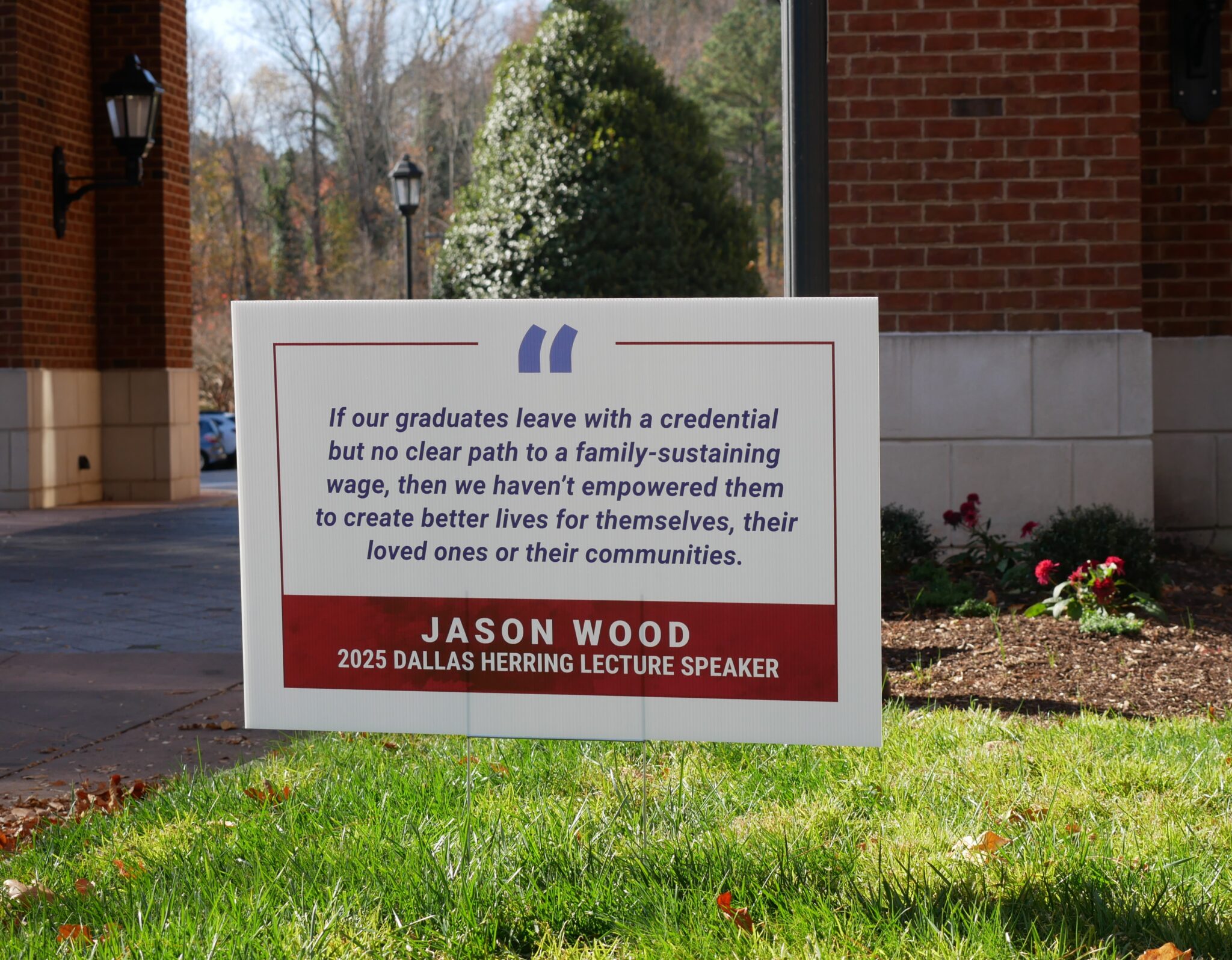
“That’s not just a value — it’s a challenge, an invitation,” said Wood. “It forces us to ask: Are our students truly better off because they came to us? Are we designing every part of the college experience not just for enrollment and completion, but for economic mobility?”
At the 2025 Dallas Herring Lecture on Tuesday, Wood delivered a keynote address that outlined a framework for designing the college experience around student success. He shared strategies for community college leaders to reimagine how they design programs, support individual students, and engage employers, all with a focus on helping the students who need it most.
During Wood’s tenure at Southwest Tech, a small, rural college located 70 miles outside of Madison, Wisconsin, the college won the 2025 Aspen Prize for Community College Excellence — the nation’s highest honor for community colleges.
The prize recognized the college’s commitment to ensuring students’ post-graduate success, noting that “far too many college students across America either don’t graduate or complete a program that costs them time and money but doesn’t effectively prepare them for a good-paying job or bachelor’s degree.”
“Opportunity without outcomes is an unfulfilled promise, and the real question isn’t whether innovation is possible, it’s whether we’re willing to do it for the people who need it the most,” Wood said during his address on Tuesday.
 Sign up for Awake58, our newsletter on all things community college.
National community college leaders have delivered the Dallas Herring Lecture since 2015. Tuesday’s event marked the 11th lecture since its inception.
The lecture honors the late W. Dallas Herring — the “father” of the North Carolina Community College System — and is hosted by North Carolina State University’s College of Education and the Belk Center for Community College Leadership and Research (Belk Center).
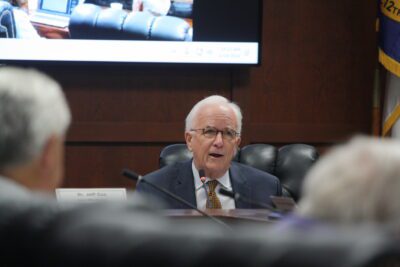
Dr. Audrey J. Jaeger, executive director of the Belk Center, said the lecture offers an opportunity to engage in critical conversations about the most urgent topics facing community colleges.
“The Dallas Herring lecture has always been about possibility,” she said. “This year’s topic calls on us once again to dig deeper — to ask how we can assure our colleges don’t just open their doors, but truly serve as engines of economic mobility and opportunity for all.”
All 58 North Carolina community colleges had someone in attendance at the lecture or watching online, according to Jaeger, and at least 12 colleges held lecture watch parties.
Jaeger also discussed the lecture’s namesake, including Herring’s charge that community colleges serve as open doors to educational opportunities for all North Carolinians and that they meet people where they are and “carry them as far as they can go.”
“We must support policies which open all of the doors to all of the people who walk through them,” she said, adding that this commitment also guides Wood in his work.
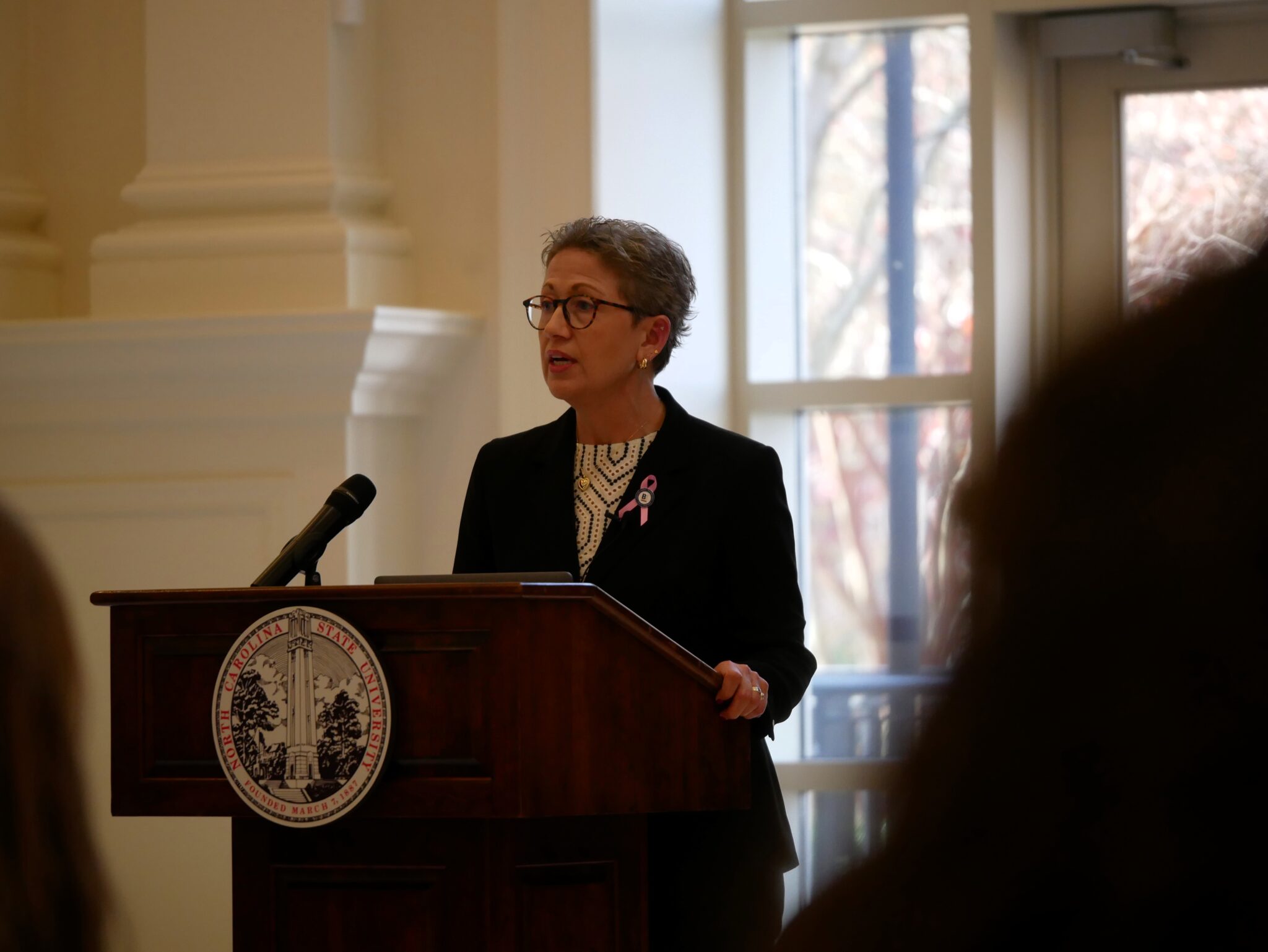
Dr. Warwick Arden, executive vice chancellor and provost at NC State University, then introduced Wood, noting that Wood’s leadership at Southwest Tech helped the college become a national model for how rural colleges can achieve results.
“Dr. Wood’s message invites us to examine the systems we lead, to design them intentionally, measure impact thoughtfully, and ensure students remain at the center of everything we do,” Arden said.
Redesigning programs to increase access to high-wage jobs
During Wood’s tenure at Southwest Tech, agriculture programs faced challenges, including all-time low enrollment and $12-$14 per hour average wages for some graduates. In response, Wood said he and his leadership team visited with agriculture employers, toured job sites, and spoke with both alumni and those who didn’t finish the program to better understand what changes were needed.
These actions informed what Wood described as a series of “bold innovations” to the college’s agriculture programs, including closing at least six outdated credentials, launching a new precision agriculture program to better meet workforce needs, and placing a new emphasis on short-term training tied to industry-recognizing credentials, such as Commercial Driver License (CDL), drone certification, and pesticide applicator certification.
“Our employers agreed to almost double entry-level wages when they came out with those credentials,” Wood said.
During his address, Wood urged other community college leaders to engage in this kind of innovation to ensure programs produce good outcomes for graduates. His advice includes:
- Prioritize an industry;
- Focus on innovations that will increase enrollment, completion rates, and access to high-wage jobs.
“Above all, it (innovation) means being bold enough to admit when what worked yesterday won’t work tomorrow, and caring enough to change it for the students,” said Wood.
Becoming an ‘employer of preference’
At Southwest Tech, the lowest-paid employees previously made in the mid-$20,000 range. Now, no one makes below $40,000, and the college offers a generous benefits package.
As a result, Wood said the positions that previously experienced high turnover — evening custodians — are now the most loyal employees, search pools are more dynamic, and community college graduates often strive to get a job at the college.
To achieve this, Wood said, “requires that you prioritize everything you spend based on the impact on students, with a willingness to invest in what makes the biggest difference: our people.”
Just as Southwest Tech is now an “employer of preference” in its community, Wood said community colleges can develop new programs to target local, high-wage industries.
In North Carolina, one example of this is Johnston Community College’s recent investments in biotechnology programs. Wood shared that the college now offers many levels of certification to allow students to enter high-paying jobs at local companies, which include Grifols, Novo Nordisk, Bayer, and Natvar, all located in Clayton.
Creating personalized student success plans
Wood then discussed how Southwest Tech works with each student to create a personalized success plan, which includes three components:
- Career counseling to help the student understand the local job market and how their strengths may align to workforce needs. Importantly, this step is completed before they submit an application.
- A schedule that maps out the courses the student needs alongside support services that will help them complete their program.
- An individual financial plan that considers tuition and living expenses, helping the student design a budget and identify their “gap.” Southwest Tech’s scholarship process then prioritizes funding based on filling those financial gaps.
Wood emphasized that these plans are not handouts — students help create them, and they are designed to be actionable.
Placing students at the center
Throughout Wood’s remarks, he emphasized the importance of building authentic connections with students and encouraged community college leaders to place one question at the center of their efforts: Will this decision help all students, especially the ones who meet at the most?
He invited community college leaders to get to know the students who may be least likely to succeed at their college by sharing meals with them, learning their stories, and using their experiences to reshape systems that better serve students.
He also invited leaders to ask students to teach them something they learned in the classroom and then thank instructors for their role in the process. Wood said asking students about their learning experiences gives him an authentic understanding of “what’s sticking, what’s resonating, and why it’s meaningful to students.”
Finally, Wood said that caring about students’ lives doesn’t end at graduation, encouraging community college leaders to collect feedback from alumni, employers, and university partners to understand where there are gaps in the student experience.
“When we courageously improve the student experience, we lift people out of poverty, benefiting generations,” he said.
Insights from recovery efforts in western North Carolina
Following Wood’s remarks, former N.C. Secretary of Commerce Sharon Decker, who now serves as senior advisor for long-term recovery for the Governor’s Recovery Office for Western North Carolina (GROW), delivered a response focused on North Carolina.
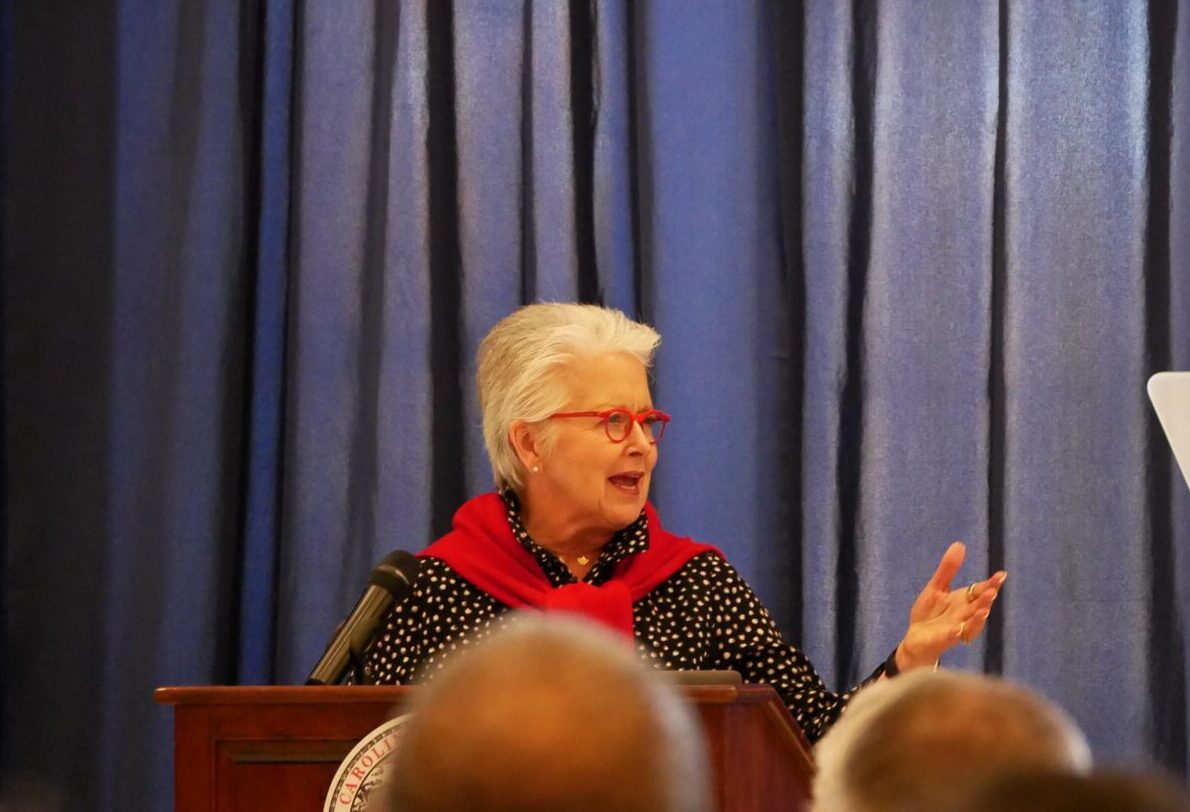
Decker reflected on the role the North Carolina Community College System has played in her life story — including that she met her husband in the parking lot of then Cleveland Tech, now Cleveland Community College, and that her father taught classes at Gaston College.
“Without our community colleges, the great success we’re experiencing in our state — to be identified as the No. 1 state for business — simply would not happen,” she said.
Drawing on Wood’s encouragement that any college can innovate with courage, humility, and urgency, Decker shared her perspective on what it takes to lead change.
First, she acknowledged the challenging conditions community colleges are working within, noting that budgets are declining, demands are growing, and “politics at every level is more challenging than I’ve known it in my lifetime.”
In that context, to ensure graduates move into meaningful careers with family-sustaining wages, Decker said it starts with courage and community.
“It takes courage to recognize that some of our long-held practices are no longer serving the students and the communities as they need to in a world that’s changing as it is,” she said, adding that it also takes courage to challenge the status quo and take risks. “We’ve got to have the courage to try, because a position of no change almost guarantees that we will fail.”
Decker also echoed Wood’s remarks about the importance of engaging with employers to better understand their workforce needs and then designing programs that meet those needs. Rather than tracking how many graduates an institution has, she encouraged community college leaders to consider how many are graduated and gainfully, happily employed.
“You can’t begin to envision that without a collaborative and partnership approach to doing the work. Have you spent time with these employers? Do you know them? Have you called on them for anything beyond fundraising?” she asked.
Drawing on her experience leading long-term economic recovery in western North Carolina in the wake of Hurricane Helene, Decker then discussed her efforts to strengthen the education and workforce development system needed to help the region recover.
With support from the John M. Belk Endowment, Decker said she is exploring:
- Engaging business and industry leaders to understand local needs, and then using that information to instruct the design of programs, credentials, job site learning opportunities, and more, particularly to help workers move into jobs with living wages.
- Defining a vision for the workforce of the future and ensuring all stakeholders understand that vision, from teachers to elected officials to students.
- Understanding the needs of the community, including the need for service workers in health care, emergency services, teaching, and social work. “For communities to thrive, the basic needs of services must be met, yet our enrollment in these programs is falling below the need every single year,” Decker said, adding that there is also a need for skilled tradespeople, including electricians, plumbers, welders, and carpenters.
- Ensuring local, state, and federal policies align and that outcomes are measured the same — “let’s get in the same boat,” she said.
- Teaching students in elementary and middle school about local career opportunities that will allow them to remain in their communities and earn family-sustaining wages. Decker noted that this is especially important for young men, adding that “across the education continuum, boys consistently fall behind academically.”
Decker concluded her remarks with a final charge: “It’s time to pull out all the stops, challenge our assumptions, and craft new ways forward. Ask more questions, be willing to identify the problem and then act on it. What have we got to lose? I’d suggest an entire generation if we don’t.”
Advice for community college leaders
To conclude the event, Jaeger moderated a brief discussion with Decker and Wood. Reflecting on Decker’s prior role as state secretary of commerce, Jaeger asked what is needed to build the workforce that will support new businesses moving to North Carolina and how community colleges can best support those efforts.
Decker returned to a message she shared in her lecture response: the importance of understanding business opportunities in your community through close relationships. She recalled meeting a significant, local employer at a recent conference who was frustrated; Decker came to understand that he didn’t know what the local community college offered.
“He had no context for what that college could do for him, but most importantly, I don’t think the college understood what he needed,” she said. “And that happens in conversation — it’s not a one-time conversation, it’s a relationship.”
Wood then reflected on his transition to leading student success efforts at Salt Lake Technical College. One difference, he said, is that there’s a much larger gap between the socioeconomic status of students at large, urban colleges compared to small, rural colleges. Regardless of campus size, Wood said there’s an opportunity for community colleges to act as conveners of local employers and to better align available resources.
Jaeger then opened the floor to audience questions. Cecilia Holden, CEO of myFutureNC, shared North Carolina’s attainment goal — 2 million adults holding an industry-valued credential or college degree by 2030 — and asked what strategies the panelists would recommend to accomplish it.
Wood said he would prioritize building clear workforce connections early, during junior high and the early years of high school, and closely connecting employers to those efforts.
“How do you design the education system early on so that it incorporates the workforce by design and leads to the first credential as an inevitable part of that journey?” Wood said.
Decker echoed Wood’s answer about the importance of starting early, adding that a cultural shift is needed to ensure students learn about career opportunities through their preferred communication channels.

J.B. Buxton, president of Durham Technical Community College, asked Wood for advice on how to work with employers to raise low wages. Wood admitted that the first few conversations were uncomfortable — employers expected a discussion about supplies or donations, and instead, they were asked to raise wages.
One tactic Wood used was reframing the invitation to employers as: If you tell us what would make our graduates more profitable for you, will you reinvest some of those earnings into their wages?
“I have not been turned down yet,” he said, adding that the biggest hurdle then became how fast the college could change the competencies it was offering.
You can watch the full 2025 Dallas Herring Lecture here.
Editor’s note: The John M. Belk Endowment supports the work of EdNC.

Recommended reading