
Some FAFSA technical issues fixed while others remain


Updated March 22, 2024: The U.S. Department of Education announced on March 22 that a miscalculation in the FAFSA Processing System resulted in incorrect Institutional Student Information Records (ISIRs) for dependent students with assets being sent to colleges and universities. Read the full statement here.
A technical glitch preventing parents without a social security number (SSN) from starting or contributing to the Free Application for Federal Student Aid (FAFSA) has been fixed. The U.S. Department of Education released an update about resolved issues with the federal aid system on March 12.
These fixes come months after the U.S. Department of Education released an updated “Better FAFSA” on Dec. 31, 2023, three months later than it typically would be released. The delay in the rollout of the new FAFSA and several technical glitches have resulted in far fewer students completing the form than in previous years.
 Sign up for Awake58, our newsletter on all things community college.
System fixes and unresolved technical issues
According to the release, parents without a SSN may now log in to FAFSA.gov to either start a FAFSA form or complete their section of the FAFSA form after being invited to participate by a student. The department recommends that students start the form and invite parents to contribute to avoid further glitches.
However, technical issues remain.
Some applicants and their contributors without a SSN are encountering an error message when trying to complete the FAFSA. The glitch happens when personally identifiable information is mismatched. If the personally identifiable information entered on the contributor’s invitation is different from what is listed on the contributor’s StudentAid.gov account, an error message occurs. The department advises students impacted by this to wait to invite contributors until the department can resolve this issue.
Additionally, users without a social security number, including those with an Individual Taxpayer Identification Number (ITIN), must manually enter their financial information. There is not an estimated timeline for this issue to be resolved.
Students with a contributor without a SSN can now access the department’s tips document for submitting the FAFSA. Students and families impacted by these issues can also sign up for regular FAFSA updates.
Open issues with the FAFSA and workarounds can be found here. Resolved issues can be found on the same page by scrolling down.
Related reading
Information for colleges and universities
Three days after the technical issues update, U.S. Secretary of Education Miguel Cardona sent a letter to college presidents and chancellors providing information on the department’s progress.
“We know the process of overhauling a broken system — making the most significant upgrade to the FAFSA form in more than 40 years –– has put great pressure on you and your institutions,” Cardona said in the letter.
The department announced in January that colleges would not receive students’ FAFSA data until March or later. Colleges use this data to determine eligibility and award aid.
As planned, the department started sending students’ FAFSA data, also known as Institutional Student Information Records (ISIRs), to a small batch of colleges earlier this month.
The letter explains the department is ramping up the volumes of ISIRs they are sending and aims to fully process and send student records about two weeks after reaching “peak processing capacity.”
The department has deployed federal personnel and nonprofit financial aid experts to nearly 300 schools to help them process aid packages. Schools who need support should get in touch with the department’s College Support Concierge.
Cardona went on to offer recommendations for how institutions can prepare to process the FAFSA data, including:
- Making sure teams have completed their Student Aid Internet Gateway (SAIG) mailbox agreement.
- Downloading and configuring key software (i.e. EDconnect).
- Developing staffing plans for processing ISIRs.
For technical assistance, schools can reach out to the department’s Concierge Service.
The letter also urges colleges to consider extending enrollment decision dates, aid applications, and payment deadlines “so that students will have equitable access to aid.”
Some colleges and universities have already made these changes. The National Association for College Admission Counseling created a public directory to show which member institutions have extended enrollment deadlines.
FAFSA completion rates are down
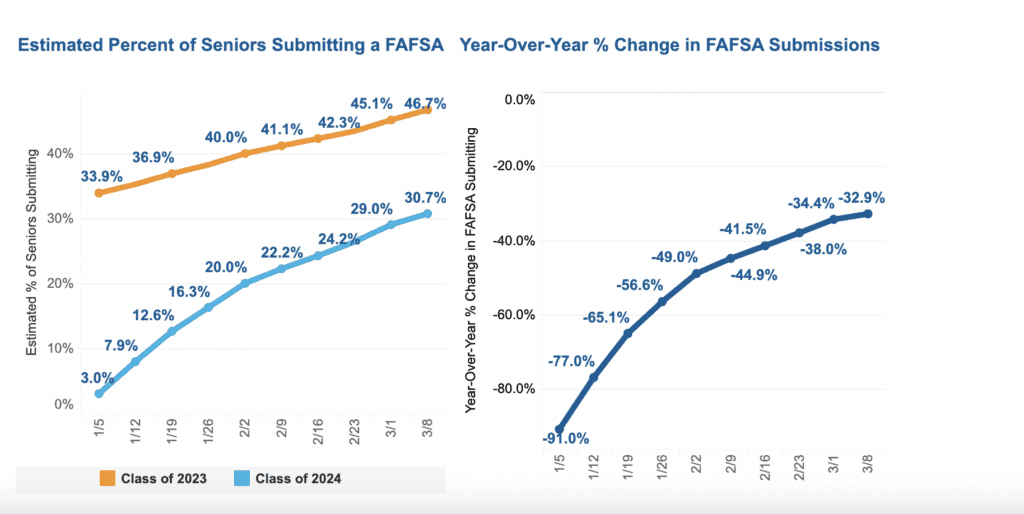
National and state-level data show FAFSA completion rates are lower than last year.
As of March 8, 2024, 30.7% of U.S. high school seniors had submitted a FAFSA, according to the National College Attainment Network (NCAN). This time last year, 1,901,549 seniors had submitted the FAFSA compared to 1,275,781 seniors this year — a difference of 625,768.
Those trends also hold true for North Carolina.
According to the North Carolina State Education Assistance Authority’s FAFSA tracker, 35,468 of North Carolina’s 102,128 seniors have submitted the FAFSA as of March 8, 2024 compared to 49,504 seniors last year.
EdNC will continue to track FAFSA updates. You can view our most recent coverage here.
Resources for students and families
- The College Foundation of North Carolina
- A list of issues with the FAFSA and potential workarounds
- North Carolina State Education Assistance Authority
- Federal Student Aid
Resources for institutions
- Better FAFSA toolkits
- College Support Concierge
- For technical issues with ISIR processing: 1-800-330-5947
- For more general FAFSA questions: FSA’s Partner Connect Help Center