
New statewide program aims to support development of high-quality principals


State Superintendent of Public Instruction Catherine Truitt likes to talk about principals as a policy lever. Most policy reforms center on teachers and instruction — but school building leadership, she says while referencing a Wallace Foundation report, is effective because it touches both.
But using principal leadership as a lever for downstream change has been hard amid elevated stress, burnout, and a leaky pipeline of qualified candidates in some parts of the state. That doesn’t mean great leaders aren’t out there, state leaders say, or that North Carolina can’t invest in growing great leaders statewide.
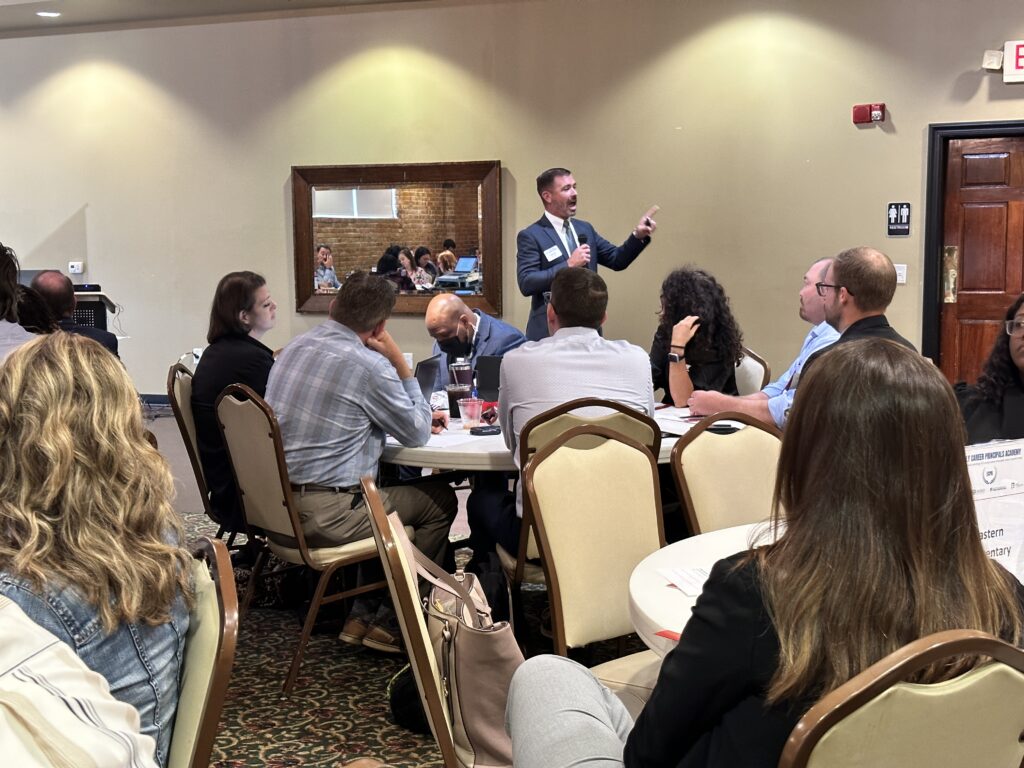
That’s why more than 200 new principals gathered in a conference space last week for the first meeting of the Early Career Principals Academy, a professional learning program intended to grow the leadership skills of principals in their first three years on the job.
“You all are the spark in your school,” Truitt told the gathering. “For those of you who are new, it’s gonna be hard. But I promise you it is well worth it. You are changing lives.”
This inaugural cohort of the ECPA will help design the program, which is just the latest in a line of partnerships between the education system and principal associations.
A continuum of support for principal leadership development
The spark that flared into the ECPA was lit at a meeting of the State Board of Education. Actually, it’s helpful to begin before that.
In 2015, the state established the Transforming Principal Preparation program (TP3). It was intended to create more and better principals at a time when there weren’t enough strong candidates to fill the needs. That initiative, now called the Principal Fellows program, took teachers with leadership aspirations and gave them professional development and tools to enter assistant principalships.
The idea was to create a pipeline for future principals.
About 200 members were inducted in the first cohort, but fewer than 30 made it to the principalship.
“They were languishing in those (AP) roles and not getting promoted,” said Shirley Prince, executive director of the North Carolina Principals and Assistant Principals’ Association (NCPAPA). “So we wanted something to identify the bright stars and get them ready to step into that principal’s role.”
In response, the Department of Public Instruction (DPI) partnered with NCPAPA last year to establish the AP Accelerator. That program offers professional development and coaching to select assistant principals, nominated by their superintendents, to help them enhance their skills and become principals.
Truitt and her team at DPI updated the State Board of Education on the AP Accelerator last fall. At the time, there wasn’t much state professional development programming for new principals. The Fellows program and NCPAPA’s Future Ready program focused on the assistant principalship, and NCPAPA’s Distinguished Leadership in Practice (DLP) program was designed for more veteran principals.
State Board Vice Chair Alan Duncan wondered whether the AP Accelerator – a one-year program with ongoing coaching – was enough. Prince’s eyes lit up, and she began scribbling ideas for what became the ECPA.
“This was the missing piece,” she said.
Supporting new principals
The ECPA was created through a partnership among DPI, NCPAPA, the N.C. Alliance for School Leadership Development, and the Belk Foundation. The ECPA curriculum will align with North Carolina and national principal performance standards and competencies while also fostering a network culture.
It is designed to meet the needs of school leaders in a blended format of in-person and virtual meetings, all facilitated by school leaders identified as exemplary.
From the show of hands during Prince’s welcome at the ECPA’s inaugural meeting, more than half of the principals in the program this year are in their first year.
“We know that the principalship, particularly in high-needs schools, is a challenging role,” said Tabari Wallace, the 2018 Principal of the Year and Truitt’s principals advisor. “And this three-year, statewide leadership development program will provide early-career principals with the support they need to improve their effectiveness, retention and satisfaction while boosting student achievement.”
The in-person sessions are designed to motivate and inspire participants and help them focus on conditions they can control to achieve optimum school environments. Follow-up, virtual sessions will provide a curriculum designed to build the leadership skills and competencies necessary to effectively control the conditions required for student success.
In the third year of the program, participants will complete NCPAPA’s DLP program.
“By investing in principals through programs like the Early Career Principals Academy, we invest in the culture and community of a school that impacts the next generation of students across our state,” Truitt said. “We know the critical role principals take in creating an environment of learning and growing for all in their buildings. Through the ECPA, principals are provided with the tools and resources to help them succeed and thrive in their roles as school leaders.”