
Twenty-five years of charter schools: A look at the data

It’s National Charter Schools Week, and this past year marked 25 years that charter schools have existed in North Carolina. At this month’s State Board of Education meeting, Board members heard the annual report on charter schools. Here is what you need to know.
 Sign up for the EdDaily to start each weekday with the top education news.
Context
The North Carolina General Assembly passed the Charter Schools Act in 1996. At the time, a cap of 100 was placed on the number of charter schools allowed in North Carolina. In 2011, the legislature lifted that cap.
As of this school year, there are 204 charter schools operating in North Carolina, with eight more slated to open in the fall.
While school choice options such as charter schools have grown in popularity over the years, traditional public schools remain the route most students in North Carolina take. Charter school Average Daily Membership (ADM) was about 8.8% of the state total. ADM is a measurement that gives the state an idea of how many students are in schools.
The state funds schools based on ADM, so as charter schools have grown, so has their funding. In 2006-07, North Carolina allotted a little over $144 million to charter schools. This school year, that amount was north of $900 million.
Accountability
Advocates of charter schools argue that these kinds of schools have the ultimate accountability. If they aren’t functioning properly, they can be closed.
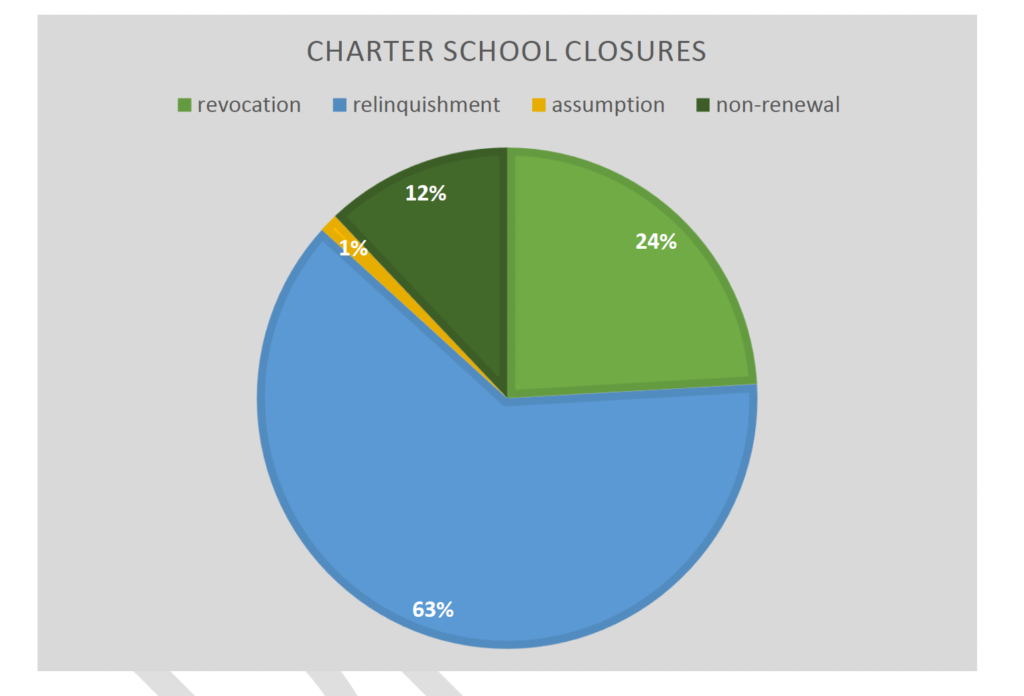
Since 1998, 20 charters have been revoked by the State Board of Education, and 10 haven’t been renewed. In addition, 52 schools voluntarily relinquished their charters, and one school’s charter was taken over by another nonprofit board.
Additionally, charter schools are measured based on financial and operational goals — such as adhering to testing and accountability policies for state assessments, staying up-to-date on fire inspections, and having appropriate insurance. Charter schools can meet or exceed their financial and operational goals, and 192 out of 200 did so, according to this year’s annual report.
Keeping track of these goals is meant to prevent problems such as the recent investigative report by the Office of the State Auditor which found that Bridges Academy had falsified student enrollment records and received more than $400,000 in state funding.
Where are the charter schools, and who is going?
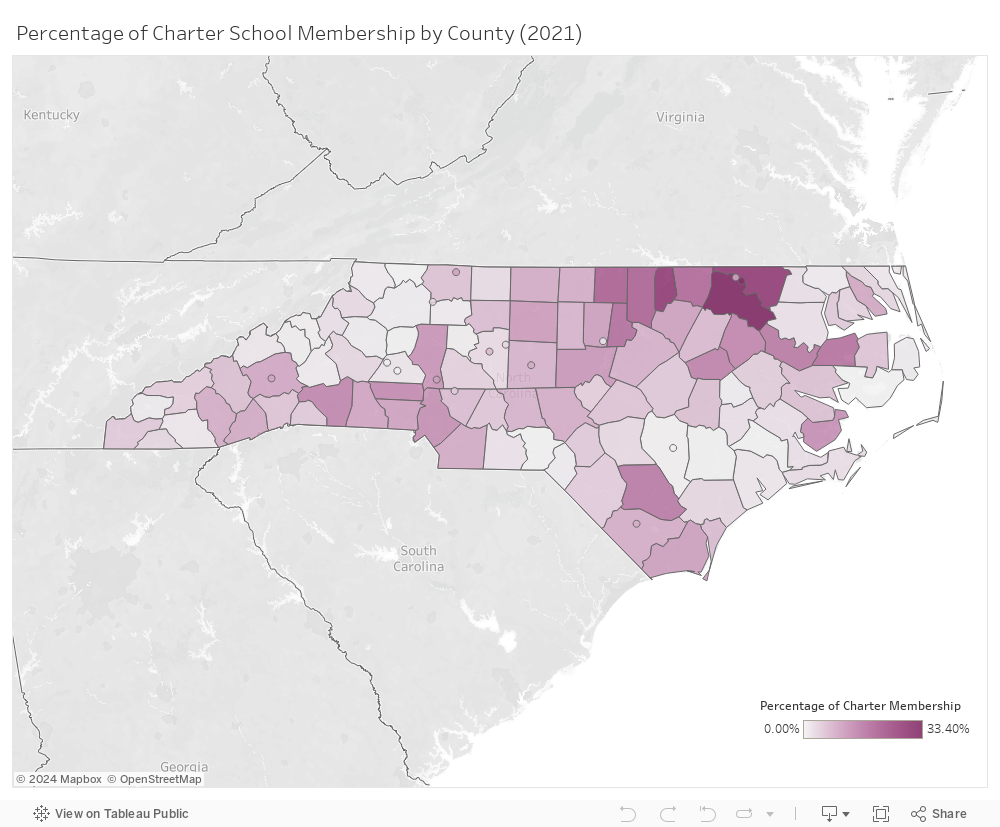
Below is a map breaking down charter school membership by district. But the top five districts are as follows:
- Halifax: 33.4%.
- Vance: 28.6%.
- Northampton: 28.4%.
- Weldon City: 27.8%.
- Person: 20.4%.
Two of those districts — Halifax and Weldon City — are in Halifax County.
About half of the state’s 130,000 charter students are white. Twenty-six percent are Black, and 13% are Hispanic. See the chart below for more detail.
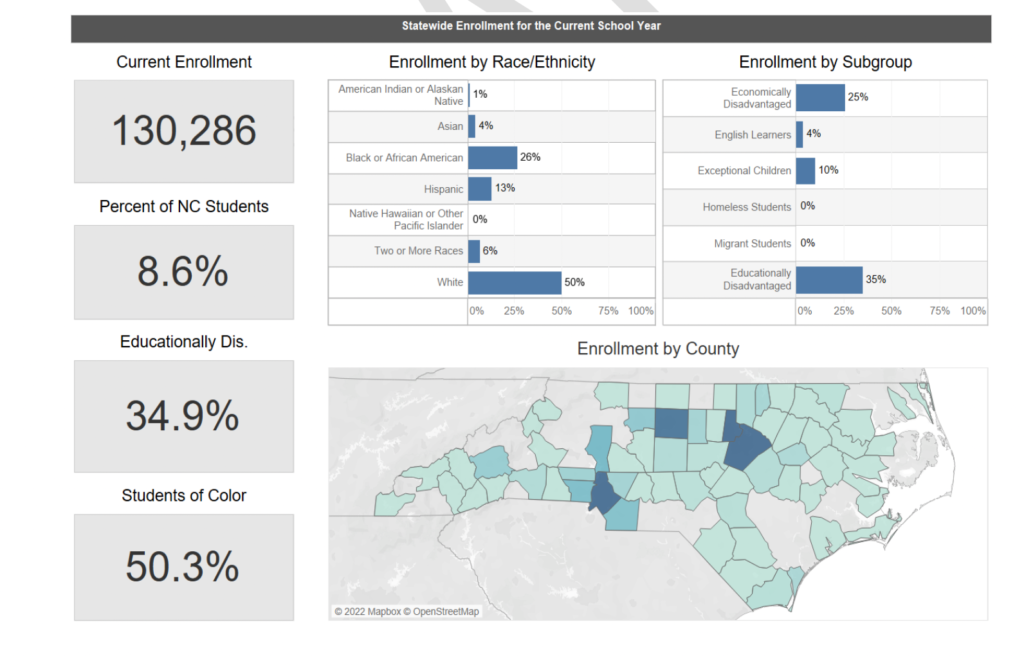
Take a deeper look at this data in the full report.
Use the map below to explore charter membership by county.
Share this story
- What districts have the most charter schools? Who goes to charter schools in North Carolina, and how many more charters will there be in the fall? Learn about all that and more here.
- The State Board of Education heard the annual charter schools report this month. Here are some of the things you need to know from that report.