
5 takeaways from the State Board of Community Colleges monthly meeting
The community college system in North Carolina is made up of 58 colleges, each with its own leadership structure and a board of trustees that oversees its strategic direction. All 58 colleges and boards of trustees report to the State Board of Community Colleges which meets monthly for two-day committee and full board sessions that are open to the public.
On July 18 and 19, the state board met, and EdNC was there. Here are five things we learned at the July state board meeting.
1. Elections
The State Board of Community Colleges elected new officers to lead the board.
Breeden Blackwell, a retired school principal from Fayetteville, was elected chair. A member of the state board since 2015, Blackwell previously served as a trustee of Fayetteville Technical Community College and was a member of both the Fayetteville City Council and the Cumberland County Board of Commissioners.
“We never should forget why we serve, and that’s the students,” Blackwell told the board Friday. “It’s about the students, and if we can always keep a focus on that in decisions we make, I don’t think we can go wrong.”
Bill McBrayer of Hickory was elected vice chair of the board. He is the human resources director of Lexington Home Brands and has served on the state board since 2015.
The board honored the outgoing chair, Scott Shook, and vice chair, James Rose, for their leadership. Both will remain on the board.
2. Wilkes Community College + Alleghany County partnership
Monica Sanchez was a waitress at a Mexican restaurant in Alleghany County, and that was as high as her aspirations went. Then, she heard about the Alleghany Educational Foundation, a partnership between Wilkes Community College Foundation and Alleghany County Schools that promises at least $1,000 to every county high school graduate who attends Wilkes Community College.
“At times, I thought it was a possibility I wouldn’t be able to go to college because I wouldn’t be able to afford it,” Sanchez said. She has known Wilkes Community College President Jeff Cox since elementary school, and once told him: “When I was in high school and I was working down at the Mexican restaurant, I thought that was all I would be able to do.”
Instead, she received a scholarship from the foundation, received her associate degree in nursing, and now works as a nurse in the emergency room at Alleghany Memorial Hospital.
The foundation is an example of a partnership between a county’s community college and school system, and Cox spoke to the State Board, he said, to share its story in hopes that other North Carolina counties could benefit from the experience and perhaps learn something.
“We wish that every county in the state could replicate what’s happening a little bit in Alleghany County,” Cox said. “It’s a story that needs to be told for sure.”
3. Legislative wins
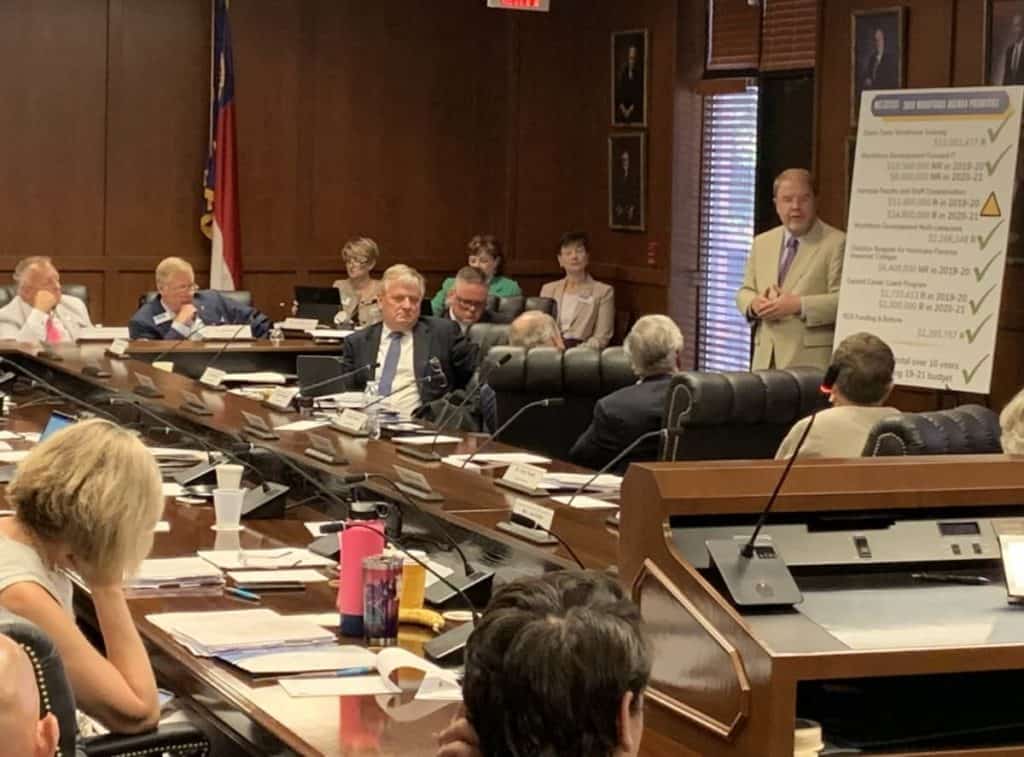
When the community college system leaders settled on a legislative agenda this past winter, they set forth an ambitious push for seven priorities. At the board meeting, Peter Hans, president of the community college system, and legislative director Mary Shuping presented the board with an update on those seven items — which were highlighted by a series of green check marks denoting success.
“I remember people saying, ‘You’ll never get this funded or that funded or this funded,’ but I never did believe that,” said David Shockley, president of the community college presidents’ association and Surry Community College. “Because we approached things differently this year in being able to get everyone to pull in the same direction at the same time for the same purpose and goal — which is our students.”
Hans and Shuping each emphasized that the bills and budget line items remain to be finalized. One bill has been signed into law, while most legislative wish-list items are non-controversial line items addressed in the state budget, which is being held up by unrelated disputes between the legislature and Gov. Roy Cooper.
“[It’s like] Christmas,” Shockley said, “in that you know that you have those presents and that they’re yours, but you can’t touch them until Christmas day.”
Based on the most recent budget proffered, though, here’s where the system is positioned on its priorities:
| Community college system’s ask: | What they got: |
| $12 million for short-term workforce training | $12,051,477 recurring |
| $15 million for workforce development focused IT | $10.5 million non-recurring in 2019-20, and $8.5 million non-recurring in 2020-21 |
| Increase in faculty and staff compensation | $12.4 million in 2019-20 and $24.8 million in 2020-21, representing a 1% increase each year |
| Workforce development multi-campuses | $2,266,348 recurring |
| Stabilize budgets for Hurricane Florence-impacted colleges | $6.4 million in 2019-2020 |
| $2.8 million to expand the career coach program | $1,733,413 in 2019-2020, and $2.3 million in 2020-21 |
| Changes to residency determination service (RDS) law that was adversely impacting community college applicants | Passage of HB 668, signed into law by Governor Roy Cooper on July 19, which allows applicants to rebut the presumption they live out-of-state with their parents by showing they graduated from a North Carolina high school.
$2,285,757 for funding community college operations related to RDS |
4. Boham’s back
Just a couple months after his interim stint at James Sprunt Community College ended, the community college system has tapped Ken Boham to lead the transition at Martin Community College… again. Boham, who began his community college presidential career at Caldwell Community College and Technical Institute, served as interim president at Martin three years ago in the wake of financial and operations controversies at the college that threatened its shutdown.
In 2018, Paul Hutchins was named president and Boham set off for James Sprunt where he ended his interim term earlier this year. In May, however, Hutchins was suspended shortly after the suspension of Martin’s dean of administrative services and capital project coordinator, Steve Taylor. Earlier this month, Hutchins formally resigned, effective July 31, and Brian Busch, the college’s executive vice president, assumed acting president duties.
Currently, Boham serves as consultant to the Martin Community College Board of Trustees. On August 1, he will assume the role of interim president and believes he can help the college transition to its full-time president by June of next year.
“All of the challenges that the college has experienced, it hasn’t affected that the college is still Martin strong,” Boham said. “And it hasn’t affected the quality of the education at the college. And it hasn’t affected the mission and the desire of the college to ensure that those people that are within our service area, and maybe in the peripheral, deserve the services and the opportunities that Martin Community College can offer. And it’s our intention to keep moving in that direction to make sure those opportunities are available.”
5. Marketing push
The Community College System is launching a major marketing push that will span radio, video, and billboards. You may have already heard some of the spots on the radio, recognizable by their tag: “Your Hire Education.” Later this month, North Carolinians will see billboards shouting, “Be a Boss,” “Rewarding Careers,” “Second Chances,” and “Bigger Paychecks” on the side of state roads.
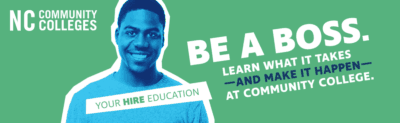

“This is a key component of our strategic plan,” Hans said, noting that the system had raised $2.5 million for the marketing efforts. “All this is designed for a very youthful audience. … How do we craft our message to appeal to them? How do we meet them where they are, in the words of Dr. Herring?”
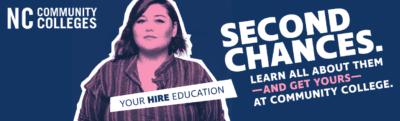

The billboards will be reinforced with social media marketing, where the system will try strategies such as listing average starting pay for various jobs that community colleges can prepare students for. One such example is electrical linemen, who can graduate the program and make, on average, $70,000 a year.
“It will also be a way for us to tell our story in a little bit more detail,” Hans said. “For those who are interested and for students to see themselves in those careers.”