
House K-12 committee gives initial OK to virtual early learning pilot
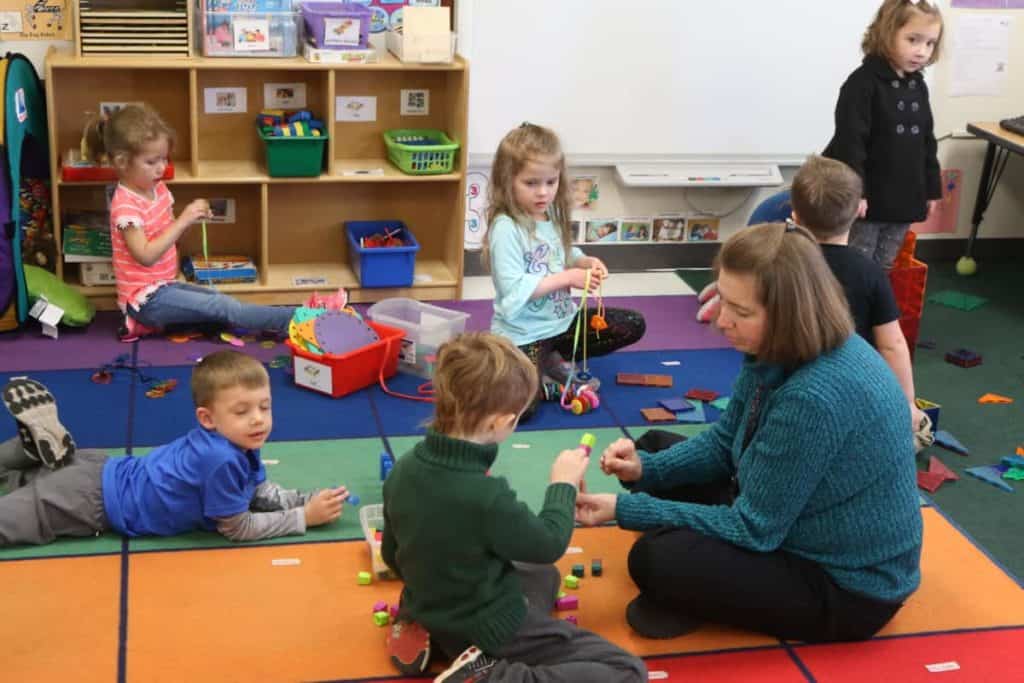

The House K-12 committee gave favorable votes to a number of bills today, including one that would create a virtual early learning pilot program.
The program, called UpStart, would be a three-year pilot targeting “at-risk” preschool children. It would be an experiment to see whether such a program could be effective for preschoolers and if it could be scaled to deliver reading, math, and science curriculum via computers to all preschool-age children in North Carolina.
Rep. Craig Horn, R-Union, called up former State Senator Howard Stephenson of Utah to talk about UpStart, which was developed in his state back in 2012.
Stephenson explained that his state was trying to improve early learning efforts but couldn’t afford to expand for all eligible children. Instead, it developed UpStart, a virtual early learning program and, according to him, the results were astounding.
“The UpStart students in Utah enter kindergarten at or above grade level,” he said. He went on to explain that when the state later looked at fourth graders who had gone through UpStart, the gains had continued. “The fourth grade results showed that these kids are 20 to 30 points of proficiency higher than their cohort,” said Stephenson.
Horn said he recognizes that high quality pre-K in a classroom is essential.
“I’ve heard, as many of us have heard, about the fact that high quality pre-K is the best solution,” he said. “No question about it.”
But he added that even if the state tripled the number of NC Pre-K slots in the state, there would still be kids who, for a variety of reasons, wouldn’t be able to make it. He said this bill is for them. The state has fully funded NC Pre-K to eliminate the waitlist, however, it is generally accepted that the waitlist does not capture the full need for NC Pre-K in the state.
Horn and Stephenson were asked how to address students who don’t have access to broadband internet from home.
Stephenson said Utah provides the computer and connectivity so that students who want to participate can take advantage, something that would also happen in North Carolina.
“That’s the advantage of the UpStart program. To get the connectivity where the kids are,” Stephenson said.
Horn was challenged as to whether there was enough money in the bill to handle the connectivity costs. The bill includes $500,000 for each year of the biennium for the program. Horn acknowledged that the bill isn’t perfect and that it may not be possible during the pilot to connect everybody who participates.
“There are other options for access to the internet, as well as the option to go to the library or some other place that has broadband access,” Horn said, adding later: “Is this a panacea that’s going to solve every challenge in North Carolina? I wouldn’t suggest that. Not even close.”
He said the program is a first step to doing something greater, if the state finds that this is a viable program.
The bill goes next to the education appropriations committee.