
Region 4 Tobacco-Free Alliance meeting confronts youth e-cig use in 11 counties

“He wasn’t just angry or irritable, he was explosive,” said Kelly Kinard of her 15-year-old son, Luka. “Overnight, he turned into an absolute monster.”
The mood change wasn’t simply a matter of adolescence, and it wasn’t the norm for Luka, a Boy Scout and straight-A student at High Point Central High School. Kinard said Luka’s unusual behavior resulted from Juuling, an e-cigarette habit that landed him with a nicotine addiction and very limited options for treatment.
“Good kids are showing the same or similar symptoms,” Kinard said. “There are more families in crisis than people realize, but they just don’t know where to turn for help.”
Salvation for the Kinards came in the form of an adolescent treatment center — all the way in California.
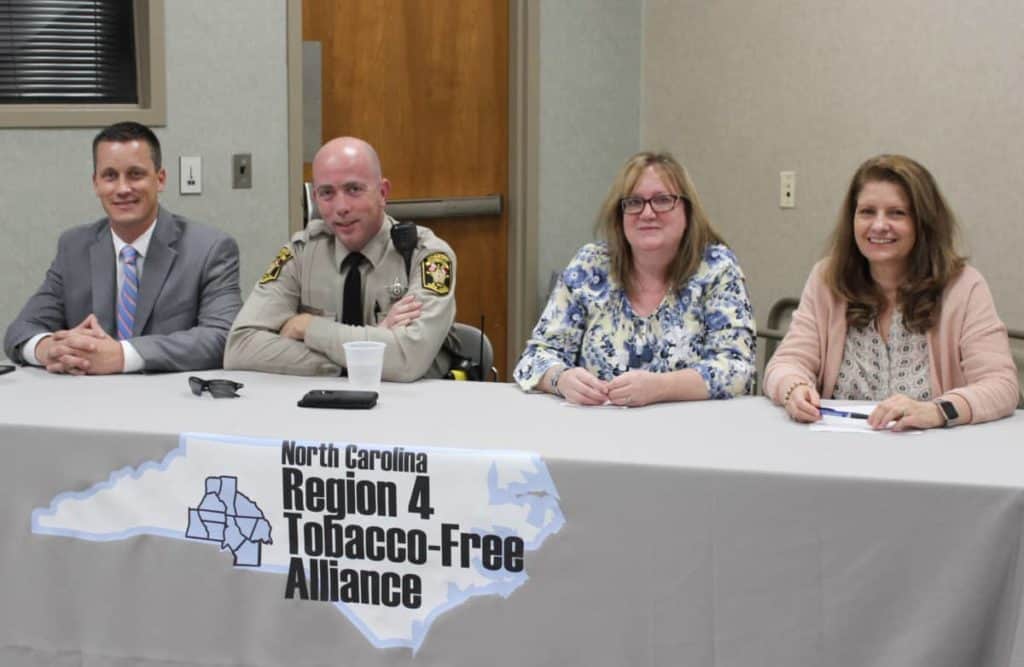
“After 39 days, he thanked me for sending him for treatment,” Kinard said, speaking as a panelist at the Region 4 Tobacco-Free Alliance meeting held at the Mecklenburg County Health Department on Tuesday. (Region 4 includes: Alexander, Cabarrus, Catawba, Cleveland, Gaston, Iredell, Lincoln, Mecklenburg, Rowan, Stanly, and Union Counties.) The panel, part of a day-long series of presentations on the issue of youth e-cigarette use, included Jay Jones, principal of Weddington High School in Union County; Deputy Chris Byrum, student resource officer at Weddington High; and Kim Spaulding, student nursing supervisor in Catawba County.
Jones and Byrum detailed their partnership at Weddington High, connecting administration and law enforcement to come up with measures to curb e-cigarette youth among their students.
“It was starting to show its ugly face in our school big time,” Byrum said of youth e-cig use, which the Food and Drug Administration called an epidemic last year. Byrum agreed with the signs of heavy e-cigarette use that Kinard warned of after seeing them himself, including the outbursts from students going through nicotine withdrawals.
“The outbursts are insane,” he said, adding that the symptoms are unique to students addicted to nicotine through vaping.
“I’ve never had to fight someone over a freaking cigarette, so that should tell you something,” he said.
The high school decided to take a more comprehensive approach to youth e-cig use by holding a public forum, regular assemblies with each grade level, and educating teachers. This year, the high school also increased disciplinary measures, moving from one day of in-school suspension to one day of out-of-school suspension for e-cigarette infractions, plus an online tobacco awareness program.
“We do feel like we’re making some progress,” Jones said, sharing that the school had 32 disciplinary incidents related to vaping last year, but only six so far this school year. He added that the administration is not naive enough to think that only 32 kids were vaping, or that students aren’t getting better at hiding e-cigarette use at school. And as a high school principal, Jones said he thought e-cigarette education should also be targeted to even younger students — to 11 to 14-year-olds in middle school.
“That is the crossroads — socially, emotionally — where they are making some game-changing decisions in terms of their identity,” Jones said.
Such school health interventions for vaping do exist, like those available through the CATCH My Breath program.
Marcella Bianco of CATCH said the program is designed to be taught by middle and high school teachers, PE teachers, tobacco educators, counselors, or nurses and is free to use for NC schools. The curriculum includes lesson plans and a peer-to-peer breakdown in each lesson, which is designed to teach students about the effects of vaping and also how to say no.
“One student at a time is what we’re looking at,” Bianco said of the intervention to curb Juuling.

Other speakers looked at more options to reduce teen e-cig use, including laws that raise the age of tobacco product sales to 21. States with potential Tobacco 21 bills this year include Virginia, Maryland, Connecticut, Texas, Washington, New York, and Illinois. Meanwhile, over 430 cities across the country have already raised the age of purchase to 21.
However, Amy Barkley of the Campaign for Tobacco Free-Kids warned that Tobacco 21 laws often “basically cross out 18 and add 21” with little enforcement.
“It’s something that we want to happen, but we want it to happen correctly,” Barkley said of the measure. Before moving to Tobacco 21, she said her organization promotes the “trifecta” of tobacco control policies that are proven to work, including raising tobacco taxes, passing comprehensive smoke-free laws, and adequate funding for tobacco prevention and cessation.
“We don’t want e-cigarettes to be a cheaper alternative to cigarettes,” Barkley explained. “We want them to be taxed as a tobacco product, which they are.”
Jennifer Park of DHHS’s Tobacco Prevention and Control Branch also presented on Tobacco 21 as well as the state’s funding and media practices to target underage tobacco product use.
“We really want to send the message that all of these products are harmful to our kids,” Park said.
To read more about e-cig use in schools, read my Juuling series here.
Editor’s Note: Yasmin Bendaas was an invited presenter at the Region 4 Tobacco-Free Alliance meeting, speaking on her Juuling series for EducationNC. Her reporting included a teacher survey in which 60 percent of Region 4 teacher respondents said their school had not implemented health education efforts around vaping.