
State Board of Community Colleges members want different way to prove student residency
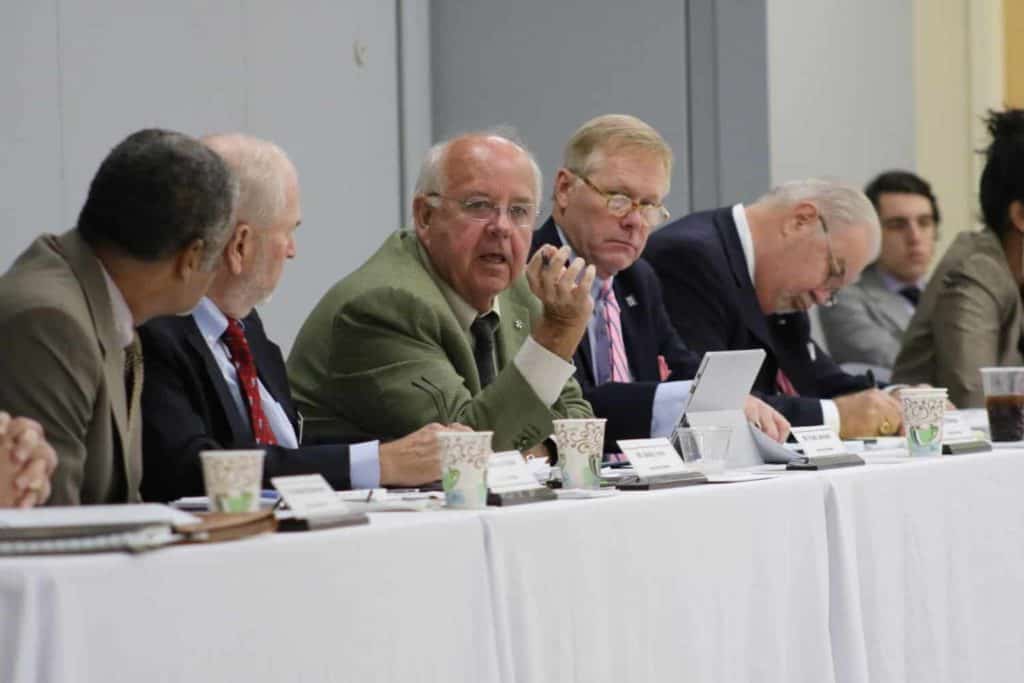

The State Board of Community Colleges met Friday after a two-day planning session at Davidson County Community College, discussing frustrations with the state-mandated process to determine student residency.
The board passed $380,000 for the second year of a five-year contract with the North Carolina State Education Assistance Authority (NCSEAA) for the Residency Determination Service (RDS), the state’s development of a “centralized, uniform process for determining residency for tuition purposes and for administration of State-funded financial aid,” according to the online item’s description. The measure was passed at the beginning of the meeting on the consent agenda — a place for items that normally do not raise as much conversation.
But board member Frank Johnson brought the funding up later in the meeting. Johnson and others wanted to ensure taking community colleges off the online platform was a priority, saying the process takes too long, hinders students from enrolling, and is unnecessary for the community college population, most of whom are in-state residents.
“We’re funding something that actually keeps people from signing up for our community colleges,” Johnson said. He said he brought the issue up last year and is concerned nothing will change.
“It prohibits people who are citizens, who are legitimate North Carolinians,” he said. “This is a hurdle for them to get into our system. We need to shoot this dog. We need to get rid of it. We need to take care of it and let the legislators know that we care about this. This is an impediment to our progress in attaining full growth in our FTE, and it needs to be done.”
David Shockley, president of Surry Community College and of the North Carolina Association of Community College Presidents, said he and system president Peter Hans have been meeting with legislators to start to raise the issue. They have also been collecting data around students’ use of the platform and have created a committee of community college presidents to develop an alternative solution to checking students’ in-state residency.
“What triggered us was students were complaining, and then when we would help the students, we would see, well this is a legitimate complaint,” Shockley said.
Shockley said the General Assembly mandated the system in 2013 after concerns that out-of-state students were trying to receive in-state tuition. The UNC system, the NC Independent Colleges and Universities, and the community college system were required to implement the centralized process instead of using campus-by-campus policies. If nothing changes, the community college system’s $380,000 annual allocations will reach a total of $1.9 million by the 2021-22 fiscal year.
The data they have collected, Shockley said, is still being analyzed. He said there could be as many as 6,000 students who stopped midway through the process. The service takes too long for community college students, who often enroll in courses last-minute, and asks for information that may be hard for some students to find with short notice, he said.
“It’s so cumbersome, and it becomes so arduous that they just withdraw, especially when you’re looking at students who are often times afraid to be in our environment to begin with, which is hard to understand, but when you understand that, you do see the impediments of it,” Shockley said to the Board. “That’s what we have to show our General Assembly, in making these stories real, putting some faces to the data and then come up with an alternative solution.”
For now, Shockley said the current system is the only way to comply with state law. The plan is to develop a different policy to add to the system’s legislative agenda for 2019’s long session.
“In the meantime, this is the option that we have for state residency,” he said. “We do not have another option in practice right now and we begin registration for spring, most community colleges, within the next two weeks.”