
Three UNC lab schools cleared by Board of Governors
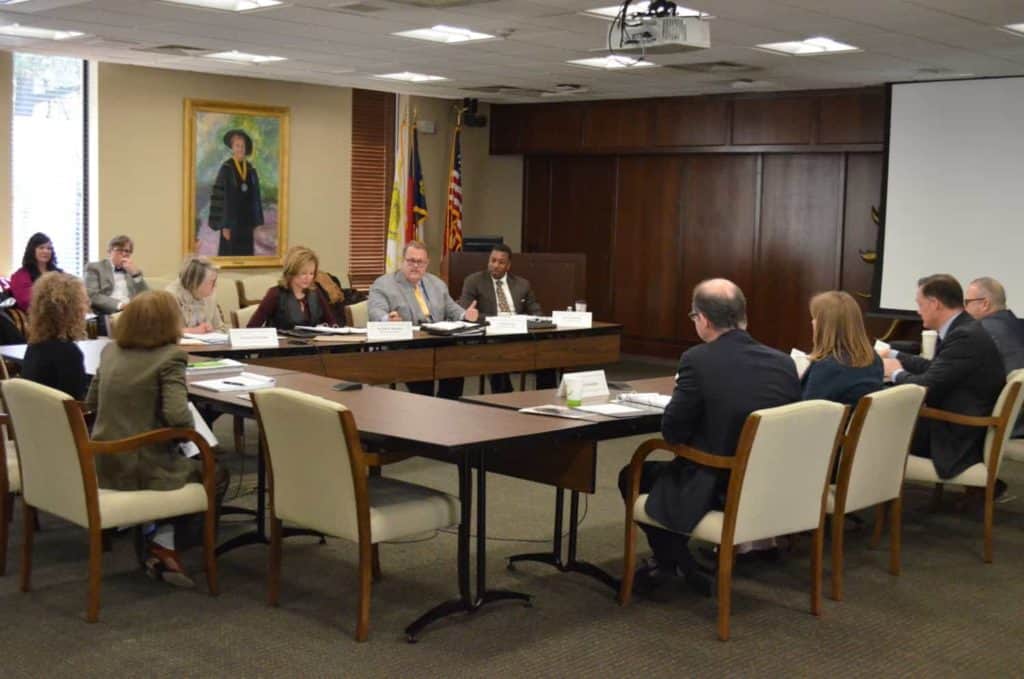
Three UNC lab schools were given the green light to open for the 2018-19 school year by the UNC Board of Governors subcommittee on laboratory schools Monday.
The three new schools will join the two K-8 lab schools already operating in North Carolina, one partnered with East Carolina University and one with Western Carolina University.
The three new schools will widen the lab schools geographic imprint, with schools operated by the University of North Carolina at Wilmington, the University of North Carolina at Greensboro, and Appalachian State University.
“We’re really thrilled to be part of this lab school effort,” said UNC-System President Margaret Spellings during the subcommittee. She commended the participating universities for trying something new. “It’s not easy, it’s not something we’ve ever been asked to do before.”
The lab schools were brought into existence in the 2016 short session of the General Assembly. Lawmakers directed the UNC system to create partnerships between universities with educator preparation programs and school systems with a large number of low-performing students. Initially the legislation required that at least 25 percent of the schools in the district be low-performing, but in a subsequent session, those requirements were relaxed.
The program’s purpose is two-fold: to increase the performance of the students who attend the schools and to give on-the-ground training to current and future teachers and administrators. Nine lab schools will ultimately operate in North Carolina.
The Board of Governors subcommittee heard presentations about the three newest schools from the respective partner universities.
Appalachian State University will operate Academy at Middle Fork in the Winston Salem/Forsyth County School District. UNC-Greensboro will run the Moss Street Partnership School in the Rockingham County school system. And UNC-Wilmington will take charge of the D.C. Virgo Preparatory Academy in New Hanover County schools.
Both Moss Street and D.C. Virgo are in districts that do not meet the initial requirement of having at least 25 percent of schools as low-performing. Under the relaxed requirements passed in 2017, these two schools will seek waivers to operate, and presenters pointed out that the students being served by the schools will still come from challenging academic and economic backgrounds.
Sean Bulson, interim vice president of university and P-12 partnerships, told subcommittee members that while there will be similarities between all of the lab schools in the state, they will all also have unique characteristics specific to the students they serve.
“The way the lab school legislation is set up, we’re planning to open nine somewhat different entities,” he said.
He said the lab schools are going to be beneficial to a great many people, including the colleges of education which will better understand how their teachings translate into practice. But the top beneficiary will be the state’s children.
“The very first benefit unquestionably is to the students it’s going to serve,” he said.
Board of Governors member C. Philip Byers, who headed the subcommittee, said the positive impact of these lab schools goes beyond the educational domain.
“Every time a child is educated, that’s a plus for the economy,” he said. “Our legislators so often look at how does the tax payer benefit. This is going to be a tremendous benefit to the taxpayer.”