
Turning around Rock Rest Elementary School

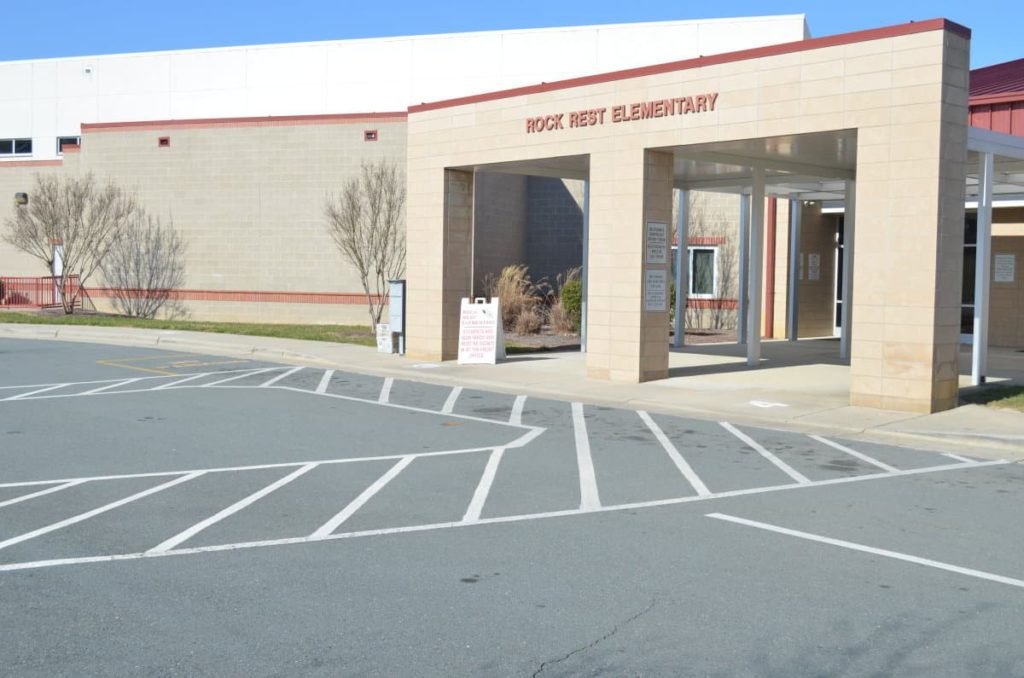
Five years ago, Rock Rest Elementary School in Union County would have had an F under the current state grading system. At the time, it was in the bottom five percent of schools in North Carolina. Under TALAS – a turnaround program of the Department of Public Instruction – the state intervened in Rock Rest. TALAS stands for Turning Around North Carolina’s Lowest Achieving Schools. When the state issued its first set of A-F letter grades in 2015, Rock Rest received a B. How did it happen?
It was an effort both locally and by the state to change the way Rock Rest operated. And while the school has dropped to a C in the most recent issuing of state letter grades, it has still come a long way from when it was in the bottom five percent of schools.
Pat Ashley, the now-retired former director of turnaround at DPI, described some of the process used at Rock Rest.
She said the state engaged first with district leadership to discuss expectations for improvement, providing professional development and coaches who went to the school to help teachers and administrators. Perhaps more importantly, the district brought in a new principal. As the school progressed, the state began to reduce the direct support and Rock Rest became a model site for other schools in the turnaround process.

The new principal was Kristy Thomas, who came from Wingate Elementary School, a Title I school in Union County. But while Wingate had its challenges, they were nothing compared to Rock Rest.
“Our last school had been needy,” Thomas said. “But not to this extreme.”
Rock Rest’s population hovers around the 90 percent mark for free-and-reduced price lunch students, according to Thomas. It has a majority Hispanic population, many of whom speak English as a second language.
Thomas and her team focused on getting to know the children. When I visited in February, I sat in on a staff meeting at the start of the school day. Thomas and some of her staff discussed individual students in detail. They knew all their students’ names, who they were and what their learning needs are.
And the way teachers taught curriculum changed, too. Rather than instructing students and waiting until test day to find out whether they are learning, teachers evaluate and intervene immediately.


The teacher will guide the class through the steps of the lesson. Then he or she gives students the chance to work on what they’ve learned independently. While they’re doing this, the teacher walks around and does what Thomas calls “aggressive monitoring.” The teacher is watching to see if the students have successfully learned the lesson. If they haven’t, the teacher intervenes on the spot.
“We want to make sure that they own the learning immediately,” Thomas said. “If we can fix it today, it will help them understand the next day’s learning and the next day, so they don’t get behind.”
The turnaround of Rock Rest wasn’t always pleasant. When Thomas came, she turned over nearly 50 percent of the teachers at the school. But it has come a long way.
I asked Ashley what characteristics Rock Rest has now that make it successful. She ticked off a number of traits common to effective schools.
Strong leadership. And not just the principal.
A focus on the children’s individual needs.
A well organized school environment.
And efficient use of time — keeping students actively engaged in learning.
Ashley remembers Rock Rest as one of the success stories during her tenure at DPI.
“To get from what would have been an F, to a B…that’s a miracle story,” she said.
Low Performing School Principals
The Public School Forum held a meeting of its low-performing school study group last week, and Thomas was one of the principals in attendance.
She joined Carrie Tulbert, principal at Concord Middle School in Concord; Rusty Hall, principal at Old Town Elementary School in Winston Salem; and Jacqueline Williams, principal of Pittman Elementary School in Halifax County.
All four schools are either now or were previously designated as low performing. Pittman and Rock Rest were part of TALAS turnaround efforts under Ashley’s tenure at DPI.
The four principals discussed low-performing schools and the current A-F grading system.
See their discussion below.
During the Public School Forum event, members of the low-performing school study group also weighed in with their opinions of the current A-F grading system. Not a one supported it. Watch below to see why they dislike the current system and what they want to see replace it.
https://www.youtube.com/watch?v=Mp1ZtSof7Po