
The General Assembly’s blind spot on advocacy

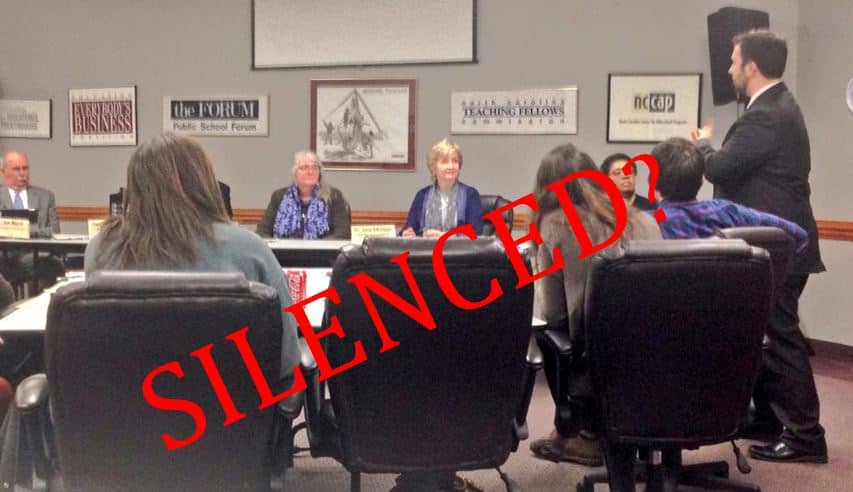
A Senate bill waiting its turn to be heard in the Senate Education Committee would gag superintendents, principals, and teachers from advocating for local, state, or federal policy that would help students. This is entirely wrong-headed: it emphatically is the job of educators to advocate for students and public education.
Senate Bill 480 makes the following acts not only grounds for disciplinary action but also Class I misdemeanors:
Utilize public funds, supplies, equipment or vehicles … to engage in advocating for or against issues of local, state, or federal policy.
Use the authority of his or her position … to secure support for or oppose any … issue in an election involving candidates for office
…engage in political activity while on duty or within any period of time during which he or she is expected to perform services for which the employee receives compensation from a local board of education
There are more limitations — some of which are reasonable — such as that an employee cannot spend time during work hours managing a political campaign. The point is that the bill goes way too far in attempting to block the participation of educators in political processes.
For superintendents, there is no question that it is part of their job. Superintendents are evaluated by their board on their advocacy skills. The evaluation instrument adopted by the State Board of Education calls for assessing the extent to which
“[t]he superintendent creates opportunities for staff members to become involved in strengthening the local community, and for community members to support the schools… and
[t]he superintendent maintains productive relationships with state and federal officials and policymakers.”
Standard Seven even more specifically provides:
“[t]he superintendent shows an appreciation for, and understanding of, larger social, political, economic, legal, and cultural issues in the community. A district leader uses this information to enhance the development of the schools.”
The importance of participation in the political process is broadly recognized in various national efforts to identify key components of effective school and school district leadership. For example, the Interstate School Leaders Licensure Consortium (ISLLC) Leadership Standards provide:
An education leader promotes the success of every student by understanding, responding to, and influencing the political, social, economic, legal, and cultural context.
A. Advocate for children, families, and caregivers
B. Act to influence local, district, state, and national decisions affecting student learning
The 2014 draft version of the ISLLC Standards expands upon this to identify as key functions of education leaders:
Advocates for policies and resources for the community
Communicates regularly and openly with families and stakeholders in the wider community.
Teachers are expected to teach civic and citizenship education. The General Assembly strongly encourages the State Board to include in the high school curriculum that “students write to a local, State, or federal elected official about an issue that is important to them” and in the middle school curriculum “that students choose and analyze a community problem and offer public policy recommendations on the problem to local officials.” How ironic that the General Assembly doesn’t want the teacher to participate in this lesson.
The curriculum concept for civic and citizenship education is sound — it even fits into the constitutional mandate that a sound basic education includes “(2) sufficient fundamental knowledge of geography, history, and basic economic and political systems to enable the student to make informed choices with regard to issues that affect the student personally or affect the student’s community, state, and nation.” Leandro v. State (1997). Unfortunately, we have no way to know whether students are gaining this understanding as the General Assembly does not provide for any assessments in history and political systems and prevents the State Board from implementing them through its broad prohibition of assessments not required by federal law or grants. It would be interesting to ask students what they thought of this bill and how it fits into their knowledge of political systems.
If the law were in effect now, could a superintendent have testified and offered opinions on state assessments in the Leandro hearing held yesterday in Judge Howard E. Manning’s courtroom?
So what happens if this bill becomes law? Can public funds and supplies be used to invite and arrange for elected officials to visit the schools? Can the superintendent travel in a school district vehicle to the legislative building in Raleigh to explain why the A-F grading system doesn’t work? Can a teacher wear a t-shirt or button to school that promotes public education? Can a principal be filmed sitting behind her desk at her school as a part of an “I am public schools” campaign? Can education leaders speak at public forums about the impact of reduction in funding? Can an administrator email Congress from his school district account regarding revisions to No Child Left Behind?
If the law were in effect now, could a superintendent have testified and offered opinions on state assessments in the Leandro hearing held yesterday in Judge Howard E. Manning’s courtroom?
This is not the first time the General Assembly has criminalized advocacy. A 1965 law punished parents who advocated for their child:
“A child so severely afflicted by mental, emotional, or physical incapacity as to make it impossible for such child to profit by instruction given in the public schools shall not be permitted to attend the public schools of the State…
If the parent or guardian of such a child persists in forcing his attendance after such report has determined that the child should not attend the public schools, he shall be guilty of a misdemeanor and upon conviction shall be punished in the discretion of the court.” Chapter 584, G.S. 115-165.
That was not a good idea then. This is not a good idea now.
References:
North Carolina Superintendent Evaluation Process, North Carolina State Board of Education, McRel, 2010. http://www.ncpublicschools.org/docs/effectiveness-model/ncees/instruments/super-eval-manual.pdf
Educational Leadership Policy Standards: ISLLC 2008 National Policy Board foe Educational Administration, http://www.ccsso.org/Documents/2008/Educational_Leadership_Policy_Standards_2008.pdf
N.C.G.S. § 115C-174.11
N.C.G.S. § 115C-81(g1)