
CMS building space equal to 21 skyscrapers

Mecklenburg voters will likely be asked to approve a new school bond referendum next year to address the county school system’s growing “honey-do” list.
Charlotte-Mecklenburg Schools has begun work to outline a list of projects that could be included in a 2016 bond package. The district updated school board members on its plans last week. School leaders quietly started discussing the possibility of a 2016 bond last year, in response to CMS’ rapidly aging infrastructure and projections for significant student growth during the next decade.
Beyond the news of a possible bond referendum itself, last week’s presentation offered fascinating detail of the scale of Charlotte-Mecklenburg Schools’ physical needs.
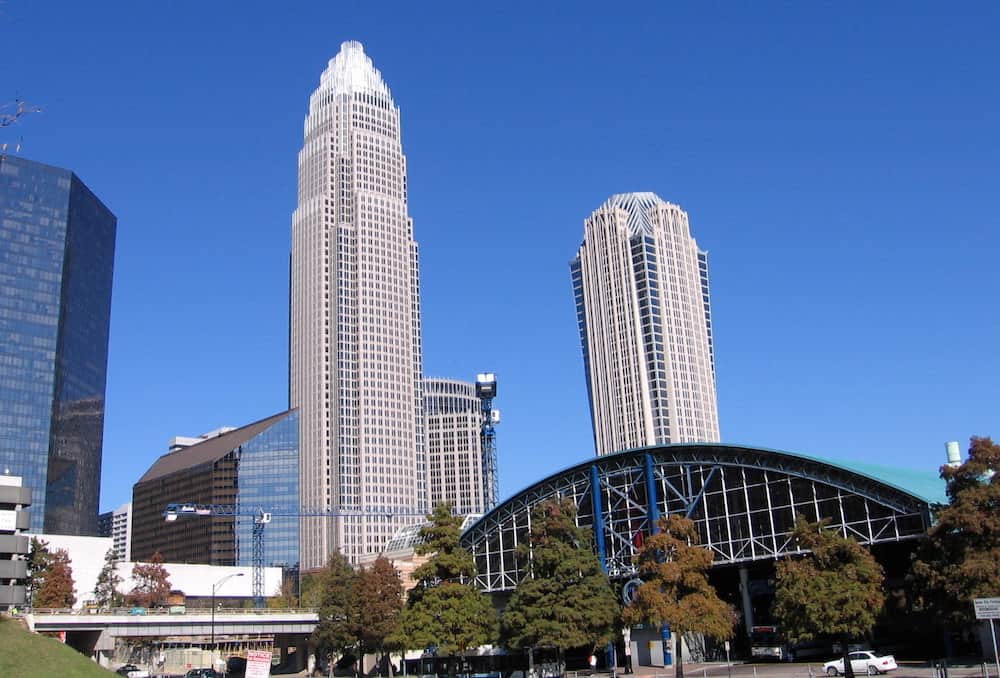
The district’s footprint is incredibly large. Its 650 buildings comprise 21.5 million square feet, roughly 21 times the square footage of the Bank of America building, Charlotte’s largest skyscraper.
A typical CMS custodian cleans the equivalent of 15 2,000-square-foot houses every day.
CMS employs a custodial staff of roughly 680 people who are tasked with maintaining those buildings. For illustrative purposes, staffers calculated the per-person cleaning responsibilities. A typical CMS custodian cleans the equivalent of 15 2,000-square-foot houses every day, the district learned. While CMS’ total square footage grew steadily during the past five years, the size of its custodial staff dropped sharply; it is down nearly 100 custodians since 2009, while it added roughly 2.5 million square feet of space during that same time.
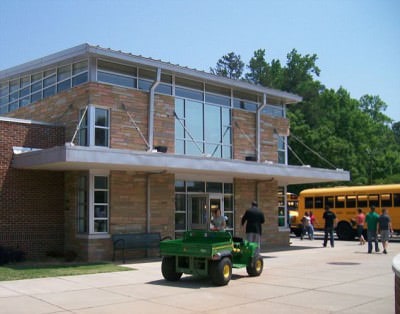
There are 164 schools, two-thirds of which are more than 30 years old. Recent bond packages sought to address this issue with significant renovations and, in some cases, complete replacements.
Coupled with the challenge of aging infrastructure is the issue of growth: Seventy-eight percent of CMS schools are at or above capacity. The solution at many schools, beyond crowded classrooms, is mobile units. CMS owns 1,100 mobile units, more than half of which are at elementary schools.
Critics of school overcrowding, particularly in the suburbs, are quick to latch onto the number of trailers at a particular campus. Completely eliminating mobile classrooms, though, is essentially impossible for CMS. Doing so would require the district to build approximately 15 new elementary schools, five new middle or K-8 schools, and two new high schools—on top of existing school construction plans.
CMS says when both lists are combined, and the total is divided across a decade, it has a minimum of $188 million in annual capital needs between now and 2025.
CMS’ current capital needs assessment includes $1.76 billion in projects to be completed during the next decade. That list includes everything from building new schools to HVAC and electrical upgrades to maintenance for sports fields. The district has a separate “deferred maintenance” list. CMS says when both lists are combined, and the total is divided across a decade, it has a minimum of $188 million in annual capital needs between now and 2025.
Growing the school system’s physical footprint includes more than the cost of the buildings, of course. CMS will spend about $27.1 million on utilities costs during this fiscal year. Obviously, as the number of buildings grows, so will CMS’ utilities bill.
District staffers plan to develop a final list of capital needs projects that could be included in a 2016 bond referendum no later than this time next year. But even that is more complicated than it would seem at first glance.
The Mecklenburg Board of County Commissioners ultimately decides the size of a school bond referendum and what projects should be included. In 2011, the county came up with a new ranking system to determine how it would prioritize projects for a bond.
Under the county’s system, projects are given a score based on weighted values. For example, contractual or legal mandates receive the most points. Safety is given the next greatest weight, then economic outcome, and so on.
The challenge CMS ran into in 2013, the last time a school bond was on the ballot, was that its way of evaluating projects didn’t line up with the county’s. School overcrowding is among the most important criteria for the district, yet growth is eighth on the county’s rubric.
CMS leaders were frustrated by the inconsistency after county commissioners shuffled the prioritization of the district’s 2013 projects.
Voters ultimately approved the 17-project, $290 million referendum by a nearly three-to-one margin. By starting the conversation now, CMS hopes to find the same end result without the confusion the district encountered in building its list of critical priorities.