
Charting accountability

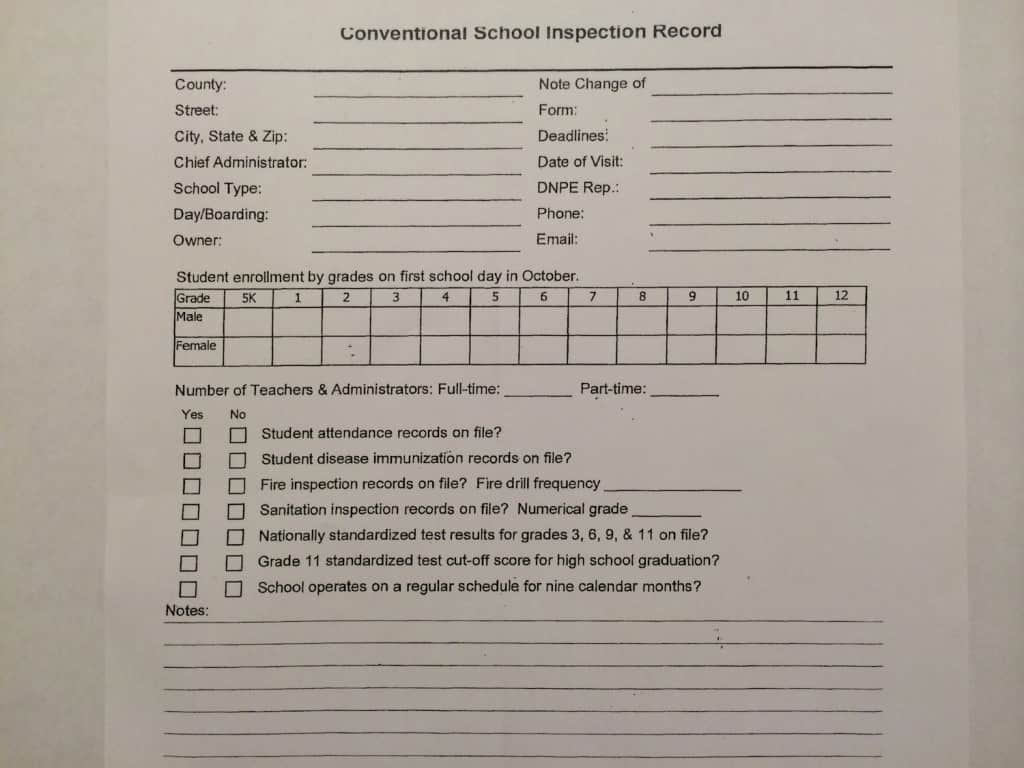
If a picture is worth a thousand words, what is a chart worth? In this case it is an inspection chart that identifies the limits of information collected about private schools in North Carolina.
An inspector from the Division of Nonpublic Education visits each private school about every two to three years and fills out this one-page form.
From this form, we learn the number of students enrolled in the school. There are no minimum requirements of the number of enrolled students to operate a school. It could be as few as one.
This is the entirety of the state’s review of private schools operating in North Carolina.
We learn the number of full- and part-time teachers. There are no licensure requirements. There are no requirements for criminal background checks.
The inspector will check the yes box or the no box as to whether the following information is on file at the school: student attendance records, student immunization records, fire inspection records, sanitation records, nationally standardized test results for grades 3, 6, 9, & 11, a standardized test cut-off score for high school graduation, and that the school operates on a “regular schedule” for nine calendar months.
This is the entirety of the state’s review of private schools operating in North Carolina. The state does not requires private schools to be accredited. So this is it.
Let’s look back at the checklist. The inspector will document whether standardized tests were given in specified grades. The inspector does not document what kind of test is used or the test results. The inspector will document if there is a cut score for the 11th grade standardized test for graduation; however there is no minimum standard of proficiency. The box will be checked yes even if the cut-score for graduation accepts failing scores on the test.
The inspector does not document the number of days or hours of instruction. That would be beyond the inspector’s legal authority. The inspector just checks for whether the school operates on a “regular schedule.” For example, the box would be checked “yes” if the inspector saw records indicating that the school was regularly opened one day a week for three hours a day over the nine-month calendar.
What happens if a box is checked “no” – that the requirement was not met? Nothing. The Division of Nonpublic Education does not have the authority to enforce the requirements. It cannot revoke the school’s registration or close the school. It cannot take steps to insist on compliance.
Why does this matter?
It is clear as a matter of constitutionally protected liberty interests and accepted deeply held customs of this country that parents can make choices in schooling. They can choose private schools – religious or not. They can choose homeschools. They can choose public charter schools or schools in their school district. In strong words, the North Carolina Constitution declares that “no human authority shall, in any case whatever, control or interfere with the rights of conscience.” (Art. 1, sec. 13.)
This issue of how we hold schools accountable is a wide flinging constitutional and public policy debate.
But the state, at a minimum, does have an interest in the welfare of children. Compulsory attendance laws are an example of this – that the state – that the citizenry as a whole – has an interest in children going to school. And here, this inspection chart demonstrates that the state’s enforcement of this basic protection of children fails.
On this day, public schools will get a new report card mandated by the General Assembly, assigning a letter grade to the school. This week, briefs have been submitted to the North Carolina Supreme Court, challenging, in part, the degree of accountability of private schools that receive taxpayer-funded tuition. This issue of how we hold schools accountable is a wide flinging constitutional and public policy debate. It encompasses the accountability of traditional public schools, public charter schools, private schools, publicly-funded private schools, and homeschools.
While this debate will happen in many places, I would like to add EdNC to the mix. And to the conversation, I would like to add this inspection chart. So what do you think?
References
- N.C. Constitution, Article I, Section 13
- N.C. Constitution, Article IX
- N.C. General Statutes 115C, Article 39, Nonpublic Schools, 115C-547, et. seq.
- Depositions and exhibits in Hart v. State, R p. 848; Supp. R. p. 1231, 1251, 1262-63, 1415 (on appeal to the N.C. Supreme Court)