A new committee was established to steer the State Board of Community Colleges through a twofold transition period for the community college system, as the search for its new president unfolds alongside the development of a new strategic plan.
 Sign up for Awake58, our newsletter on all things community college.
New executive committee
On Thursday, the State Board of Community College’s executive committee met for the first time.
Created by Board Chair Tom Looney, the special committee was established to “ensure alignment, speed, and clarity of decision-making during a pivotal period of leadership transition and system-wide transformation,” according to the committee’s charter.
This year, the State Board is overseeing a variety of transitions in the North Carolina Community College System (NCCCS), including the hiring of a new system office president to replace Dr. Jeff Cox, who announced his retirement effective June 30, 2026. Separately, the Board is providing oversight of a major technology transformation and the development of a new 2026-29 strategic plan.
The executive committee is one of six special committees listed on the State Board’s website, which also includes a system advisory council and a transformation committee. According to State Board bylaws, “special committees may be established and their duties may be prescribed by the Chair of the State Board.”
Current members of the executive committee include Board Chair Looney, Board Vice Chair John Kane, and the chairs of other State Board committees, including:
- Geoffrey Lang, chair of the accountability and audit committee,
- Lisa Estep, chair of the finance committee,
- Bill McBrayer, chair of the personnel committee,
- Sarah West, chair of the programs and student success committee,
- Hon. Chaz Beasley, chair of the State Board policy and governance committee,
- Dr. Dale McInnis, chair of the strategic planning committee, and
- Scott Ottman, chair of the transformation committee.
The executive committee’s charter specifies that the committee will not replace the full State Board’s authority and will “not take actions reserved for the full Board under statute or bylaws.” Additionally, all actions and recommendations from the committee will be reported to the full Board.
Responsibilities of the committee, according to its charter, include:
- Ensuring alignment and coordination across standing committees, including resolving “overlaps, gaps, or conflicts before matters reach the full Board.”
- Supporting the presidential transition, including providing governance continuity and supporting the onboarding of the incoming system president.
- Accelerating systemwide transformation, including monitoring the progress of major transformation initiatives, identifying risks, and elevating issues requiring full Board action.
- Strengthening communication and transparency, and ensuring “consistent communication across committees and with the full Board.”
Executive committee meetings will be called by Looney as needed, “with increased frequency during critical transition periods,” and may be held virtually or in person, according to the committee’s charter.
Presidential search update
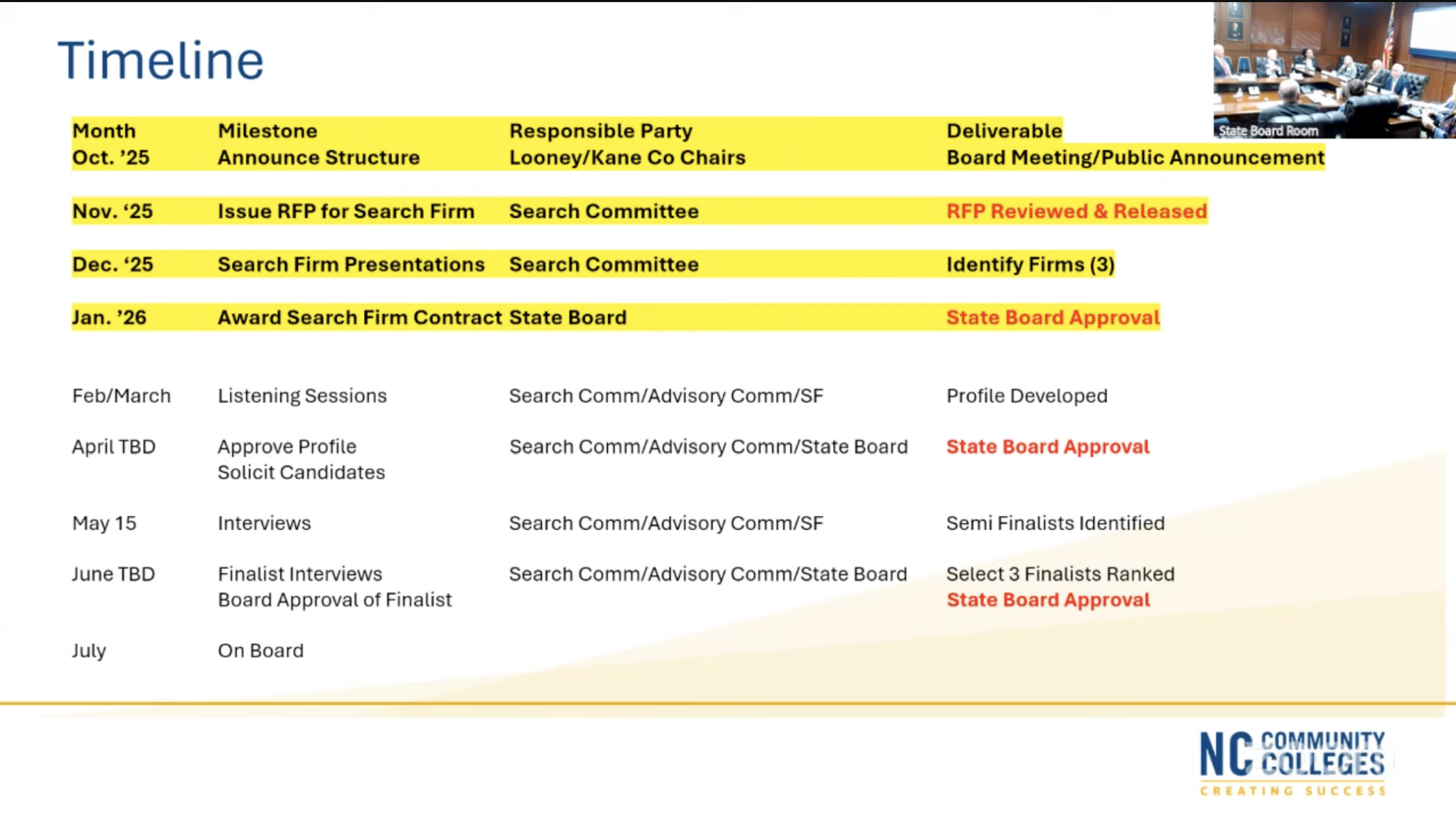
On Friday, Looney also shared an updated timeline for the presidential search process to replace Cox after his retirement in June.
Through February and March, the presidential search committee will host listening sessions with various stakeholders and develop a presidential profile. The Board will approve the presidential profile during its March meeting, and then candidate solicitation will begin, followed by interviews.
Semifinalists will be identified by May 15, and Looney will call a special State Board meeting in June to consider three ranked finalists and approve a finalist as president. The new president will be brought on board in July, according to the new timeline.
When the Board launched its search in the fall, Looney said it hoped to hire a new president by April.
“The search moved out about 45 days — initially, we had hoped to vote on this in the April, May timeframe,” Looney said during a presidential search committee meeting on Feb. 5.
During the Feb. 5 meeting, McInnis, who also serves on the presidential search committee, outlined core responsibilities of the system president, based on both the statutory requirements of the position and listening sessions held with various stakeholders through the new strategic planning process:
- Articulating a compelling vision for the system, including the system office and the 58 community colleges.
- Providing guidance and policy recommendations to the State Board and building a successful governance model for the system.
- Leadership and oversight for all system office cores responsibilities and employees.
- Close coordination, communication, and collaboration with presidents and boards of trustees of the 58 community colleges.
- Ensuring effective and timely system office support for all 58 community colleges.
- Leading technology transformation across the system.
- Leading and coordinating system advocacy and marketing efforts, serving as the face and voice of the system.
- Development, implementation, and oversight of annual budget allocations for the colleges and system office.
- Resource development for the system in coordination with colleges, the system foundation, and its stakeholders.
- Execution and administration of State Board code and general statutes applicable to the community college system and the system office.
- Applied political acumen, building effective relationships across all North Carolina stakeholders.
During Friday’s State Board meeting, Looney explained that Buffkin Baker, the executive search firm, will be responsible for coordinating the upcoming listening sessions, advising on the presidential profile, making public postings, screening candidates, and assisting with negotiations, among other tasks. Still, the presidential search committee will be responsible for evaluating candidates and making final decisions, Looney said.
He said the goal of the process is to recruit a leader capable of providing stability while accelerating the system’s modernization and strengthening partnerships.
“The goal of the committee is to really feel like everyone had a voice in selecting a new leader, for what is the most important organization in North Carolina,” Looney said. “We need a leader who is not looking for a job. It’s a leader who we recruit to this role.”
System office mission statement, strategic goals adopted
As part of the development of the new strategic plan, the Board approved on Friday a new system office mission statement and strategic goals.
The mission statement clarifies the role of the system office within the NCCCS following listening sessions with presidents and feedback from Board members and system office staff. After reviewing a draft of the statement in January, the Board approved the following version:
The System Office leads statewide policy, advocacy, modernization, and workforce alignment to strengthen community college capacity and ensure North Carolina is the global leader in talent and workforce readiness.
Minor updates were made to the strategic goals since their presentation to the Board in January to reflect the system’s work to support “continued academic, professional, and career advancement,” “lifelong learning,” and degree attainment.
In January, McInnis said the Board would “tap the brakes” on the strategic planning process until the presidential search concludes.
Until then, the Board will focus on analyzing the results of the current strategic plan. Key performance indicators (KPIs) and tactics for the new strategic plan will not be finalized until the new system president is in place, according to the proposed goals document presented in January.


Recommended reading