February is Financial Aid Awareness Month, and many agencies, organizations, and schools are working to help students apply for financial aid for postsecondary education.
The 2026-27 Free Application for Federal Student Aid (FAFSA) form is still open, and students are encouraged to submit it as soon as possible. The deadline to submit the FAFSA is June 1, 2026 for UNC System institutions, Aug. 15, 2026 for North Carolina community colleges, and as soon as possible for private institutions, according to studentaid.gov.
 Sign up for the EdDaily to start each weekday with the top education news.
College for North Carolina (CFNC), a free service of the state of North Carolina that helps students plan, apply, and pay for college, has released a toolkit for students, advisers, and college counselors.
See EdNC’s previous reporting for how to apply, eligibility requirements, and why the FAFSA is important. A list of resources from previous EdNC reporting is available at the end of this article.
Read about FAFSA and financial aid programs

FAFSA completion rates outpace previous year
According to the U.S. Department of Education, 2026-27 FAFSA completion rates have outpaced those of previous years. As of mid-December, 5 million forms had been submitted nationally, representing a nearly 150% increase from the 2025-26 FAFSA period, according to a press release.
As of the end of January, the Department of Education reported 7.6 million forms completed, and attributed the success to an early release date for the form and a streamlined user experience. The 2026-27 FAFSA form opened one week ahead ahead of the anticipated Oct. 1 launch. The Department of Education has also highlighted this year’s smooth rollout of the form compared to a months-long delay in 2024-25.
According to the National College Attainment Network (NCAN), making the FAFSA form easier to complete and simplifying the eligibility criteria has resulted in more students qualifying for federal aid, including Pell Grants.
The news is good nationally and in North Carolina. The CFNC FAFSA Tracker, which is updated weekly, shows an estimated $85.5 million in Pell Grant earnings for the current cycle and a FAFSA completion rate of 39.9% as of Feb. 6, compared to 32.0% at the same time last year. So far, nearly all counties in North Carolina have a higher completion rate than they did last year at the same time.

A North Carolina State Education Assistance Authority (NCSEAA) press release said that 50% of FAFSAs are completed between January and late August, “so it’s important to continue to emphasize for students the importance of this tool.”
Tyler Dew, NCSEAA manager for college access and FAFSA outreach, said at a regional training on Friday that about 12% of students submitted their FAFSA over the summer, and it is a good idea to encourage students to submit their form earlier so they can be better prepared and get help from school staff.
NCAN’s FAFSA Tracker estimates that North Carolina is outpacing the national average FAFSA completion rate. Last year’s final FAFSA completion rate in North Carolina was 61%. In 2030, myFutureNC has set a goal of 80% of high school seniors in North Carolina submitting the FAFSA.
Updates from a CFNC regional training
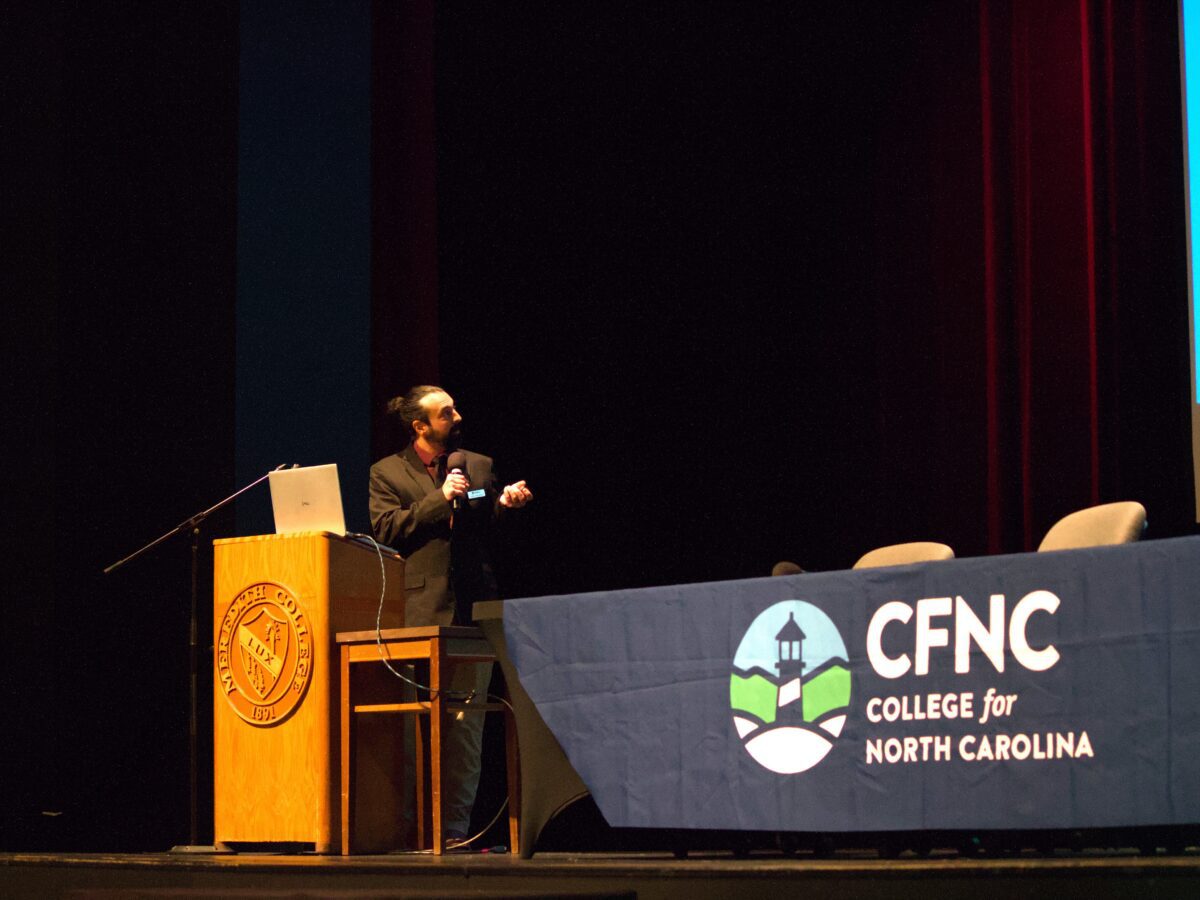
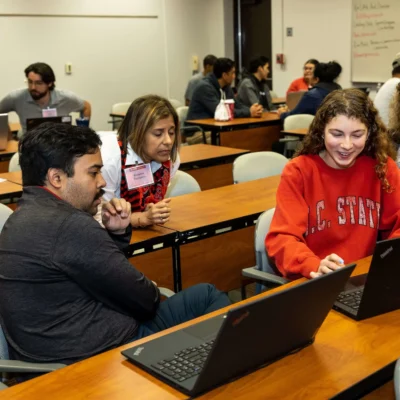
CFNC hosts regional trainings for high school counselors, college access professionals, educators, and youth-serving community organizations. During the regional training at Meredith College in Raleigh on Feb. 6, representatives from CFNC and NCSEAA gave updates on the FAFSA.
NCSEAA Associate Director of College Access Dr. Joseph Rampersad shared outcomes from College Application Week, a week in October when dozens of North Carolina colleges and universities waived their application fees.
According to a presentation, during College Application Week in 2025, 25,091 students applied to at least one college on CFNC.org, 66,529 total applications were submitted through CFNC, and 87,095 transcripts were processed — an increase of 42.2%, 71.6%, and 56.4% from College Application Week in 2024, respectively.
“NC College Connect was really the driving force behind this,” Rampersad said, referring to the program that provides automatic admission to certain North Carolina colleges and universities. According to a press release from the N.C. Department of Public Instruction, more than 23,000 public high school seniors accepted direct admission through NC College Connect, representing roughly 21% of the class of 2026.
Rampersad said 80% of students in a survey said participating in Countdown to College — the name of CFNC’s yearlong initiative to encourage and help students apply to college and for financial aid — played a big part in their applying to college. CFNC’s data showed that NC College Connect had a greater impact among students with lower GPAs and first-generation college students.
Rampersad also noted the majority of students found out about NC College Connect through counselors or college advisers.
“Thank you all for all the hard work you’re doing. We cannot do this without you,” he said to the crowd of counselors and advisors at the CFNC training.
‘FAFSA February’
“FAFSA February,” a term coined by CFNC, is a month dedicated to promoting the FAFSA and helping students complete it. The promotion plan presented at the training, which advisers, counselors, and others involved in the college application and financial aid process are encouraged to follow, is outlined below:
Week One
- Promotion of FAFSA completion
- Live walkthrough of FAFSA for families via Zoom
- Encouraging students to contact college financial aid offices for assistance
Week Two
- Encouragement of scholarship applications
- Promotion of two scholarship-related webinars (recordings): Searching for Scholarships and NCCF Scholarships
Week Three
- Award letter comparison
- Two live webinars on reading award letters, one for counselors and one for families
Week Four
- How to Pay for College Week
- Promotion of How to Pay for College webinar (recording)
- Promotion of Creative Ways to Pay for College webinar (recording)
See more information and resources related to FAFSA February.
Updates on the FAFSA
Alex Granados, associate director of communications for NCSEAA, provided additional updates on the FAFSA at the regional training on Friday.
- Missing student and parent signatures, Granados said, have historically been the biggest error that prevents a FAFSA form from being processed. Last summer, NCSEAA encouraged Federal Student Aid (FSA) to change the design of the form to reduce errors. Granados said rejections due to missing student signatures have dropped by 97% and rejections due to missing parent signatures declined by 90% — a “big win.”
- Granados highlighted that for the 2026-27 FAFSA, there are no cuts to the maximum Pell award. It remains at $7,395.
- He also said there is no change in protections around parent data shared in a FAFSA form. There has historically been concern over the data necessarily submitted to the FAFSA by parents without legal status. Granados said an agreement was renewed last year that says data submitted through the FAFSA can only be used for its intended purpose.
- Granados presented data that showed many of the friction points where FAFSAs get delayed are steps involving parents. He told counselors and advisers that it’s important to emphasize the role parents play so a student doesn’t miss out on their chance to get financial aid.
- The Department of Education launched a new earnings indicator which, after the FAFSA is completed, shows students a “lower earnings” disclosure for any of the colleges they selected where students earn less than a high school completer on average. Granados said postsecondary institutions in North Carolina that might see that disclosure are primarily barber and beauty school institutions. You can see a list on this studentaid.gov webpage.
- The 2027-28 FAFSA beta is expected to open Aug. 3, 2026, and FSA intends to open the 2027-28 FAFSA a few days ahead of Oct. 1, 2026, Granados said.
- Granados said to keep an eye out for artificial intelligence-driven fake college scams. “Convincing” fake college websites may lead you to forms to enter your data under the guise of a college or financial aid application. The 2026-27 FAFSA is available here.
Workforce Pell, Next NC, and other scholarships
Granados also gave an update on Workforce Pell Grants, a recent expansion of Pell Grants that can be used for nondegree workforce programs. The plan is still for the new grants to be implemented in July 2026, he said. He also clarified that students will not be able to receive traditional and Workforce Pell Grants in the same enrollment period.
Workforce Pell Grants will apply to programs that are 8-15 weeks and that:
- Lead to a recognized, stackable credential
- Are approved by the governor
- Are aligned with in-demand jobs
- Have already existed for at least a year
- Are provided by an accredited institution
Programs must also have a completion rate of at least 70%, a job placement rate of at least 70% within 180 days of completion, and median earnings greater than tuition and fees plus 150% of the federal poverty level.
The North Carolina Community College System has resources and information about the rollout of Workforce Pell on its website. The system also published a list of potentially eligible Workforce Pell programs.
Granados highlighted a number of scholarships counselors, advisers, and students applying for financial aid should keep in mind, including the Next NC Scholarship, a need-based scholarship that combines federal Pell Grant dollars and state aid.
According to Granados, most students from households making $80,000 or less in income will qualify, which is most students in North Carolina. Students attending a community college will get at least $3,000 per year, which covers all tuition and fees, and students attending a University of North Carolina four-year institution will get at least $5,000 per year, which covers more than half of tuition and fees.
Students planning to return to rural communities after their education should consider the Golden LEAF Scholarship Program, whose application closes on March 1.
Other scholarships are dependent on county residency, such as the Aubrey Lee Brooks Scholarship. CFNC has a scholarship search tool here.
Resources for the FAFSA application
- The 2026-27 FAFSA
- FAFSA FAQ page
- FAFSA Issue Alerts page
- FAFSA deadlines
- FAFSA eligibility requirements
- FAFSA assistance through CFNC
- If you are a student reapplying for the FAFSA, your college’s counseling office is also a great resource.
- Financial Aid Toolkit: Updated resources for school counselors, college access professionals, and mentors with information about the FAFSA process.
- FAFSA videos: Updated videos to help students and families understand the importance of the FAFSA, who is a FAFSA contributor, and what happens after submitting the form
See more on changes to this year’s FAFSA in this article.
Editor’s note: Tyler Dew’s name and title have been corrected.

Recommended reading