North Carolina ranks 48th in the nation for K-12 public school teacher salaries and growth in public school funding per student, according to a new analysis from the Reason Foundation think tank, which promotes libertarian principles.
The analysis looks at data from the U.S. Census Bureau and National Center for Education Statistics from 2002 to 2023.
 Sign up for the EdDaily to start each weekday with the top education news.
According to the report, funding per student nationwide grew from $14,969 per student in 2002 to $20,322 per student in 2023 after adjusting for inflation. In 2023, the nation’s public schools received $946.5 billion in funding.
Eight states spent more than $25,000 per student in 2023, including New York at $36,976 per student, New Jersey at $30,267 per student, and Vermont at $29,169 per student.
North Carolina spent $13,661 per student in 2023, ranking 47th in the nation.
The report also analyzed percentage growth in funding per student from 2002 to 2023. With an 8.5% growth rate, North Carolina ranked 48th, just above Idaho and Indiana.
From 2020 to 2023, the state’s 8.7% growth in funding ranked 17th in the nation. That growth rate was just above the nation’s 8.6% growth rate. The report says that the majority of funding during those years came from federal dollars for COVID-19 relief.
“With federal pandemic relief funding now expired, combined with rising economic uncertainty, declining public school enrollment, and increased competition from school choice and homeschooling, the era of unrelenting public school funding growth may be coming to an end,” the report says.
Reason Foundation also analyzed rising costs in benefit spending, including their main driver: teacher pension debt. From 2002 to 2023, North Carolina’s spending per student on K-12 employee benefits — such as teacher pensions, health insurance, and other expenses — has nearly doubled. The state ranks 13th in the nation for spending on K-12 employee benefits per student — with a 98.9% growth rate in employee benefits per student over the course of the analysis period.
The report says public school staff nationwide has also grown by 15.1% from 2002 to 2023. Most new hires weren’t teachers, though. Hiring of non-teacher staff, such as counselors, social workers, speech pathologists, or instructional aides, grew by 22.8%. Teacher hires grew 7.6% during those years.
“Since the start of the COVID-19 pandemic, the public school staffing surge has persisted,” the report says. “Despite public school enrollment falling by 1.18 million students between 2020 and 2023, public schools added over 81,000 non-teaching staff to their payrolls during that period.”
North Carolina had the 12th highest number of non-teaching staff in public schools in 2023. But from 2002 to 2023, that employee group’s growth rate has remained below the national average, at 18.2%.
The report highlights that this trend has continued despite a nationwide drop in public school enrollment. The National Center for Education Statistics estimates public school enrollment will drop 5.3% between 2024 and 2032, the report says.
In North Carolina, the analysis shows a 1.2% drop from 2020 to 2023. From 2002 to 2023, the opposite is true, as enrollment grew 17.2% during those years — the 9th highest growth rate in the nation.
The Reason Foundation also found that the average teacher salary nationwide dropped during COVID-19. Average salaries stayed “virtually flat” between 2002 and 2020, decreasing by .6%. But from 2020 to 2022, average salaries dropped $4,151 when adjusted for inflation, or by 5.6%.
North Carolina saw the largest drop of any state in teacher salaries during that same period, decreasing 9.6% from 2020 to 2022. But that drop was part of a longer trend in the state: from 2002 to 2022, teacher salaries dropped by 20.6%.
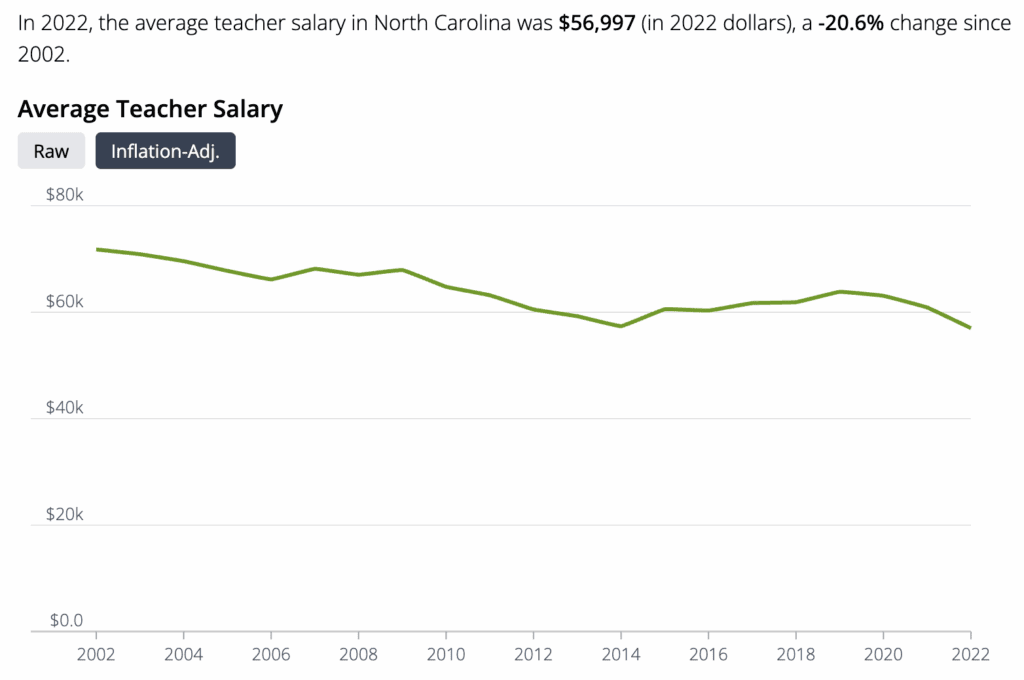
The report said inflation was the main culprit for the drop in salaries during the pandemic.
“Large and widespread increases in nominal pay would’ve been required just for teacher salaries to keep pace with inflation, let alone increase, during these years,” the report said.
The report concludes that policymakers will need to address public education’s challenges — many of which have persisted during periods of increased funding — through “policy solutions that address their root causes and maximize the use of existing K-12 funding.”
You can read the full analysis here.

Recommended reading